
营商环境创新

Search documents
知识产权质押融资“经开模式”入选昆明营商环境创新案例
Xin Lang Cai Jing· 2026-02-09 22:25
Group 1 - The core viewpoint of the news is that the Kunming Economic Development Zone has been recognized for its innovative model of intellectual property pledge financing, which fills gaps in multiple fields and provides replicable experiences for intellectual property financial innovation in the province [1] - In 2024, the Kunming Economic Development Zone established a risk compensation fund pool of 10 million yuan for intellectual property pledge financing, creating a "government-bank-enterprise" risk-sharing mechanism to alleviate credit concerns of financial institutions [1] - The zone has developed a comprehensive intellectual property operation service system, integrating various platforms and resources, including a public service center for intellectual property, and has established a financial liaison mechanism with 14 financial institutions to provide tailored financing solutions for local enterprises [1] Group 2 - The Kunming Economic Development Zone has pioneered a cross-regional collaboration model by successfully enabling a local company to obtain the first data product intellectual property registration certificate in Yunnan, resulting in a financing credit of 10 million yuan [2] - A diversified pledge asset system has been formed, incorporating not only traditional patents and trademarks but also new plant varieties, geographical indication trademarks, and water rights into the pledge financing scope [2] - From 2021 to 2025, the zone has facilitated 74 pledge financing transactions totaling 839 million yuan, organized over 20 training sessions on intellectual property pledge financing, and assisted over 1,000 enterprises, effectively reducing financing costs through government subsidies [2]
呼和浩特上榜营商环境创新城市
Nei Meng Gu Ri Bao· 2025-11-07 07:00
Core Insights - The "2024-2025 Urban Business Environment Innovation Report" highlights Hohhot as an exemplary city for business environment innovation, particularly in the dimension of "innovation factor improvement" [1] - The report focuses on major cities and counties in China, showcasing their innovative practices in creating a market-oriented, law-based, and international business environment [1] Group 1: Government Initiatives - Hohhot has implemented a series of practical measures to optimize the business environment, emphasizing "delegating power, streamlining administration, and improving services" [1] - The city has introduced mechanisms such as "first inquiry responsibility," "time-limited completion," and "one-time notification," leading to a decrease in both demand work orders and phone inquiries, while improving government completion rates and public satisfaction [2] - The city has innovated full-process service models for construction projects, including "multi-dimensional project profiles" and "fast review and approval," significantly accelerating project approval processes [2] Group 2: Regulatory Reforms - Hohhot's market regulation department has advanced the "delegating power, streamlining administration, and improving services" reform to create a more accessible entry environment for businesses [3] - The time required to establish a business has been reduced to 0.5 working days, with comprehensive implementation of "one matter, one time" and "individual to enterprise" reforms [3] - The "separation of licenses and permits" reform has been fully implemented, significantly lowering institutional transaction costs for businesses since the 14th Five-Year Plan began [3]
城市24小时 | 增速倒数 能源大省再提“转型”
Mei Ri Jing Ji Xin Wen· 2025-10-30 16:10
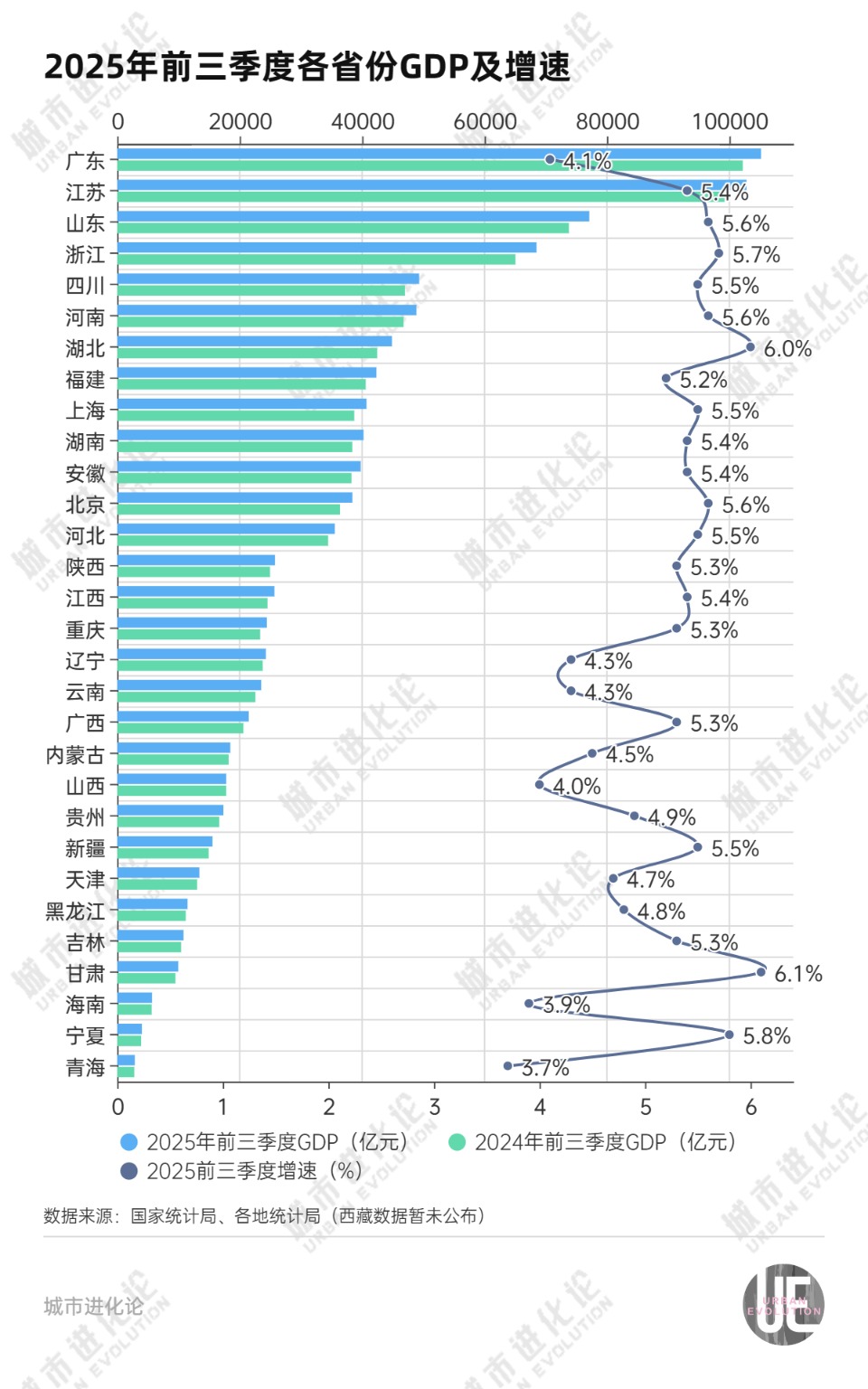
Economic Data Overview - As of now, 30 provinces in China have released their GDP data for the first three quarters, with only Tibet not reporting [1] - 19 provinces outperformed the national average GDP growth rate of 5.2%, with Gansu leading at 6.1% and Fujian matching the national rate [1] - 10 provinces lagged behind the national average, with Qinghai, Hainan, and Shanxi having the lowest growth rates at 3.7%, 3.9%, and 4.0% respectively [1] Shanxi Province Economic Performance - Shanxi's GDP growth remains weak, with a mere 1.8% growth in the same period last year, ranking it at the bottom nationally [4] - The province's GDP growth for the first three quarters of this year is reported at 4.0%, which is an increase of 0.2 percentage points from the first half of the year [4] - The industrial sector, particularly the secondary industry, is a significant drag on growth, with a reported increase of 3.5% in value added for the secondary industry [4] Coal Industry Impact - Shanxi, being a major energy province, has over 30% of its GDP and 50% of its fiscal revenue coming from the coal industry, making its economy highly sensitive to coal market fluctuations [5] - From January to September, the coal mining and washing industry saw a 20% decline in revenue and a 51% drop in total profits, despite a 13% decrease in operating costs [5] - The value added of the coal industry in Shanxi grew by 5.6% in the first three quarters, but this represents a decline of 1.5 percentage points from the first half of the year [5] Transition and Development Initiatives - Shanxi has been recognized as a national pilot for energy revolution reforms since 2019, focusing on transitioning from coal to smarter and higher-value products, including investments in wind, solar, and hydrogen energy [6] - The province's government emphasized the need for a robust transition strategy, highlighting the challenges of insufficient technological innovation and the small scale of emerging industries [6] - Notable growth in emerging sectors includes a 6.9% increase in the value added of equipment manufacturing, with renewable energy equipment manufacturing growing by 160% [6] - Investments in high-tech services, new energy vehicles, and renewable energy generation have also seen significant increases of 13.2%, 36.5%, and 26.4% respectively [6]

城市24小时 | 增速倒数,能源大省再提“转型”
Mei Ri Jing Ji Xin Wen· 2025-10-30 15:53
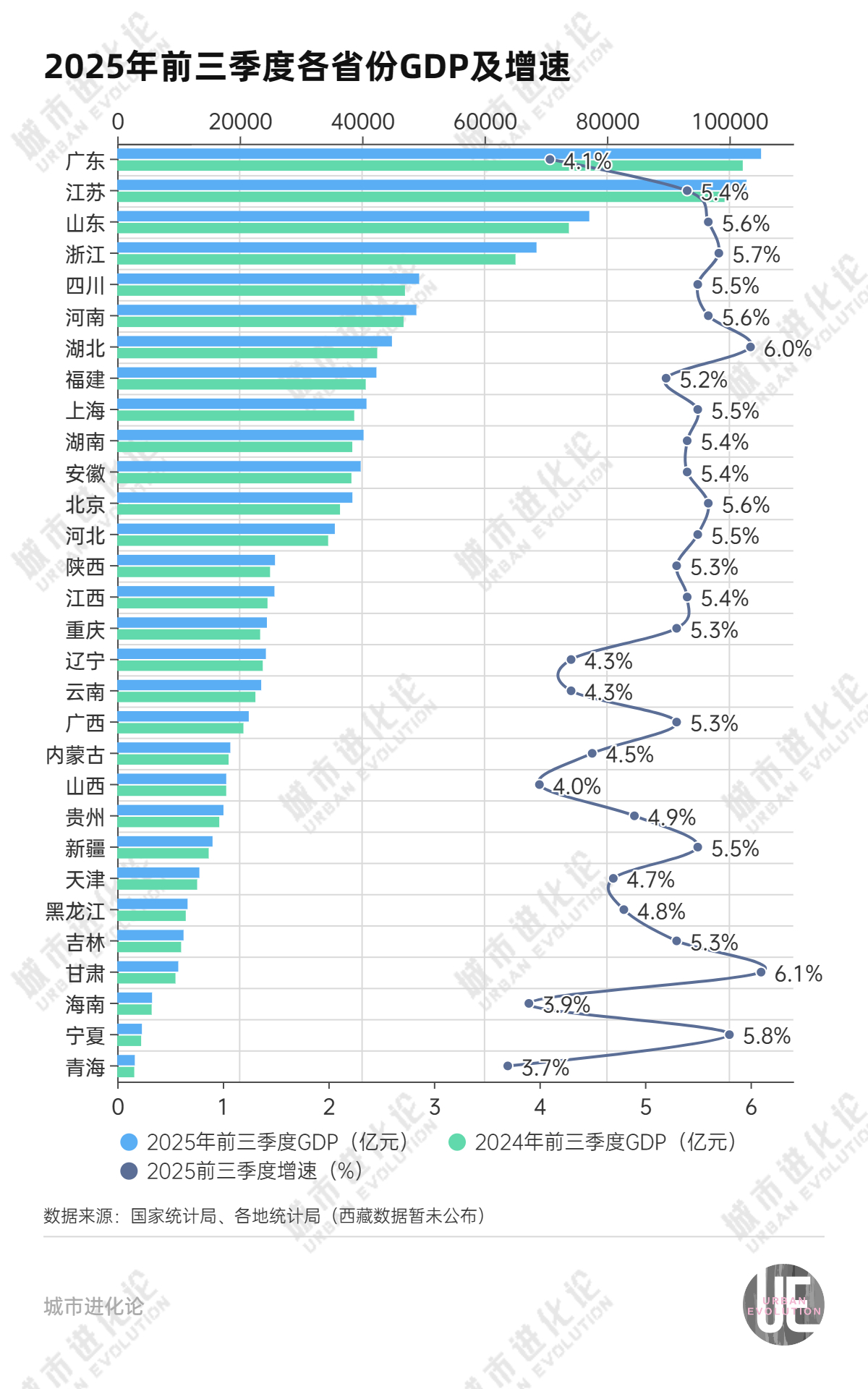
Economic Data Overview - As of now, 30 provinces in China have released their GDP data for the first three quarters, with only Tibet remaining [1] - 19 provinces outperformed the national average GDP growth rate of 5.2%, with Gansu leading at 6.1% and Fujian matching the national rate [1] - 10 provinces lagged behind the national average, with Qinghai, Hainan, and Shanxi having the lowest growth rates at 3.7%, 3.9%, and 4.0% respectively [1] Shanxi Province Economic Performance - Shanxi's GDP growth remains weak, with a mere increase compared to last year's 1.8%, ranking last nationally [4] - The province's GDP for the first three quarters grew by 4.0%, a slight acceleration of 0.2 percentage points from the first half of the year, despite a decline in the coal industry [4] - The added value of the secondary industry in Shanxi was 690.725 billion yuan, growing by 3.5% [4] Coal Industry Impact - Shanxi's economy is heavily influenced by the coal industry, which once accounted for over 30% of GDP and 50% of fiscal revenue [5] - From January to September, the coal mining and washing industry saw a 20% decline in revenue and a 51% drop in total profit, despite a 13% decrease in operating costs [5] - The added value of the coal industry in Shanxi grew by 5.6%, but this was a 1.5 percentage point decline from the first half of the year [5] Transition and Development Initiatives - Shanxi has been pushing for a transformation away from coal dependency since becoming a pilot for energy reform in 2019 [6] - The province aims to enhance its coal industry through smart technology and shift towards high-value products, with significant investments in wind, solar, and hydrogen energy [6] - In the first three quarters, the added value of equipment manufacturing in Shanxi grew by 6.9%, with new energy equipment manufacturing increasing by 160% [6] - Investments in high-tech services, new energy vehicle manufacturing, and renewable energy generation saw growth rates of 13.2%, 36.5%, and 26.4% respectively [6]
这个两岁半的省级新区,改革创新因何“走在前列”?
Zhong Guo Jing Ji Wang· 2025-05-07 04:16
Core Viewpoint - Linyi Yihe New District is leveraging reform and innovation to explore a unique development path, focusing on high-quality growth through the establishment of specialized industrial parks and improved business environments [2][4]. Group 1: Development Initiatives - The Yihe New District has established 11+1 specialized industrial parks, including the Instrument Industry Park and Intelligent Manufacturing Park, aiming to enhance industrial strength and stimulate local economic activity [2][3]. - The district has implemented a "reform and innovation breakthrough year" initiative, focusing on optimizing resource allocation and improving the business environment to drive high-quality development [2][4]. Group 2: Economic Performance - In 2023, the district cleared 4,700 acres of idle land, significantly increasing land supply and generating 32.9 billion yuan in land transfer fees, which is 5.1 times the amount in 2023 [3]. - The number of industrial enterprises in the district is projected to reach 94 by 2024, with an expected industrial output value of 172.3 billion yuan [2]. Group 3: Business Environment - The district has introduced 38 key tasks to enhance the business environment, significantly reducing transaction and operational costs, and streamlining administrative processes [4]. - The establishment of a project guarantee fund of 4 billion yuan aims to support land acquisition and project construction, facilitating the launch of 52 projects [3]. Group 4: Industrial Growth - The Gree Electric (Linyi) intelligent manufacturing base, which is the largest investment project in northern China for Gree, produced 325,000 air conditioners in Q1, achieving an industrial output value of 479 million yuan, a 164% increase year-on-year [5]. - The number of "above-scale" enterprises in the district surpassed 1,100 last year, with a total industrial output value growth of 10% and fixed asset investment growth of 8.5% [6].