烟蒂理论

Search documents
巴菲特的时代结束了
虎嗅APP· 2025-11-14 12:04
Core Viewpoint - Warren Buffett announced he will no longer write Berkshire Hathaway's annual report or give long speeches at the annual shareholder meeting, indicating a transition to a quieter phase in his career [2][3]. Group 1: Transition of Leadership - Buffett will step down as CEO at the end of the year, with Greg Abel set to take over, while Buffett will remain as chairman and retain a significant number of shares [3]. - At 95 years old, Buffett acknowledges his declining physical abilities but continues to work five days a week at the office [4][5]. Group 2: Investment Philosophy and Achievements - Buffett's investment philosophy has evolved from the "cigar butt" approach, focusing on undervalued companies, to a "moat" strategy, emphasizing companies with sustainable competitive advantages [10][11][14]. - Berkshire Hathaway's annualized return from 1965 to 2024 is 19.9%, significantly outperforming the S&P 500's 10.4% during the same period, showcasing Buffett's successful investment strategies [5][16]. Group 3: Notable Investments - Buffett's investment in PetroChina during the SARS outbreak in 2003 yielded approximately 7 times the return, demonstrating his ability to identify undervalued opportunities [6]. - His investment in BYD, initiated during the 2008 financial crisis, resulted in a return of over 600 billion HKD from an initial investment of 1.8 billion HKD [6]. Group 4: Business Structure of Berkshire Hathaway - Berkshire Hathaway's business model is characterized by a foundation in insurance, stable cash flow from various businesses, and stock investments for capital appreciation [18][19]. - The insurance segment, including GEICO and Berkshire Hathaway Reinsurance Group, provides low-cost float capital for investments [18]. Group 5: Challenges and Future Outlook - The investment landscape has changed, making it difficult to replicate Buffett's past successes due to market efficiency and the evolution of investment opportunities [22][24]. - Buffett predicts that in the next decade, many companies may outperform Berkshire Hathaway, indicating the challenges of maintaining growth at scale [30]. Group 6: Comparison with Chinese Investors - The article discusses the absence of a "Chinese Buffett," attributing it to the relatively short history of the Chinese capital market and the lack of long-term investment culture [38][40]. - However, it notes that as the Chinese market matures and improves in governance, there may emerge unique investment legends in the future [42][43].


银行还能疯多久?
虎嗅APP· 2025-08-22 00:41
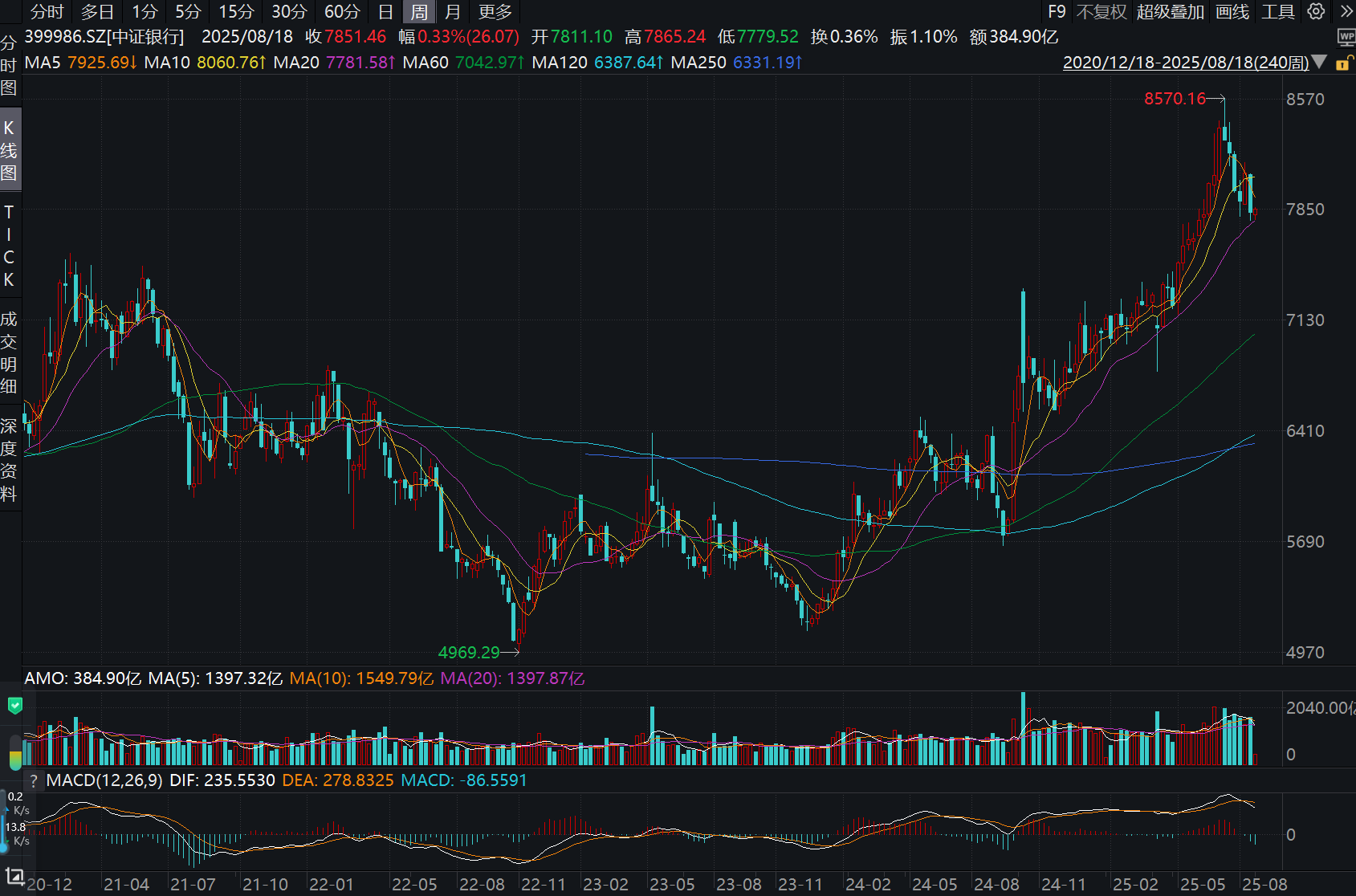
Core Viewpoint - The banking sector has shown significant recovery since the end of 2023, with the China Securities Banking Index experiencing a bull market, rising approximately 70% from its low at the end of 2023 to its peak in July 2024 [4][5]. Group 1: Market Performance - The banking sector, including both state-owned banks and previously underperforming banks, has seen notable price increases, with active fund managers increasing their allocation to banking stocks from 2% to around 4% [5][6]. - Insurance capital has become a significant force in the market, frequently acquiring banking stocks and contributing to the upward trend in bank share prices [6]. Group 2: Valuation and Investment Potential - Despite the recent price increases, many banking stocks remain undervalued, with most trading below a price-to-book (PB) ratio of 0.5, indicating potential for further appreciation [8][11]. - The average PB ratio for the China Securities Banking Index is currently at 0.72, suggesting that there is still room for growth, especially if valuations return to levels seen in previous bull markets [13]. Group 3: Dividend Yield and Long-term Investment - The average dividend yield for the banking sector is approximately 3.97%, which remains attractive compared to the 10-year government bond yield of around 1.8% [15]. - Insurance companies are expected to increase their investments in banking stocks significantly, with projections indicating that an additional 2 trillion yuan could flow into the banking sector from 2025 to 2027 [17]. Group 4: Economic Conditions and Future Outlook - The banking sector is currently in a phase of confirming its bottom, with signs of marginal improvement in asset quality and net interest margins, which are crucial for future profitability [21][26]. - Concerns regarding real estate, local government debt, and retail loan quality are gradually improving, which could support a more favorable environment for banks moving forward [24][25]. Group 5: Growth Opportunities - The potential for growth in banking stocks is linked to the overall economic recovery, with banks that have strong retail or corporate lending capabilities likely to outperform as the economy strengthens [30][31]. - Specific banks, such as China Merchants Bank and Industrial Bank, are positioned well for recovery due to their strong market positions and recent performance improvements [31].

银行股,高处不胜寒?
Hu Xiu· 2025-08-21 09:16
Core Viewpoint - The banking sector has shown a significant recovery since the end of 2023, with the China Securities Banking Index rising approximately 70% from its low at the end of 2023 to its peak in July 2024, following a period of substantial decline in 2022 [1][3]. Group 1: Market Performance - The banking sector experienced a deep adjustment in 2022, with a decline of around 33% from its peak in mid-2021 [1]. - The banking sector's recovery has attracted attention from active management funds, with their allocation to banks increasing from 2% to about 4% over the past year [3]. - Insurance capital has frequently targeted bank stocks in the secondary market, contributing significantly to the upward momentum of bank shares [3][6]. Group 2: Valuation and Investment Appeal - Despite a challenging fundamental outlook, bank stocks have seen a slow bull market, with prices rising even as net interest margins have decreased from 1.69% in 2023 to 1.42% by mid-2024 [4][6]. - The average price-to-book (PB) ratio for listed banks is currently around 0.72, indicating that valuations remain reasonable, with potential for further upside if they return to previous levels seen in 2019 [8][11]. - The dividend yield for the China Securities Banking Index stands at 3.97%, which remains attractive compared to the 10-year government bond yield of approximately 1.8% [11]. Group 3: Future Outlook - There is still significant room for growth in bank stocks, particularly as the market's risk appetite increases and as banks are expected to benefit from a recovering economy [8][19]. - The banking sector is currently in a phase of confirming its bottom, with signs of marginal improvement in profitability and asset quality [15][19]. - The potential influx of long-term capital from insurance companies, estimated to reach around 2 trillion yuan from 2025 to 2027, could further support bank stock prices [12][14]. Group 4: Sector-Specific Insights - Among the 42 listed banks, different types exhibit varying growth characteristics, with Agricultural Bank of China showing the best performance among state-owned banks [23]. - Banks like China Merchants Bank and Industrial Bank are expected to perform well due to their strong retail and corporate business segments, respectively [22][23]. - The ongoing recovery in the real estate sector and improvements in asset quality are expected to reduce the risks associated with bad debts, particularly in retail and local government financing [18][19].