
牛市规律

Search documents
A股三次大牛市:启动、上涨与终结
泽平宏观· 2026-03-03 16:06
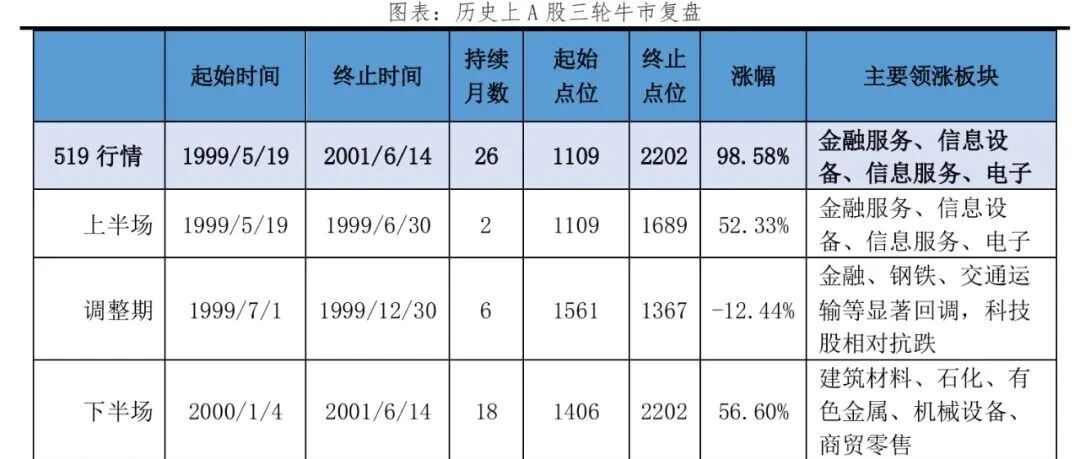
Core Viewpoint - The article discusses the unprecedented stimulus policies since late September 2024 that have ignited a "confidence bull market" in A-shares and Hong Kong stocks, exploring the patterns of previous bull markets and the potential trajectory of the current market [1][2]. Summary by Sections Historical Bull Markets - The article reviews three major bull markets in A-shares: the 519 market from 1999-2001, the cyclical bull from 2005-2007, and the reform bull from 2014-2015, analyzing their characteristics and outcomes [2][10]. 1999-2001 519 Market - Initiated during economic downturns with policy stimulus, ending due to profit inability to support valuation bubbles. The Shanghai Composite Index rose 98.6% over 26 months [3][15]. - The first half was driven by policy and valuation speculation, while the second half saw a surge due to economic recovery and tech stock performance, culminating in a peak in June 2001 [15][21]. 2005-2007 Cyclical Bull Market - This bull market was driven by strong economic fundamentals and the resolution of the split share structure, with the Shanghai Composite Index increasing by 513.6% over 28 months [4][28]. - The market experienced a three-phase structure: recovery from undervaluation, a brief adjustment, and a performance-driven surge, particularly in resource and financial sectors [31][35]. 2014-2015 Reform Bull Market - Triggered by economic slowdown and policy easing, this market saw the Shanghai Composite Index rise by 148.96% in 11 months, primarily driven by leverage and external capital inflows [5][47]. - The market transitioned from cyclical to growth stocks, with significant gains in technology and consumer sectors, but ended due to lack of fundamental support and regulatory tightening [51]. Key Discoveries from Historical Bull Markets - A bull market requires three conditions: policy shift, capital inflow, and low valuations, often starting amid controversy and ending in exuberance [6][53]. - Bull markets typically progress through three phases: policy-driven, capital-driven, and fundamentally driven, with the latter being crucial for sustainability [6][54]. - A-shares exhibit characteristics of short bull markets and long bear markets, with average bull market durations of 17.35 months compared to 27.12 months for bear markets [7][53]. Current "Confidence Bull Market" Analysis - The current bull market shares similarities with previous ones, starting during economic downturns and driven by policy shifts, with a focus on technology and liquidity [8][56]. - The market's sustainability hinges on continued policy support, technological innovation, and effective management of leverage to avoid extreme volatility [62][61].

牛市的10大规律
2025-08-06 03:33
Summary of Key Points from the Report on Bull Market Patterns Industry or Company Involved - The report focuses on the Chinese stock market, specifically the performance of the CSI 300 index and related sectors during bull markets. Core Insights and Arguments 1. **CSI 300 High Points Consistency**: Historical data shows that the CSI 300 index has consistently reached high points in the range of 5300-5800 during major bull markets, with a 25% increase from February 6, 2024, to July 30, 2025, indicating potential for further growth of approximately 32% to reach 5500 points [10][12][19]. 2. **Five-Year Planning Cycles**: Major bull markets often coincide with the transition years of China's five-year plans. The current bull market began in 2024, with 2025 marking the end of the 14th Five-Year Plan and 2026 the start of the 15th, suggesting a potential for significant market movements in 2025-2026 [13][15]. 3. **Equity Risk Premium Levels**: The equity risk premium tends to approach or fall below zero during bull markets, indicating high investor optimism. As of July 30, 2025, the A-share market's valuation suggests a potential upside of at least 60% if the equity risk premium returns to zero [16][19]. 4. **Dividend Yield Thresholds**: Historically, the CSI 300's dividend yield reaches around 1.5% during bull markets. As of July 30, 2025, the yield was approximately 2.8%, suggesting an 85% upside potential if it normalizes to 1.5% [20][23]. 5. **Valuation Phases**: The report indicates that the market valuation has not yet peaked, with a potential 19% increase remaining before reaching the valuation levels seen in early 2021 [24][26]. 6. **Performance Confirmation Timing**: The report outlines that the performance confirmation for return on equity (ROE) has not yet occurred, with the first quarter of 2025 showing a slight positive turn in year-on-year profit growth [26]. 7. **Leading Styles in Bull Markets**: Advanced manufacturing and growth technology sectors have historically led bull markets. However, the current performance of these sectors is lagging compared to previous bull markets, with advanced manufacturing showing less than 45% growth since the bottom [29][33]. 8. **Mid-Cap Sector Performance**: Historically, mid-cap stocks have performed well during bull markets, but the current bull market has seen limited growth in this sector, indicating a potential opportunity for future gains [34][38]. 9. **Return of Fund Heavyweights**: The report notes that fund-heavy styles tend to return during bull markets. After a significant downturn from 2021 to 2024, these styles are expected to regain prominence as high-growth investments return [39][41]. 10. **Leading Industries in Bull Markets**: Key industries that have historically led bull markets include military, electric equipment, and machinery. Currently, the performance of these sectors is below historical averages, indicating potential for recovery [44][47]. Other Important but Possibly Overlooked Content - **Risk Factors**: The report highlights several risk factors that could impact market performance, including unexpected global economic fluctuations, uncertainties in U.S. trade and monetary policies, and potential inflationary pressures [48][50][51]. - **Data Limitations**: There are cautions regarding the accuracy and timeliness of data used in the report, emphasizing that some metrics may not reflect the latest market conditions [52][53]. This comprehensive analysis provides insights into the current state and potential future movements of the Chinese stock market, particularly focusing on the CSI 300 index and its associated sectors.
策略专题报告:牛市的10大规律
Guohai Securities· 2025-08-01 10:04
Group 1: Market Trends - The report identifies ten key rules of bull markets, focusing on macro trends, styles, and industries [7] - The Shanghai Composite Index (CSI 300) is expected to reach a peak between 5300 and 5800 points, based on historical performance [10][12] - Major bull markets often coincide with the transition years of five-year plans, suggesting potential for significant market movements in 2025 and 2026 [13][15] Group 2: Valuation Metrics - The equity risk premium tends to approach or fall below zero during bull markets, indicating extreme optimism in valuations [16][19] - The CSI 300's dividend yield typically reaches around 1.5% during bull markets, with current yields suggesting substantial upside potential [20][23] - Historical data shows that valuation peaks often coincide with market tops, indicating limited upside once valuations reach their peak [24][25] Group 3: Performance by Style and Sector - Advanced manufacturing and growth technology sectors have historically led bull markets, with current performance lagging behind previous cycles [29][33] - Mid-cap stocks have shown potential for significant gains in past bull markets, but current performance remains subdued [34][38] - Fund-heavy styles are expected to return as high-growth investments gain traction, following a period of underperformance [39][41] Group 4: Leading Industries - Historically, leading industries during bull markets include military, electric equipment, and machinery, with current performance in these sectors underwhelming compared to historical averages [44][47]