物质资本

Search documents
“投资于人”需要放在更加突出的位置
Xin Lang Cai Jing· 2026-02-08 18:31
Core Viewpoint - The article emphasizes the importance of "investing in people" as a key lever to enhance investment efficiency and support economic transformation in China, shifting from a "demographic dividend" to a "talent dividend" [1] Investment in Human Capital - "Investing in people" is crucial for improving investment efficiency, optimizing investment structure, and playing a key role in economic transformation [1] - The contribution of human capital to modern economic growth has surpassed that of physical capital [1] - Compared to developed countries, there is still room for improvement in the average years of education for the labor force in China [1] Economic Growth and Labor Quality - Continuous improvement in labor quality and supply is necessary to support high-quality economic development [1] - A World Bank study indicates that for every additional year of education for the labor force, GDP increases by 9% [1] Investment Requirements - A comprehensive investment in human capital is estimated to require between 80 trillion to 100 trillion yuan [1] - Proposed annual investments include 5 trillion yuan for equalizing basic medical services, 500 billion yuan for universal high school education, and 2 to 3 trillion yuan for improving the fertility support system [1] Vision for Development - The vision of becoming a "big country in people's livelihood" through "investing in people" aims to accumulate substantial material capital and cultivate strong human capital, ultimately leading to common prosperity [1]
中国增长进入人和物的乘法时代
Di Yi Cai Jing· 2025-12-01 12:25
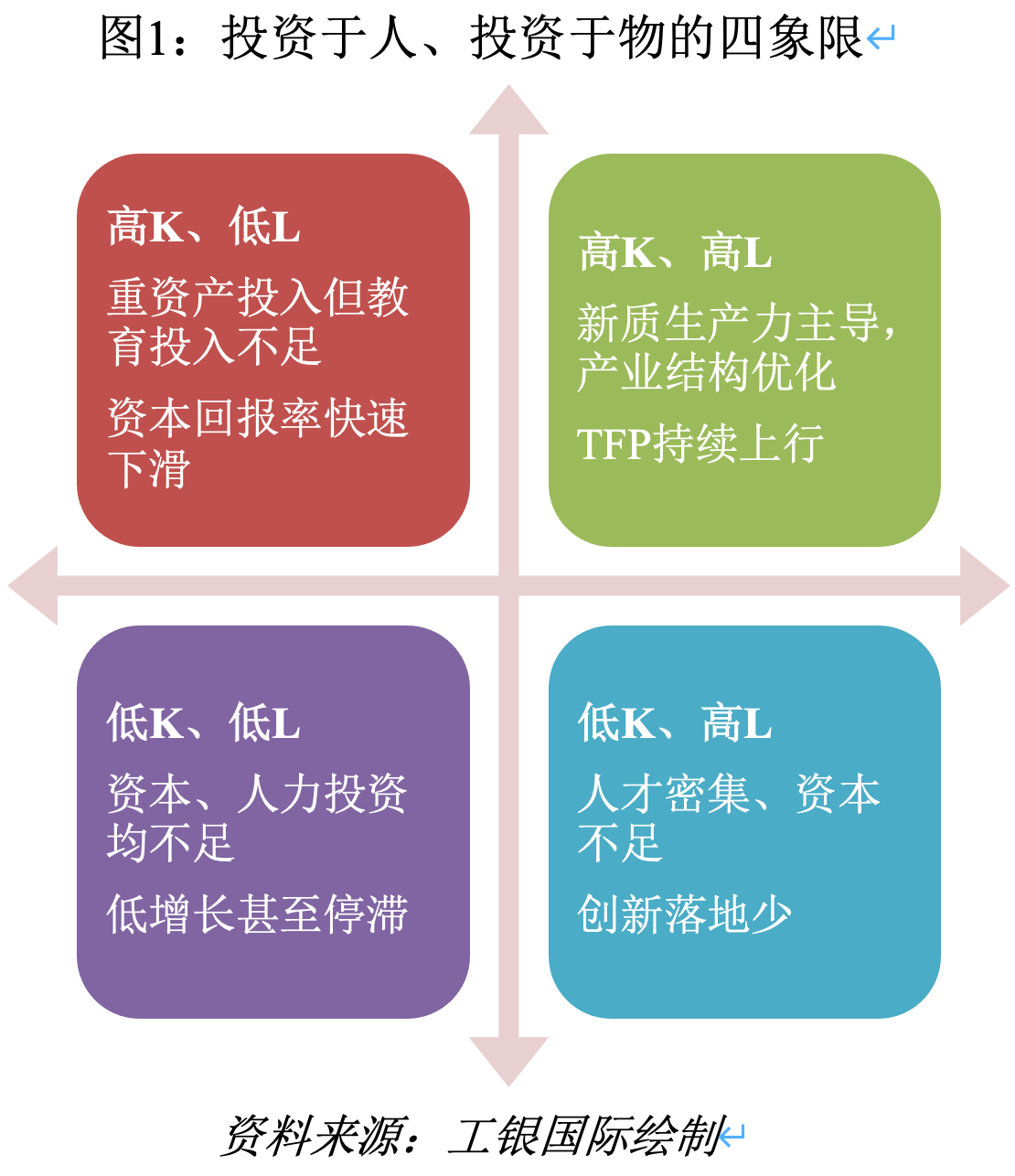
Group 1 - The core idea is the transition from additive growth focused on expanding investment scale to multiplicative development that combines investment in people and material, aiming to enhance total factor productivity (TFP) [1][3] - The investment policy logic is shifting towards a new development paradigm driven by the synergy of human capital and material capital, as highlighted in the "14th Five-Year Plan" [2][3] - The relationship between capital (K) and labor (L) is evolving, with K now encompassing broader forms of capital, including digital infrastructure and intelligent equipment, while L includes various dimensions such as skill levels and innovation capabilities [2][3] Group 2 - Path one emphasizes developing new quality productivity by effectively investing in both material and human aspects, focusing on high-return capital with technological spillover effects [6][8] - Path two focuses on releasing the "quality dividend" by upgrading human capital to extend the demographic dividend, with significant contributions from labor quality improvements to economic growth [10][11] - Path three advocates for establishing a synchronous mechanism to ensure the resonance between material capital and human capital, enhancing TFP through coordinated upgrades [12][13]