
质量红利

Search documents
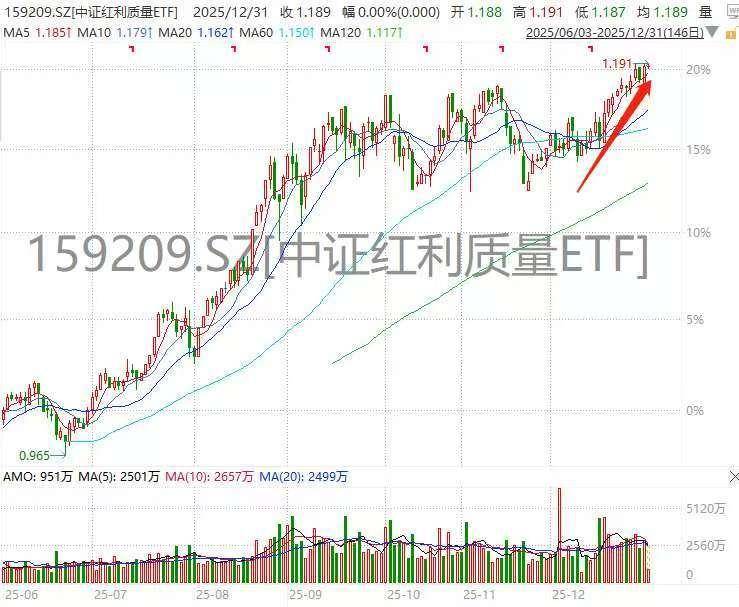
A股红利之王诞生!中证红利质量ETF(159209)年内累涨超20%,收官之日再创历史新高!
Sou Hu Cai Jing· 2025-12-31 02:50
Core Insights - The market is focusing on the "high dividend + high quality" strategy of the CSI Dividend Quality ETF (159209), which has achieved over 20% annual returns and recorded 49 historical highs in 2023, with 13 consecutive trading days of net inflow [1][3]. Group 1: Fund Performance - The ETF's strong performance is attributed to its evolved strategy, which combines the defensive attributes of "high dividends" with the offensive potential of "high quality" companies, ensuring both stable dividend income and growth potential [3]. - The fund tracks the CSI Dividend Quality Index, which rigorously selects companies with high profitability, robust finances, and sustainable growth, exemplified by leading firms like Kweichow Moutai [3]. Group 2: Product Features - The ETF features a low comprehensive fee rate of 0.20%, significantly reducing long-term holding costs for investors [3]. - It implements a monthly dividend assessment mechanism, enhancing the investment experience by catering to investors' needs for regular cash flow [3]. Group 3: Market Implications - The ETF's performance and strong capital inflow indicate a shift in A-share dividend investment from merely chasing high yields to a new phase that balances "profit quality" and "long-term value" [3]. - In a declining risk-free interest rate environment, this balanced strategy is becoming a crucial choice for investors in core asset allocation [3].

战略数据研究|专题报告:\质量红利\占比调升,从红利低波年度调仓初看2026年红利配置机会
Changjiang Securities· 2025-12-18 08:11
Group 1: Dividend Index Changes - The recent rebalancing of the dividend indices, including the CSI Dividend and Low Volatility Dividend indices, indicates a shift towards "quality dividend" assets, reflecting a trend from traditional dividend assets[2] - The number of stocks added to the CSI Low Volatility Dividend index was 18, while the CSI Dividend index saw 20 stocks added, showing a higher turnover rate in the Low Volatility Dividend index[20] - The weight of quality dividend assets has marginally increased in the Low Volatility Dividend index, suggesting a transition towards quality-focused investments[6] Group 2: Sector and Dividend Yield Changes - New sectors such as healthcare, non-metal materials, and public utilities have been added to the indices, indicating a diversification of included industries[6] - The weight of stocks with dividend yields between 5% and 8% has significantly increased in the CSI Dividend index after adjustments[7] - The CSI Low Volatility Dividend index has also seen a notable increase in the proportion of stocks with dividend yields above 5%[30] Group 3: Market Conditions and Investment Strategy - The report suggests that in a declining interest rate environment, bond-like and stable dividends are more beneficial, while quality and cyclical dividends perform better in a rising interest rate and liquidity phase[8] - The analysis indicates that the quality dividend assets are better suited for a stable or rising interest rate environment, enhancing their investment appeal[36]
中国增长进入人和物的乘法时代
Di Yi Cai Jing· 2025-12-01 12:25
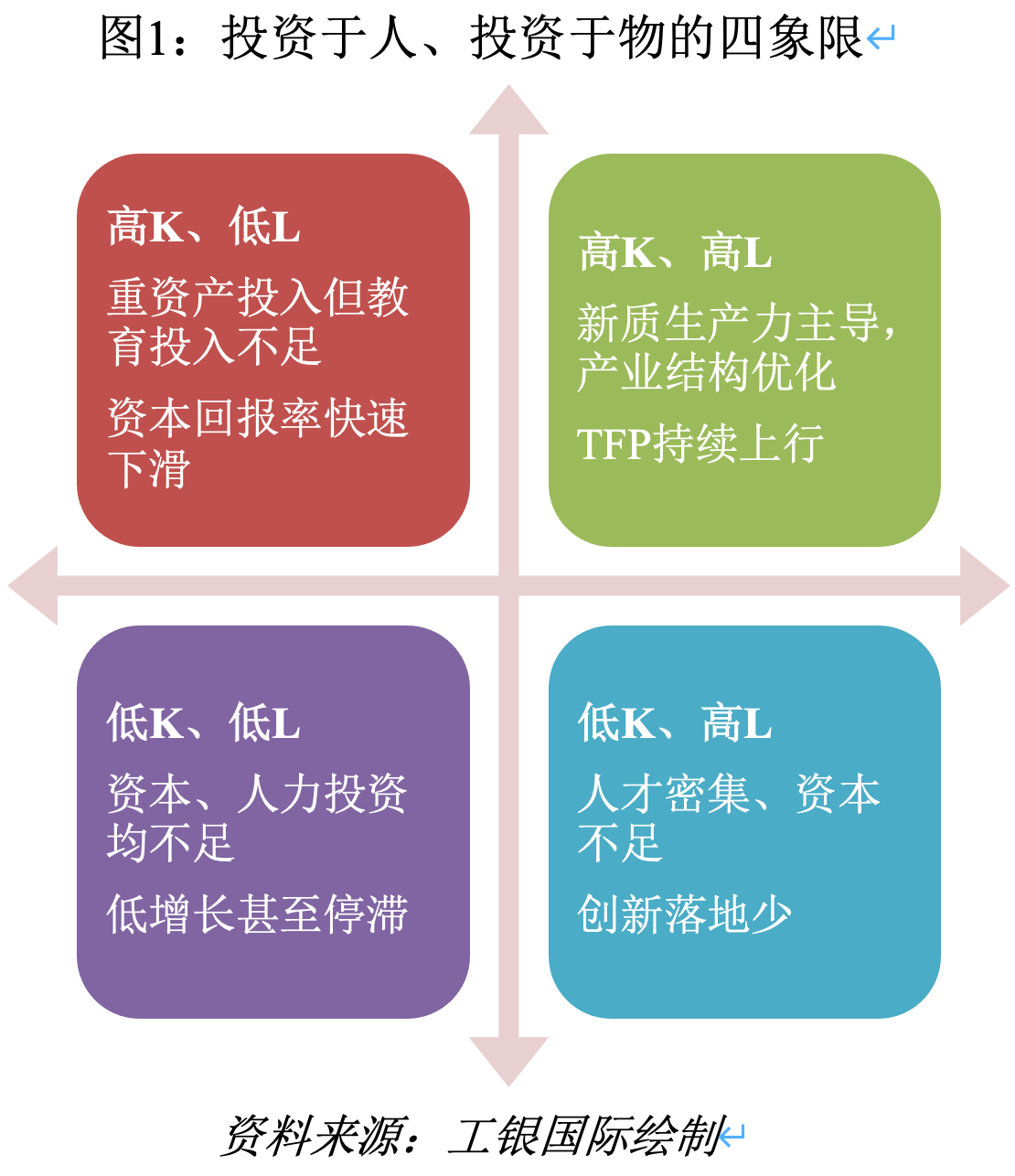
Group 1 - The core idea is the transition from additive growth focused on expanding investment scale to multiplicative development that combines investment in people and material, aiming to enhance total factor productivity (TFP) [1][3] - The investment policy logic is shifting towards a new development paradigm driven by the synergy of human capital and material capital, as highlighted in the "14th Five-Year Plan" [2][3] - The relationship between capital (K) and labor (L) is evolving, with K now encompassing broader forms of capital, including digital infrastructure and intelligent equipment, while L includes various dimensions such as skill levels and innovation capabilities [2][3] Group 2 - Path one emphasizes developing new quality productivity by effectively investing in both material and human aspects, focusing on high-return capital with technological spillover effects [6][8] - Path two focuses on releasing the "quality dividend" by upgrading human capital to extend the demographic dividend, with significant contributions from labor quality improvements to economic growth [10][11] - Path three advocates for establishing a synchronous mechanism to ensure the resonance between material capital and human capital, enhancing TFP through coordinated upgrades [12][13]
量化大势研判:预期成长优势差继续扩大
Minsheng Securities· 2025-08-04 06:40
Quantitative Models and Construction Methods 1. Model Name: Quantitative Market Trend Judgment Framework - **Model Construction Idea**: The framework identifies the dominant market style by comparing the intrinsic attributes of assets, which are tied to their industry lifecycle stages. It prioritizes assets based on the sequence of growth rate (g) > return on equity (ROE) > dividend yield (D) to determine the most advantageous assets and focuses on the most promising sectors[5][6][9] - **Model Construction Process**: 1. Define five style stages for equity assets: external growth, quality growth, quality dividend, value dividend, and distressed value[5] 2. Compare assets globally to identify advantageous ones based on their intrinsic characteristics[5] 3. Use the priority sequence g > ROE > D to evaluate whether good assets exist and whether they are overvalued[5][6] 4. Focus on sectors with the most advantageous characteristics in the current market[5][6] - **Model Evaluation**: The framework has demonstrated strong explanatory power for A-share market style rotations since 2009, achieving an annualized return of 26.70%[16] 2. Model Name: Asset Comparison Strategy - **Model Construction Idea**: This model categorizes assets into primary and secondary groups. Primary assets include actual growth, expected growth, and profitability assets. Secondary assets are prioritized based on crowding levels and fundamental factors[9] - **Model Construction Process**: 1. Classify assets into primary (expected growth, actual growth, profitability) and secondary (quality dividend, value dividend, distressed value) categories[9] 2. Allocate market funds to primary assets when any of them show an advantage; otherwise, shift to secondary assets[9] 3. Rank secondary assets by crowding levels and fundamental factors, with the order: quality dividend > value dividend > distressed value[9] --- Model Backtesting Results 1. Quantitative Market Trend Judgment Framework - Annualized return: 26.70% since 2009[16] - Historical performance: Positive excess returns in most years, with limited effectiveness in 2011, 2012, 2014, and 2016[16][19] - Excess returns by year: - 2009: 51% - 2010: 14% - 2013: 36% - 2017: 27% - 2020: 44% - 2022: 62%[19] --- Quantitative Factors and Construction Methods 1. Factor Name: Expected Growth (gf) - **Factor Construction Idea**: Measures the expected growth rate based on analysts' forecasts, regardless of the industry lifecycle stage[6] - **Factor Construction Process**: 1. Use analysts' forecasted growth rates as the primary input[6] 2. Calculate the spread (Δgf) between top and bottom groups to assess the trend of expected growth[21] - **Factor Evaluation**: The factor has shown consistent expansion, with top groups driving the increase, indicating analysts' optimism about high-growth sectors[21] 2. Factor Name: Actual Growth (g) - **Factor Construction Idea**: Focuses on performance momentum (Δg) during transition and growth phases[6] - **Factor Construction Process**: 1. Calculate the spread (Δg) between top and bottom groups based on actual growth rates[25] 2. Monitor the trend of Δg to identify growth opportunities in the market[25] - **Factor Evaluation**: The factor has shown gradual expansion, with opportunities in sectors maintaining strong momentum despite a slowdown in top-tier growth[25] 3. Factor Name: Profitability (ROE) - **Factor Construction Idea**: Evaluates valuation levels using the PB-ROE framework, focusing on mature industries[6] - **Factor Construction Process**: 1. Calculate the PB-ROE residuals for each industry[40] 2. Rank industries based on residuals to identify undervalued high-ROE sectors[40] - **Factor Evaluation**: The factor's advantage has declined, and its crowding level remains low, suggesting limited opportunities in the current market[28] 4. Factor Name: Quality Dividend (DP+ROE) - **Factor Construction Idea**: Combines dividend yield (DP) and ROE to identify high-quality dividend-paying industries[6] - **Factor Construction Process**: 1. Calculate DP and ROE scores for each industry[43] 2. Combine the scores to rank industries and select the top-performing ones[43] - **Factor Evaluation**: The factor has shown significant excess returns in specific years, such as 2016, 2017, and 2023[43] 5. Factor Name: Value Dividend (DP+BP) - **Factor Construction Idea**: Combines dividend yield (DP) and book-to-price ratio (BP) to identify undervalued dividend-paying industries[6] - **Factor Construction Process**: 1. Calculate DP and BP scores for each industry[47] 2. Combine the scores to rank industries and select the top-performing ones[47] - **Factor Evaluation**: The factor has demonstrated strong excess returns in years like 2009, 2017, and 2021-2023[47] 6. Factor Name: Distressed Value (PB+SIZE) - **Factor Construction Idea**: Identifies industries with low price-to-book ratios (PB) and small market capitalization (SIZE), focusing on stagnation and recession phases[6] - **Factor Construction Process**: 1. Calculate PB and SIZE scores for each industry[51] 2. Combine the scores to rank industries and select the lowest-scoring ones[51] - **Factor Evaluation**: The factor has shown significant excess returns during periods like 2015-2016 and 2021-2023[51] --- Factor Backtesting Results 1. Expected Growth (gf) - Δgf continues to expand, driven by top-tier groups, indicating analysts' optimism about high-growth sectors[21] 2. Actual Growth (g) - Δg shows gradual expansion, with opportunities in sectors maintaining strong momentum despite a slowdown in top-tier growth[25] 3. Profitability (ROE) - ROE advantage continues to decline, with low crowding levels and limited opportunities in the current market[28] 4. Quality Dividend (DP+ROE) - Significant excess returns in 2016, 2017, and 2023[43] 5. Value Dividend (DP+BP) - Strong excess returns in 2009, 2017, and 2021-2023[47] 6. Distressed Value (PB+SIZE) - Significant excess returns during 2015-2016 and 2021-2023[51]
量化大势研判202503:成长或将趋弱,切向质量红利
Minsheng Securities· 2025-03-03 05:28
Quantitative Models and Construction Methods 1. Model Name: Quantitative Market Trend Judgment Framework - **Model Construction Idea**: The framework identifies the dominant market style by comparing asset characteristics based on their intrinsic attributes and industry life cycle stages. It evaluates assets using the priority sequence of growth (g) > return on equity (ROE) > dividend yield (D) to determine the most advantageous sectors[5][6][7] - **Model Construction Process**: - Classifies assets into five style stages: external growth, quality growth, quality dividend, value dividend, and distressed value[5] - Prioritizes mainstream assets (actual growth, expected growth, profitability) over secondary assets, with secondary asset priority determined by crowding levels[7] - Uses metrics such as Δg (actual growth momentum), Δgf (expected growth momentum), PB-ROE (valuation), and DP (dividend yield) to evaluate and rank assets[6][7] - **Model Evaluation**: The framework has demonstrated strong explanatory power for A-share market style rotations since 2009, achieving an annualized return of 26.85%[14] --- Quantitative Factors and Construction Methods 1. Factor Name: Actual Growth (g) - **Factor Construction Idea**: Measures the momentum of actual growth by evaluating the change in net profit growth rates (Δg)[18] - **Factor Construction Process**: - Calculates the spread between the top and bottom quintiles of industries based on net profit growth rates[18] - Δg > 0 indicates strengthening growth momentum, while Δg < 0 signals weakening momentum[18] 2. Factor Name: Expected Growth (gf) - **Factor Construction Idea**: Captures analysts' optimism by assessing changes in expected net profit growth rates (Δgf)[21] - **Factor Construction Process**: - Similar to Δg, calculates the spread between the top and bottom quintiles of industries based on expected net profit growth rates[21] - Δgf > 0 indicates increasing optimism, while Δgf < 0 suggests declining optimism[21] 3. Factor Name: Profitability (ROE) - **Factor Construction Idea**: Evaluates asset quality by combining ROE with valuation metrics (PB-ROE)[22] - **Factor Construction Process**: - Ranks industries based on ROE and PB-ROE residuals[30] - Identifies high ROE industries with low valuations for allocation[30] 4. Factor Name: Quality Dividend (DP+ROE) - **Factor Construction Idea**: Combines dividend yield (DP) and ROE to identify high-quality dividend-paying industries[33] - **Factor Construction Process**: - Scores industries based on DP and ROE, selecting the highest-scoring sectors for allocation[33] 5. Factor Name: Value Dividend (DP+BP) - **Factor Construction Idea**: Combines dividend yield (DP) and book-to-price ratio (BP) to identify undervalued dividend-paying industries[36] - **Factor Construction Process**: - Scores industries based on DP and BP, selecting the highest-scoring sectors for allocation[36] 6. Factor Name: Distressed Value (PB+SIZE) - **Factor Construction Idea**: Identifies distressed industries with low price-to-book ratios (PB) and small market capitalization (SIZE)[38] - **Factor Construction Process**: - Scores industries based on PB and SIZE, selecting the lowest-scoring sectors for allocation[38] --- Backtesting Results of Models and Factors 1. Quantitative Market Trend Judgment Framework - **Annualized Return**: 26.85% since 2009[14] - **Excess Returns**: Positive in most years, with notable outperformance in 2020 (44%), 2021 (38%), and 2022 (62%)[15] 2. Actual Growth Factor - **Recent Performance**: Δg turned negative, indicating weakening growth momentum and reduced opportunities for actual growth strategies[18] 3. Expected Growth Factor - **Recent Performance**: Δgf turned negative, signaling a halt in analysts' optimism and limited opportunities for expected growth strategies[21] 4. Profitability Factor - **Recent Performance**: ROE advantage continues to decline, but reduced crowding levels suggest potential opportunities in a weakening growth environment[22][24] 5. Quality Dividend Factor - **Recent Performance**: Outperformed in 2016, 2017, and 2023; recent recommendations include sectors like "Other Home Appliances" and "Service Robots"[33] 6. Value Dividend Factor - **Recent Performance**: Outperformed in 2009, 2017, and 2021-2023; recent recommendations include sectors like "Pet Food" and "Security"[36] 7. Distressed Value Factor - **Recent Performance**: Outperformed in 2015-2016 and 2021-2023; recent recommendations include sectors like "Other Electronic Components" and "Printing and Dyeing"[38]