现场发电

Search documents
金融时报:接入电网太慢“等不起”,数据中心抢购“航空发动机”发电
美股IPO· 2025-12-28 16:03
Core Insights - The article discusses the shift in power supply strategies among tech giants, who are increasingly turning to aviation engines and diesel generators for emergency power due to long wait times for grid access, which can extend up to 7 years [2][6] - Companies like GE Vernova and Cummins are experiencing significant increases in demand for their power generation solutions, with GE Vernova reporting a one-third increase in orders for aviation-derived turbines [3][8] Group 1: Market Trends - There is a notable increase in orders for aviation-derived turbines as manufacturers aim to bypass the grid and provide direct power to data centers [2][3] - The demand for on-site power generation solutions is reshaping the power equipment market, with developers willing to incur higher costs to avoid delays in grid access [2][6] Group 2: Company Developments - GE Vernova is supplying aviation-derived turbines to data center developers, expected to provide nearly 1 gigawatt (GW) of power for projects involving OpenAI, Oracle, and SoftBank [3] - Cummins has sold over 39 gigawatts (GW) of power equipment to data centers this year, nearly doubling its capacity [8] Group 3: Economic and Environmental Considerations - The cost of on-site power generation is approximately double the industrial average, raising concerns about increased carbon emissions due to lower efficiency [10][11] - Regulatory changes are emerging, with suggestions to utilize existing backup generators to strengthen the grid, indicating a shift in how power generation is approached [9]


接入电网太慢“等不起”,数据中心抢购“航空发动机”发电
Hua Er Jie Jian Wen· 2025-12-27 13:18
Core Insights - Developers are increasingly turning to aircraft engines and fossil fuel generators to bypass long electricity grid connection wait times, which can last up to 7 years, to power AI operations [1] - The demand for aviation-derived turbines is surging, with GE Vernova reporting a one-third increase in orders for these turbines in the first three quarters of 2025 compared to the previous year [2] - Traditional diesel and gas generators are also seeing increased usage, with Cummins selling over 39GW of power equipment to data centers this year, nearly doubling its capacity [4] Group 1 - The shift towards using aircraft-derived turbines highlights the urgency tech giants feel regarding infrastructure development, as they prefer to incur higher costs rather than wait for grid access [1] - GE Vernova is supplying aviation-derived turbines to data center developers like Crusoe, expected to provide nearly 1GW of power for projects involving OpenAI, Oracle, and SoftBank [2] - Boom Supersonic, supported by Sam Altman, plans to sell turbines capable of providing 1.2GW of power, using revenue from these turbines to fund its jet business [3] Group 2 - The interest in on-site primary power sources is growing, as evidenced by Cummins' significant sales of power equipment to data centers [4] - Regulatory changes are emerging, with suggestions to utilize existing backup generators to strengthen the grid, and allowances for more frequent operation of diesel generators at data centers [4] - Despite the urgent need for on-site power, the cost of this electricity is approximately double the industrial average, raising concerns about increased carbon emissions due to lower efficiency [6]
SOFC行业深度报告:北美数据中心电力短缺,SOFC迎来快速增长
Shanghai Aijian Securities· 2025-12-19 06:24
Investment Rating - The report rates the industry as "Outperform" [2] Core Insights - The demand for power in North American data centers is increasing, leading to a shortage of electricity supply, which presents a significant opportunity for Solid Oxide Fuel Cells (SOFC) [2][6] - The U.S. data center market is expected to see substantial growth, with an estimated addition of 55GW of IT capacity from 2025 to 2030, driven by major operators like Amazon AWS and Microsoft [2][9] - SOFC technology is positioned as a viable solution to meet the power demands of data centers due to its rapid deployment capabilities, economic advantages, and ability to respond quickly to load fluctuations [2][25] Summary by Sections 1. Background - The U.S. has over 4,000 data centers, the highest globally, with significant contributions to electricity demand, projected to account for over 6.7% of total U.S. electricity consumption by 2028 [2][14] - The total electricity consumption of U.S. data centers has increased from 58TWh in 2014 to approximately 176TWh in 2023, with projections of reaching between 325TWh and 580TWh by 2028 [14][18] 2. SOFC Technology - SOFC operates through electrochemical reactions to generate electricity and heat, functioning at high temperatures (500-1000°C) [25][27] - The modular design of SOFC allows for quick installation and adaptability to varying power demands, making it suitable for dynamic environments like data centers [39][41] - The levelized cost of electricity (LCOE) for SOFC is expected to decrease as production scales up, with current costs ranging from $7,000 to $10,000 per kW, potentially dropping to $2,000 per kW by 2030 [50][53] 3. Market Landscape - The SOFC market is predominantly led by companies from Japan, the UK, and the U.S., with significant market shares held by Mitsubishi Power (14.80%), Ceres Power (12.40%), and Bloom Energy (9.40%) [59] - Domestic companies are increasingly entering the SOFC market, with a notable number of projects and installations planned for 2024 [59][60]
Bloom Energy(BE) - 2025 Q3 - Earnings Call Transcript
2025-10-28 22:00
Financial Data and Key Metrics Changes - Revenue for Q3 2025 was $519 million, up 57% year-over-year [16] - Gross margin increased to 30.4%, a rise of 510 basis points from 25.2% in Q3 2024 [16] - Operating income was $46.2 million compared to $8.1 million in Q3 last year [16] - Adjusted EBITDA reached $59 million, up from $21 million in Q3 2024 [16] - Earnings per share (EPS) was a positive $0.15, compared to a loss of $0.01 a year ago [16] Business Line Data and Key Metrics Changes - Product margins were reported at 35.9%, while service margins were at 14.4% [16] - The service business achieved its second consecutive quarter of double-digit margins [17] Market Data and Key Metrics Changes - Bloom Energy is now competitive in large power-hungry markets such as the Midwest, Mid-Atlantic, Mountain West, and Texas, in addition to historical markets like California and the Northeast [6] - The company is embedded in seven distinct AI ecosystem channels, with strong traction and robust commercial activity [12] Company Strategy and Development Direction - The company aims to double its capacity to 2 gigawatts by December 2026, which is expected to support about four times its 2025 revenue [12] - Bloom Energy is focused on becoming the global standard for onsite power generation, leveraging advancements in product innovation and operational excellence [5][13] - The strategy involves establishing credibility with lighthouse customers in each vertical, then expanding to other tier-one customers [9] Management's Comments on Operating Environment and Future Outlook - Management expressed optimism about the future, expecting 2025 to exceed previously stated annual guidance on financial metrics [13] - The company is positioned to benefit from unprecedented market dynamics, particularly in the AI sector [18] - Management highlighted the importance of natural gas as a long-term solution for power generation, especially in international markets facing power shortages [31][32] Other Important Information - The partnership with Brookfield is significant, with Brookfield investing $5 billion and positioning Bloom as the preferred onsite power provider for its AI infrastructure portfolio [29][30] - The company is actively investing in operational talent and capabilities to support its expansion plans [13] Q&A Session Summary Question: Can you discuss the pace of commercial activity and future agreements? - Management noted that commercial momentum is accelerating across all segments, not just AI, with larger deals involving more complex negotiations [21] Question: How does Bloom Energy compare to emerging technologies in the data center space? - Management emphasized that Bloom's technology is purpose-built for data centers, offering significant advantages over traditional solutions, including lower emissions and faster deployment [22][23] Question: Can you elaborate on the Brookfield partnership and its financial implications? - The partnership is crucial, with Brookfield recommending Bloom to its portfolio companies and planning to finance Bloom-sourced deals [29][30] Question: How will regulatory changes impact Bloom Energy? - Management expressed optimism that expedited regulatory processes for data center connections will benefit Bloom by allowing faster deployment of their systems [35][36] Question: What is the outlook for capacity expansion and utilization? - Management indicated that they are prepared to expand capacity as needed and will not be a bottleneck for customer growth [50][51] Question: Can you provide guidance on margins as capacity increases? - Management suggested waiting for the next quarterly guidance but indicated a history of double-digit cost reductions and disciplined operational practices [58] Question: What is the status of the CFO search? - The CFO search is ongoing, with a sense of urgency but no rush to fill the position [66]

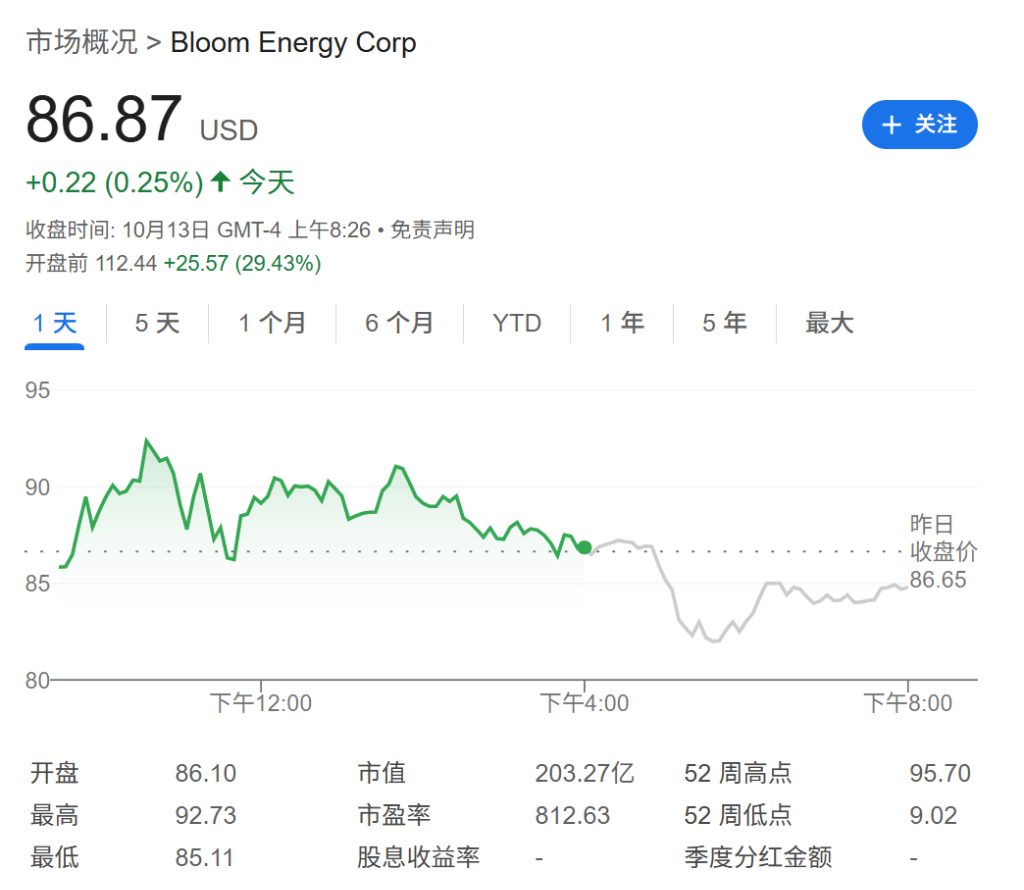
股价暴涨近30%!Bloom Energy与Brookfield达成50亿美元数据中心供电项目 燃料电池成AI供电新宠?
美股IPO· 2025-10-13 16:03
Core Insights - Brookfield Asset Management is set to invest up to $5 billion in collaboration with Bloom Energy to deploy onsite fuel cell power generation technology for AI data centers, aiming to bypass the constraints of an aging power grid [1][2] - The investment is a strategic move to address the significant power demand of AI, which is projected to reach 10 gigawatts, comparable to the electricity consumption of New York City during peak summer [3][6] Group 1: Investment and Collaboration - Brookfield's investment marks its first major commitment to support the power and computing infrastructure for AI data centers [2][6] - The partnership with Bloom Energy is seen as a critical milestone for the commercialization of Bloom's technology in the AI sector [6] Group 2: Industry Challenges and Solutions - The AI industry's rapid expansion is putting unprecedented pressure on the electrical system, with new data center projects facing challenges due to the slow and complex process of increasing power supply capacity [3] - Onsite power generation is emerging as a key solution to the power supply challenges faced by data centers, allowing for faster deployment and greater energy autonomy [3][6] Group 3: Global Strategy - Both companies are collaborating globally to design and deliver "AI factories," with plans to announce a specific project location in Europe by the end of the year [2][4] - Brookfield has been actively investing in Europe, previously announcing a €20 billion plan to develop AI projects, aiming to create the largest AI infrastructure cluster in the region [6]

燃料电池成AI供电新宠?Bloom Energy与Brookfield达成50亿美元数据中心供电项目
Hua Er Jie Jian Wen· 2025-10-13 12:35
Core Insights - Brookfield Asset Management has partnered with Bloom Energy to deploy onsite power generation technology for AI data centers, with an investment of up to $5 billion [1][5] - The collaboration aims to address the energy constraints faced by the rapidly expanding AI industry, particularly in relation to the aging U.S. power grid [3][4] Group 1: Investment and Strategic Importance - Brookfield's investment marks its first significant commitment to support the power and computing infrastructure for AI data centers [1][5] - The partnership is a milestone for Bloom Energy, enhancing its market presence and scaling its technology in the AI sector [5] Group 2: Energy Solutions and Market Demand - The AI industry's growth is creating unprecedented pressure on the power system, with significant power demands, such as the 10 gigawatts required for new data center clusters [4] - Onsite power generation is emerging as a critical solution to meet the energy needs of data centers, providing reliable power without relying on the existing grid [4][3] Group 3: Global Collaboration and Future Projects - Brookfield and Bloom Energy are collaborating globally to design and deliver "AI factories," with plans to announce a specific project location in Europe by the end of the year [3][5] - This partnership reflects a broader trend among major investors seeking to leverage alternative energy technologies to overcome energy limitations in AI development [3]