理财产品业绩展示规范

Search documents
理财产品靠“化妆”留不住用户
Jing Ji Ri Bao· 2025-11-27 21:44
Core Viewpoint - The article highlights the discrepancies between advertised high returns of financial products and the actual returns experienced by investors, emphasizing the need for transparency and responsible marketing practices by financial institutions [1][2][3]. Group 1: Issues with Performance Display - Financial institutions often showcase selective past performance metrics, emphasizing the best-performing periods while downplaying less favorable results, leading to potential investor disappointment [1][2]. - The performance metrics displayed can vary significantly based on the selected time frame, which can mislead investors if they do not scrutinize the details [2][3]. Group 2: Importance of Asset Management - The core of financial management lies in asset allocation and management capabilities, which are crucial for retaining investor trust and long-term relationships [2]. - Investors are increasingly focused on the financial institution's ability to manage assets effectively, especially in a market where products no longer guarantee returns [2][3]. Group 3: Recommendations for Investors and Institutions - Financial institutions are urged to adhere to regulations and maintain consistency in how past performance is displayed, ensuring that it reflects stability and logical coherence [3]. - Investors should prioritize long-term performance over short-term gains, recognizing that consistent performance is often more valuable than sporadic high returns [3].
理财产品收益“注水”?业界呼吁规范业绩展示
Zhong Guo Ji Jin Bao· 2025-11-23 14:19
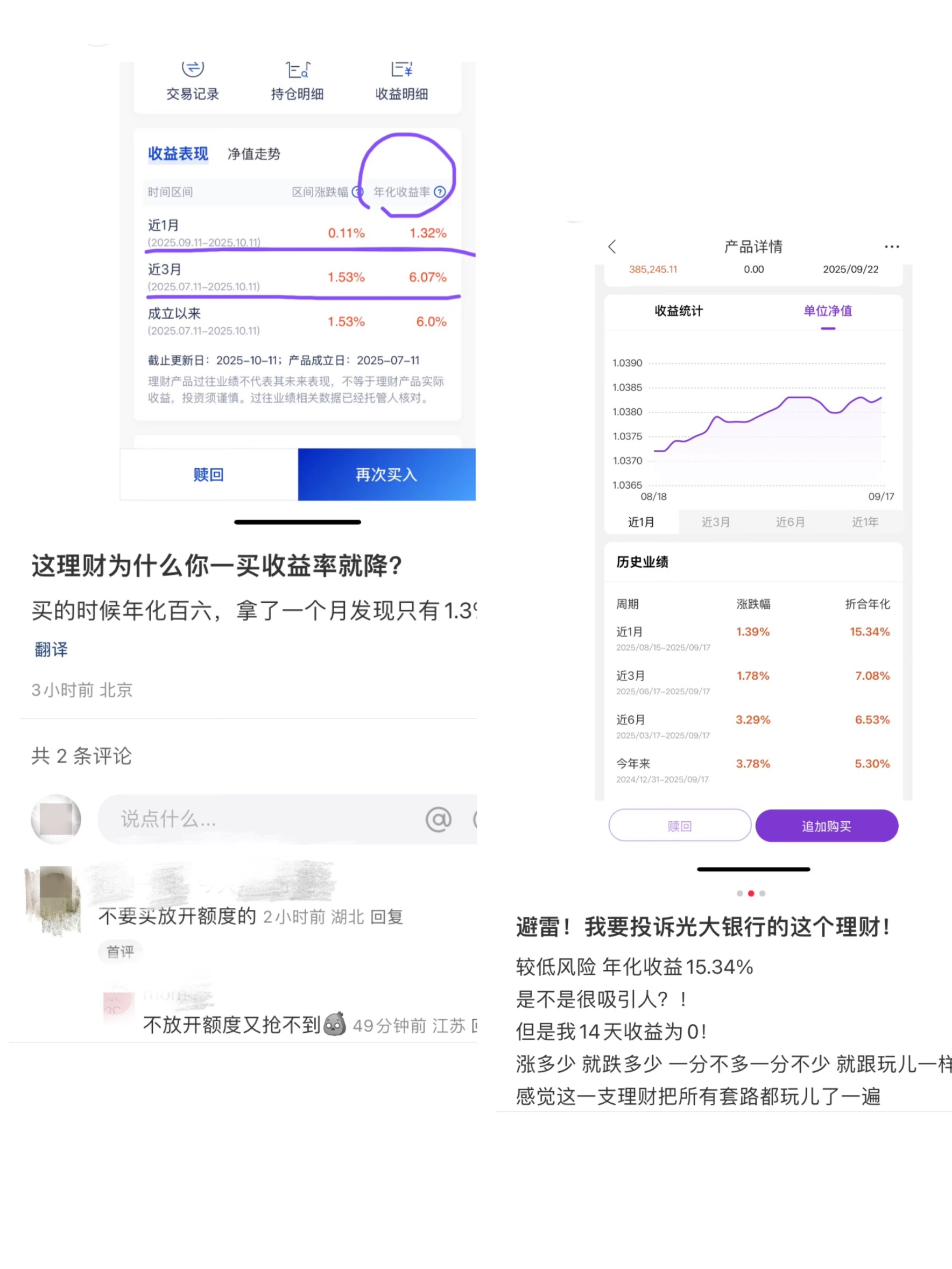
Core Viewpoint - The issue of "inflated" returns on wealth management products has gained significant attention, with many investors reporting discrepancies between advertised and actual returns, prompting calls for standardized performance disclosures in the industry [1][2]. Group 1: Factors Leading to Inflated Returns - Wealth management institutions often highlight better-performing return periods prominently while downplaying poorer performance, leading to investor dissatisfaction when actual returns fall short of expectations [2]. - Some banks employ various methods to artificially boost short-term returns to enhance product rankings, which can mislead investors [2]. - A specific example shows a bank's product advertised a historical annualized return of 3.149%, while actual returns over the past months were significantly lower, failing to meet the performance benchmark [2][3]. Group 2: Underlying Causes of the Issue - The persistent focus on scale and performance metrics among wealth management firms drives them to create products with misleadingly attractive returns [3]. - There is a conflict between risk appetite on the liability side and the reality of net value management, as clients transitioning from savings accounts expect stable returns, increasing the need for accurate information disclosure [3]. - The low-interest-rate environment has created challenges for enhancing returns, leading some firms to resort to technical adjustments to reported returns [3]. Group 3: Industry Recommendations - There is a call for the industry to standardize performance disclosures, with suggestions to clarify that performance benchmarks are reference targets rather than guaranteed returns [4][5]. - Firms should shift towards a client-demand-driven service model, focusing on asset allocation solutions tailored to individual client needs, enhancing long-term engagement [5]. - Strengthening capabilities in multi-asset strategies and developing transparent, low-cost index products can provide investors with clearer, more resilient investment options [5]. Group 4: Investor Awareness - Investors need to recognize that the implementation of new asset management regulations means there are no longer guaranteed returns, and they should remain vigilant against misleading promotions [6]. - Understanding that performance benchmarks are merely reference points, not promises of returns, is crucial for investors [6]. - Investors should consider the relationship between product returns and the bond market, which is influenced by macroeconomic factors, to avoid being misled by short-term performance of individual products [6].
理财产品收益“注水”?业界呼吁规范业绩展示
中国基金报· 2025-11-23 14:15
Core Viewpoint - The article highlights the issue of "inflated" returns on bank wealth management products, calling for standardized performance disclosures to protect investors and enhance industry integrity [2][3]. Group 1: Causes of Inflated Returns - Multiple factors contribute to the inflation of returns on wealth management products, including the strategic placement of high-performing returns on promotional platforms while downplaying poorer performance [4]. - Some banks artificially boost short-term returns to enhance product rankings, leading to discrepancies between advertised and actual performance [4]. - The underlying reasons for these practices include a focus on scale-driven growth, the mismatch between risk preferences of clients and net value management, and the challenges posed by a low-interest-rate environment [5][6]. Group 2: Industry Response and Recommendations - There is a call for the industry to standardize performance disclosures, ensuring that performance benchmarks are seen as reference targets rather than guaranteed returns [8][9]. - Recommendations include providing historical performance data, enhancing risk disclosures, and shifting towards a client-centric service model that focuses on asset allocation solutions [9][10]. - The industry is encouraged to innovate in multi-asset strategies and develop transparent, low-cost index products to improve return resilience while managing volatility [9][10]. Group 3: Investor Awareness - Investors are urged to recognize that the implementation of new asset management regulations has eliminated the concept of guaranteed returns, emphasizing the principle of "seller responsibility, buyer risk" [9][10]. - A proper understanding of performance benchmarks is essential, as they serve as reference points rather than guaranteed outcomes, influenced by various macroeconomic factors [9][10]. - Investors should evaluate the market representation and transparency of indices linked to products, as well as the overall performance and risk management capabilities of the product managers [10].


金改前沿 | “收益好的买不到,买到了收益肯定立马下降!”——银行理财产品频现“橱窗戏法”
Xin Hua Cai Jing· 2025-10-15 07:08
Core Viewpoint - The article highlights the persistent issue of inflated annualized returns displayed by banks for their wealth management products, leading to a significant trust deficit among investors [1][6][12]. Group 1: Market Trends - The shift from traditional savings accounts to bank wealth management products has become a new trend as the one-year fixed deposit rate falls below 1% [6]. - The total scale of the bank wealth management market reached 30 trillion yuan in the first half of the year [6]. Group 2: Issues with Product Display - Banks are criticized for showcasing the highest returns while hiding the actual performance, leading to confusion among investors [8][9]. - There is a lack of standardized information disclosure mechanisms, resulting in various performance metrics that complicate investor decision-making [8][10]. - Some banks only display historical performance for specific periods, omitting more relevant short-term returns [7]. Group 3: Investor Experience - Investors express frustration over the difficulty in accessing quality wealth management products, often requiring special permissions or facing limited availability [10][11]. - Many investors report that the performance metrics presented do not accurately reflect the long-term performance of the products, leading to misinterpretations of potential returns [9][12]. Group 4: Regulatory Environment - Regulatory bodies have issued guidelines to address the misleading display of wealth management product performance, yet issues persist in the market [12][13]. - The transition to a net asset value-based system for wealth management products is seen as a necessary step for improving transparency and accountability [12][13].