
生态保护与产业发展融合

Search documents
内蒙古乌拉特后旗: 戈壁红驼托起生态富民新产业
Zhong Guo Jing Ji Wang· 2025-12-23 06:57
Core Viewpoint - Inner Mongolia's Bayannur City is implementing a strategy of "industrial ecologicalization" by leveraging the Gobi Bactrian camel industry to integrate ecological protection, industrial development, and border governance, aiming for high-quality development with ecological priority and green leadership [1] Group 1: Industry Development - The high-standard Gobi Bactrian camel breeding base has adopted a "company + cooperative + base + herdsman" operational model, signing one-year leasing contracts with herdsmen for lactating camels and calves, with a rental fee of 2,000 yuan per camel per year [2] - The breeding base has successfully increased income for the collective by 1.5 million yuan and directly increased herdsmen's income by 210,000 yuan through this model [2] Group 2: Ecological Integration - The Gobi Bactrian camel is referred to as a "mobile ecological engineer," and the region is promoting ecological protection alongside industrial development, leading to sustainable development by reducing grassland carrying capacity and alleviating ecological pressure [3] - The shift from traditional "passive grazing" to market-oriented "order production" has transformed herdsmen into stakeholders and workers in a modern industrial system, providing them with stable asset income and advanced breeding techniques [3] Group 3: Community Impact - The operational model has encouraged more herdsmen to stay and develop locally, attracting young people to return and start businesses, effectively addressing issues of aging and hollowing in border pastoral areas [3] - The local government aims to enhance the Gobi Bactrian camel industry into a modern green industry that is ecologically friendly, technology-enabled, and beneficial to the public, ensuring the sustainability of grasslands and shared development benefits for herdsmen [3]

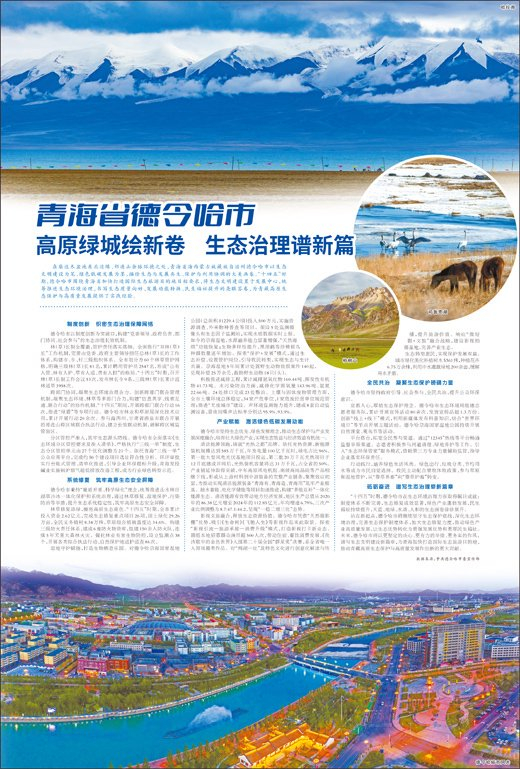
青海省德令哈市 高原绿城绘新卷 生态治理谱新篇
Ren Min Wang· 2025-12-10 01:21
Core Viewpoint - Delingha City in Qinghai Province is focusing on ecological civilization construction and green low-carbon development, aiming to balance ecological protection and economic growth during the 14th Five-Year Plan period [4][13]. Group 1: Institutional Innovation - Delingha City has established a long-term ecological governance mechanism led by the Party, with responsibilities clearly defined across various levels of government and society [5]. - The city has implemented a comprehensive "Double Forest (Grass) Chief" system, with 81 forest (grass) chiefs and 2,547 caretakers, ensuring effective management of forest and grassland resources [6]. - A cross-departmental collaborative management mechanism has been created, conducting 16 joint actions during the 14th Five-Year Plan to enhance ecological governance [6]. Group 2: Systematic Restoration - The city has invested 262 million yuan in ecological restoration projects, achieving significant improvements in ecosystem stability and biodiversity [7]. - Delingha has implemented a fire prevention system and established monitoring points for pest control, resulting in no major forest fires for five consecutive years [7]. - Wetland protection efforts have led to enhanced water conservation capabilities and increased biodiversity in the Gahai National Wetland Park [8]. Group 3: Industrial Empowerment - Delingha is promoting green industries, with a focus on clean energy, achieving a total installed capacity of 5.85 million kilowatts and generating 10 billion kilowatt-hours of electricity annually [9]. - The city has developed a complete industrial chain for clean energy, contributing to a GDP growth from 8.638 billion yuan in 2020 to 11.285 billion yuan in 2024, with an annual growth rate of 6.79% [9]. Group 4: Ecological Transformation - Urban greening efforts have included planting over 5,361 trees and 67,500 flowers, utilizing recycled water for irrigation [11]. - The city has engaged the public in ecological protection through volunteer programs and educational campaigns, enhancing community involvement in environmental governance [12]. Group 5: Future Outlook - Delingha aims to continue improving its ecological governance system, enhance ecological restoration efforts, and promote high-quality development of green industries, contributing to the establishment of an international ecological tourism destination in Qinghai [13].

草原肉库 生态奶罐 绿色草都锡林浩特市:“三驾马车”带动畜牧业提质增效
Nei Meng Gu Ri Bao· 2025-11-19 02:31
Core Insights - Xilin Gol League is leveraging its regional advantages to establish itself as a significant agricultural and livestock product production base, focusing on high-quality development in animal husbandry through the "grassland meat library," "ecological milk can," and "green grass city" initiatives [1] Group 1: Grassland Meat Library - The city is promoting a shift from quantity to quality in sheep farming, emphasizing the importance of superior breeding stock to enhance income and reduce pasture burden [2] - A breeding system has been established for the Ujumqin sheep, including a breeding center and multiple breeding farms, with an annual supply capacity of over 3,000 breeding sheep [2] - The beef cattle industry is also seeing improvements, with the establishment of two breeding farms and a focus on high-quality breeds like Simmental and Huaxi, leading to increased profitability for local farmers [3] Group 2: Ecological Milk Can - The city is transitioning from selling live animals and fresh milk to selling processed dairy products, enhancing the value chain through industrial parks and integrating processing with tourism [4] - The establishment of the Shifang Food Industrial Park and the Cheese Culture Industrial Park has led to significant investments and production capacity, with annual output reaching approximately 28,000 tons of various dairy products [4][5] - A cooperative model led by grassroots organizations is helping small dairy producers improve sales and profitability, with a focus on direct sales and e-commerce [6] Group 3: Green Grass City - The city is prioritizing ecological protection while enhancing forage supply, integrating natural grassland management with technological advancements in forage production [7] - The Maodeng Ranch has developed a 360,000-acre ecological park, significantly improving vegetation coverage and forage variety, which has led to increased production [8] - Technological innovations, such as hydroponic forage systems, are addressing challenges related to weather dependency in forage supply, creating a robust supply system for the livestock industry [9]