电气化/新能源转型

Search documents
“银色狂想曲”停不下来! 散户们掀起“抢银狂热” 2025年疯涨150%的白银仍在翱翔
智通财经网· 2026-01-21 07:51
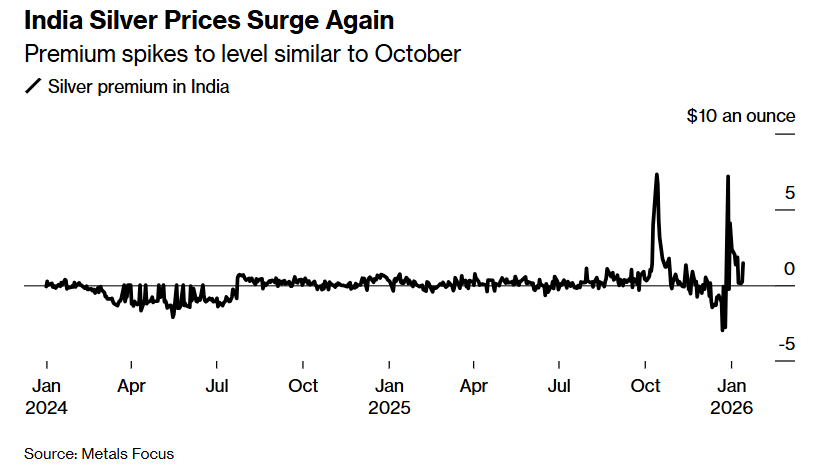
Core Viewpoint - The resurgence of geopolitical tensions and the "sell-off of American assets" has led to a significant influx of safe-haven funds into gold and silver, driving both metals to record highs since 2025 [1][3]. Group 1: Market Trends - Gold and silver prices have continued to rise, with silver futures hovering around $94.6, following a peak of $95.77 [1]. - The demand for silver has surged, with retail investors in countries like Turkey and India willing to pay high premiums for the metal, leading to shortages of silver coins and small bars [2][4]. - Citigroup has made aggressive bullish predictions for precious metals, forecasting silver prices to reach $100 per ounce and gold to potentially exceed $5,000 in the next three months [3][13]. Group 2: Demand Drivers - The primary driver for the current rise in precious metals is demand, particularly from central banks for gold and industrial expansion for silver [2]. - Industrial applications, such as data center infrastructure and innovative silver-based batteries, are significantly boosting silver demand, while supply growth struggles to keep pace [2][12]. - The World Silver Association highlights that the growth in sectors like AI data centers, electric vehicles, and renewable energy will continue to drive silver demand through 2030 [12]. Group 3: Retail Investor Behavior - Retail investors are exhibiting unprecedented demand for silver, leading to supply shortages and high premiums in various markets [4][10]. - The phenomenon of retail buying is not limited to large consumer countries; it is spreading globally, with reports of rapid sell-outs in markets like South Korea and Singapore [10][11]. - Misleading market information has also fueled retail buying, as investors react to perceived shortages and policy changes [10]. Group 4: Supply Constraints - Precious metal refiners are struggling to meet the soaring demand for small-sized silver bars and coins, leading to significant supply constraints [8][9]. - The focus of refiners on larger silver bars has exacerbated the shortage in the retail market, where demand for smaller denominations is highest [9][10]. - The supply chain has been affected by geopolitical tensions and trade policies, further complicating the availability of silver in key markets [7][11].

白银从“非对称暴利”走进“高波动决胜局” 2026年将在泡沫争议中冲刺100美元?
Zhi Tong Cai Jing· 2025-12-31 01:12
Core Viewpoint - Silver prices have experienced significant volatility, with a recent peak above $84 followed by a sharp decline, raising concerns about a potential bubble in the market. However, analysts from Societe Generale caution against solely relying on quantitative models that suggest bubble behavior, emphasizing the need for a nuanced interpretation of price movements [1][2]. Group 1: Market Analysis - The recent surge in silver prices is attributed to a combination of macroeconomic factors, including expectations of lower interest rates from the Federal Reserve, structural supply constraints, and increased industrial demand driven by trends in electrification and renewable energy [3][4]. - The LPPLS model used by Societe Generale indicates that the current market state of silver may resemble a bubble, but analysts argue that this model should be viewed as a diagnostic tool rather than a definitive predictor of market behavior [2][3]. Group 2: Industrial Demand - The World Silver Association highlights that industrial demand for silver is being driven by significant growth in sectors such as AI data centers, electric vehicles, and renewable energy, with projected compound annual growth rates of 17% for the photovoltaic industry and 13% for the electric vehicle sector [4][5]. - The association forecasts that the demand for silver in industrial applications will continue to rise, particularly as global data center IT power capacity is expected to increase dramatically by 2025, necessitating more silver for essential components [5]. Group 3: Future Projections - Analysts predict that silver could reach $100 per ounce by 2026, supported by ongoing market dynamics and investment trends, although this target is viewed as an extreme bullish scenario [6][7]. - The dual role of silver as both an industrial metal and a store of value is attracting significant investment, with experts suggesting that the long-term bullish factors for silver remain strong [6][7].
“银色狂想曲”进入高波动章节? 白银火速跳水 创84美元历史最高位后急跌超3%
Zhi Tong Cai Jing· 2025-12-29 01:13
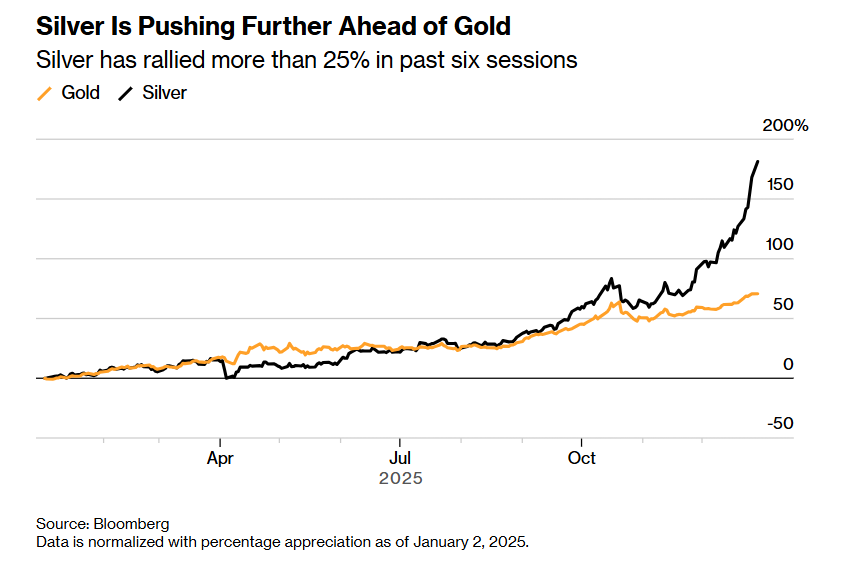
Core Viewpoint - Silver prices have surged to record highs, surpassing $80 per ounce for the first time, driven by speculative trading and supply shortages, with a notable increase of 165% year-to-date [1][4]. Group 1: Price Movements and Market Dynamics - Silver reached an all-time high of $84 per ounce before experiencing a sharp decline, highlighting the volatility driven by profit-taking among speculative investors [1]. - The recent six-day rally in silver prices has resulted in a cumulative increase of approximately 25%, marking the largest six-day gain since 1950 [1]. - The price of silver has been influenced by significant inflows of speculative funds and a supply mismatch in global commodity markets [1]. Group 2: Supply and Demand Factors - The silver market has been in a structural deficit for five consecutive years, with physical inventories rapidly depleting, leading to a supply squeeze [7]. - In 2025, global silver demand is projected to reach 1.24 billion ounces, while supply is expected to be only 1.01 billion ounces, resulting in a supply gap of 100 to 250 million ounces [7]. - The primary reason for the supply constraints is the rigid nature of global mining supply, as silver is often a byproduct of copper and zinc mining, and new mines take over a decade to develop [7]. Group 3: Investment Sentiment and Future Projections - Analysts suggest that the current surge in silver prices is driven by macroeconomic factors, including expectations of further interest rate cuts by the Federal Reserve, tight supply conditions, and strong industrial demand narratives [8]. - The World Silver Association highlights that the growth in demand for silver is supported by trends in AI data centers, electrification, and the transition to electric vehicles, with significant growth rates projected for these sectors [8][9]. - Some analysts predict that silver could reach $100 per ounce, driven by ongoing industrial demand and investment flows, with expectations of continued price increases until at least 2026 [10].