电煤长协新机制

Search documents
国泰海通|煤炭:煤价理性回落,关注全球能源格局下煤炭资产价值重估
国泰海通证券研究· 2025-12-09 15:25
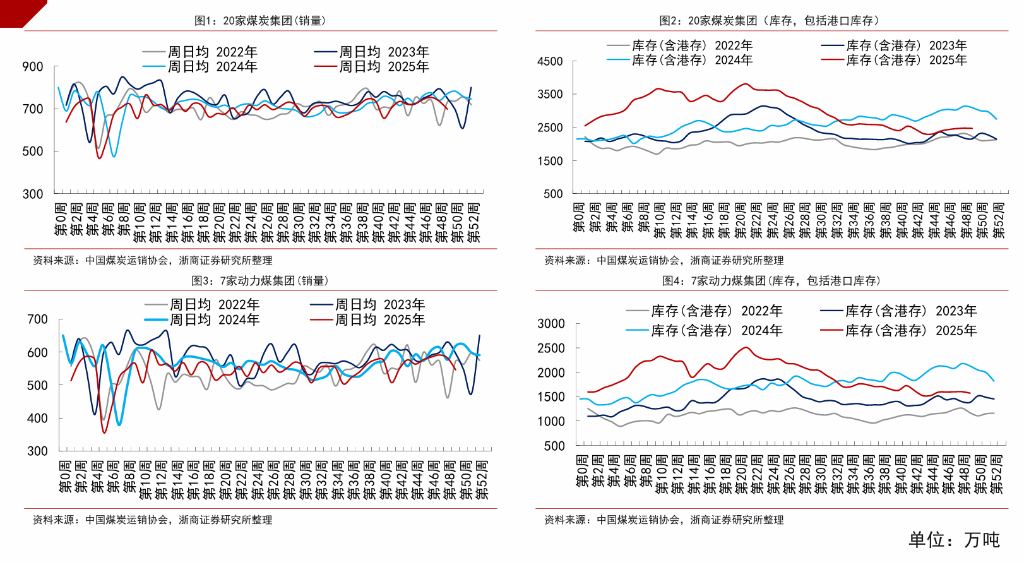
Core Viewpoint - The coal sector has confirmed its cyclical bottom in Q2 2025, with a reversal in supply-demand dynamics and sufficient release of downside risks [1] Group 1: Coal Price Trends - Domestic coal prices have transitioned from an upward trend to a rational decline since November, with the focus on whether winter demand can exceed expectations [1] - As of December 5, 2025, the price of Q5500 coal at Huanghua Port was 801 RMB/ton, down 27 RMB/ton (-3.3%) from the previous week [2] - The adjustment of long-term coal contracts for 2026 aims to enhance the upper limit while ensuring compliance rates, which is beneficial for sector valuation [1] Group 2: Supply and Demand Dynamics - Domestic supply remains stable while imports continue to decrease, with total supply expected to maintain a steady decline throughout the year [2] - The demand side shows significant improvement during the off-season, with Q3 profitability expected to rebound [2] - As of December 5, 2025, the inventory of coking coal at three ports totaled 2.9 million tons, with a utilization rate of 79.18% for coking enterprises with over 200,000 tons [3] Group 3: Global Energy Landscape - The short-term position of coal in the global energy landscape remains strong, with attention drawn to issues such as electricity shortages in the U.S. [1] - The cost of domestic Q5500 coal is 35 RMB/ton lower than that of Australian imported coal, indicating competitive pricing [3] - The price of Australian coking coal increased by 7 USD/ton (3.1%) to 222 USD/ton, highlighting fluctuations in global coal pricing [3]


双焦大跌,发生了什么?
Hua Er Jie Jian Wen· 2025-12-08 10:46
Core Viewpoint - The recent decline in coking coal and coke futures, driven by weak spot market conditions and a surge in import supply, has led to significant sell-offs in the market [1][3]. Group 1: Market Performance - On December 8, coking coal and coke futures continued their downward trend, with both coking coal contracts (2605 and 2601) and coke contract (2601) dropping over 6% [1]. - The main coking coal contract (2605) fell below the 1100 yuan mark, while the 01 contract faced pressure at the 1000 yuan support level [1]. - Since November, coking coal futures have seen a monthly decline of 17%, while coke futures have dropped by 11% [1]. Group 2: Demand and Supply Dynamics - Analysts attribute the recent price drop to sluggish seasonal demand recovery, with November's higher temperatures leading to lower-than-expected daily coal consumption at power plants [3]. - As of December 4, the average daily coal consumption across 25 provinces was 5.56 million tons, a year-on-year decrease of 3.9% [4]. - The total coal inventory at power plants reached 136.41 million tons, remaining stable year-on-year despite ongoing accumulation [4]. - The influx of imported coal has further alleviated supply pressures, contributing to the inability of spot prices to maintain high levels [3][5]. Group 3: Inventory Levels - High inventory levels at ports and production sites are key factors suppressing coal prices. As of December 5, inventory at the four northern ports reached 17.64 million tons, an increase of 1.09 million tons year-on-year [6]. - The total social inventory was 182.24 million tons as of December 4, with a week-on-week increase of 320,000 tons [6]. - The continuous accumulation of inventory, coupled with slow demand recovery, is directly causing the accelerated decline in coal prices [8]. Group 4: Future Demand Expectations - There is a divergence in market expectations regarding winter demand, with some analysts predicting that December temperatures will be close to or above normal, providing potential upward momentum for demand [9]. - The China Meteorological Administration indicates that most regions will experience temperatures near or above seasonal averages, with only specific areas expected to be colder [9]. - Analysts from Guotai Junan Securities believe that the coal sector's cyclical bottom was confirmed in the second quarter of this year, with a potential shift in supply-demand dynamics expected [9]. Group 5: Long-term Contract Mechanism - The introduction of a new long-term coal contract mechanism for 2026 is expected to provide policy support for the market [10]. - The National Development and Reform Commission has outlined new requirements for long-term coal contracts, allowing for more market-oriented pricing adjustments [10]. - This adjustment is anticipated to enhance the industry's performance and improve valuation prospects, especially as coal consumption is expected to peak during the "14th Five-Year Plan" period [10].