白银出口管控

Search documents
白银“稀土级管控”,扼住全球高科技产业“咽喉”!
Sou Hu Cai Jing· 2026-01-07 15:07
Core Viewpoint - China has implemented new export controls on silver, elevating it to the level of strategic materials like rare earths, which will significantly impact the global silver market and prices [1][4]. Group 1: Export Control Measures - China is now requiring a license for silver exports, with stringent criteria including a minimum annual production of 80 tons for companies and a thorough background check on buyers and their intended use [1][4]. - This move mirrors the 2010 rare earth export licensing system, which increased approval processes and quotas, leading to a significant price surge [3]. Group 2: Global Market Impact - China accounts for 23.4% of global silver trade, exporting approximately one ton of silver for every four tons traded worldwide [4]. - The country possesses 60% to 70% of the global silver refining capacity, making it a critical player in the silver supply chain [4]. - Last year, silver prices surged by 146%, outpacing gold's 60% increase, driven by industrial demand [4]. Group 3: Industrial Demand for Silver - Silver is essential in various industries, including solar energy, electric vehicles, and AI technologies, with significant quantities required for each application [6]. - For instance, a 100 MW solar project requires approximately 2.5 to 3 tons of silver, and the projected production of 30 million electric vehicles in China by 2025 will demand between 1,500 to 3,000 tons of silver annually [6]. Group 4: Strategic Resource Management - The global silver market has been in a supply deficit for five consecutive years, with demand exceeding supply by at least 3,660 tons last year [7]. - Countries like the U.S. and Russia are recognizing silver's strategic importance, with the U.S. including it in its critical minerals list and Russia adding it to its foreign exchange reserves [9][10]. - China's export control on refined silver is part of a broader strategy to secure its technological advancements and enhance its position in global resource management [10].

只有中国敢这么干!把白银当稀土管控,新政一出,西方只能被动接招
Sou Hu Cai Jing· 2025-12-12 11:43
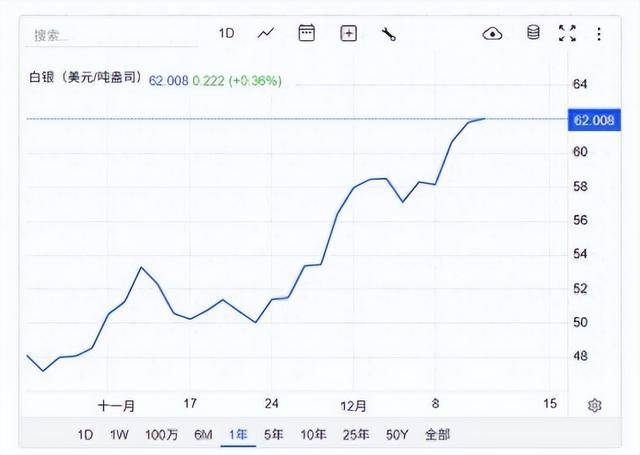
Core Viewpoint - The global silver market is experiencing a significant surge, with spot silver prices surpassing $60 per ounce, driven by China's upcoming export control policy set to take effect in January 2026 [1][19]. Group 1: Export Control Policy - China's Ministry of Commerce announced a new export control policy for silver, requiring state-owned trading companies to declare export qualifications, which includes having a three-year export record or meeting specific production standards [3]. - The new policy shifts from a dual system of quotas and licenses to a stricter export license management, requiring companies to submit usage explanations and downstream customer qualifications for export [5]. - This policy aims to limit disordered exports and low-value-added products, aligning with the management model used for rare earths [5]. Group 2: Industrial Demand for Silver - Silver's industrial demand has surpassed 60%, particularly in the renewable energy and high-tech sectors, making it an essential material [5]. - The photovoltaic industry, where China produces over 80% of global solar modules, significantly drives silver demand, with the domestic installation plan for 2025 alone requiring a substantial amount of silver [7]. - Other sectors such as electronics, medical, and chemical industries also rely heavily on silver due to its superior conductivity and stability, indicating that a supply shortage could halt critical industries [7]. Group 3: Strategic Resource Management - China's export control is primarily aimed at safeguarding domestic development needs and responding to global resource dynamics, as the country faces a growing demand for silver that outpaces its production [9]. - The previous export practices primarily involved low-value primary products, and the new policy encourages domestic companies to focus on high-value-added products, enhancing China's position in the global supply chain [11]. - Western countries, particularly the EU, the US, and Japan, heavily depend on Chinese silver exports, with the EU's photovoltaic companies sourcing over 70% of their silver from China [11]. Group 4: Market Reactions and Price Dynamics - Following the initial signs of the new policy, silver exports to the EU and the US decreased, leading to production slowdowns in German photovoltaic companies and increased costs for US semiconductor firms [13]. - Alternatives for sourcing silver from countries like Mexico and Peru face challenges, including higher production costs and unstable supply, making it difficult for Western countries to find substitutes [13]. - The expectation of continued interest rate cuts by the Federal Reserve and the overall unstable global economic situation have contributed to rising silver prices, as investors seek safe-haven assets [17]. Group 5: Long-term Implications - China's control over silver exports mirrors its previous strategies with rare earths, aiming to gain dominance over strategic resources and break the pricing monopoly held by Western markets [19]. - By regulating global supply through export controls and enhancing the influence of the Shanghai silver futures market, China is working to ensure that silver prices reflect actual supply and demand, thereby increasing its economic leverage [19].