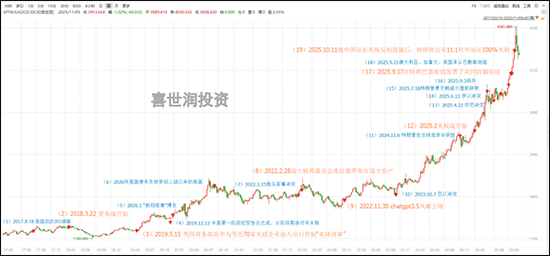
百年大变局

Search documents
对话财通基金唐家伟:今年经济复苏预期较强,铜等有色金属具备中长期韧性
Sou Hu Cai Jing· 2026-02-04 09:22
Core Viewpoint - The A-share market is expected to experience a significant recovery in 2026, with a focus on cyclical sectors driven by strong economic recovery expectations [1] Group 1: Market Outlook - The total market capitalization of A-shares is projected to reach 100 trillion yuan by 2025, with the Shanghai Composite Index surpassing 4,000 points, marking a nearly ten-year high [1] - The cyclical sector is highlighted as a key area for investment opportunities, with a three-phase market cycle: recovery expectations, performance improvement, and market peak [1][3] - Current market conditions indicate that the cyclical stocks are in the first phase, with non-ferrous metals likely entering the second phase [1][6] Group 2: Sector Analysis - Non-ferrous metals, particularly copper and aluminum, are expected to show strong performance due to supply constraints and increasing demand from sectors like AI and infrastructure [5][6] - The supply side for copper is facing a rigid shortage due to insufficient capital expenditure and declining ore grades, while demand is expected to rise significantly [6] - Aluminum production is also constrained by domestic capacity limits, leading to a tight supply situation [6] Group 3: Investment Logic - The core investment logic for 2026 revolves around decreasing supply and increasing marginal demand, emphasizing the importance of supply-demand balance [9] - The cyclical market is characterized by a transition from passive to active inventory adjustments, with the current phase being a potential turning point for price increases [5][6] - The performance of precious metals like gold and silver is driven by financial attributes and global uncertainties, making them a safe haven in the current geopolitical climate [8][9]
喜世润投资关歆:黄金的定价逻辑已重构,百年变局是本轮黄金牛市的根本原因
Sou Hu Cai Jing· 2025-11-05 10:12
Core Viewpoint - The ongoing "century-long changes" in the global political and economic landscape are the fundamental drivers behind the sustained rise in gold prices, with significant historical parallels drawn to the 1970s gold bull market [6][29]. Group 1: Factors Influencing Gold Prices - The shift in global asset allocation towards "safety first" strategies by central banks, particularly in non-Western countries, has increased the focus on gold as a valuable asset [2][11]. - Historical events and geopolitical changes have historically driven gold prices more than economic and financial variables alone [2][14]. - The current geopolitical tensions, including the Russia-Ukraine conflict and U.S.-China trade relations, have created an environment conducive to rising gold prices [9][11]. Group 2: Market Mechanisms and Trends - Gold prices may have entered a new "reflexive" cycle, where increased investment in gold by institutions and individuals leads to lower volatility and a gradual upward trend in prices [3][33]. - The historical inverse relationship between U.S. stock markets and gold prices suggests that a significant correction in U.S. equities could trigger a new surge in gold prices due to increased demand for safe-haven assets [34][36]. - The unique physical and chemical properties of gold, along with its limited annual production compared to total stock, reinforce its scarcity and monetary attributes [5][11]. Group 3: Historical Context and Comparisons - The gold bull market of the 21st century is seen as a result of the re-emergence of a multipolar world, similar to the dynamics observed in the 1970s [20][27]. - Key historical events, such as the introduction of the euro and China's accession to the WTO, have significantly influenced global economic structures and, consequently, gold demand [21][22]. - The current trajectory of gold prices mirrors the patterns observed in the 1970s, suggesting potential for substantial future increases if historical trends continue [29][39]. Group 4: Future Outlook - The ongoing "century-long changes" are expected to continue influencing gold prices, with projections suggesting that gold could rise above $8,000 per ounce if current trends persist [39]. - The digitalization of gold and the rise of gold-backed cryptocurrencies may lower investment barriers and support gold prices from the demand side [33][39]. - The geopolitical landscape, particularly the U.S.-China rivalry, is anticipated to be a critical factor in shaping the future of gold prices [38][39].