盈利增长扩散

Search documents
别再盯着科技股!美股轮动持续扩散 小盘股与周期板块领涨
Zhi Tong Cai Jing· 2026-01-27 15:32
Group 1 - The core narrative on Wall Street has shifted from a focus on large-cap tech stocks to a broader market rally, with sectors like materials, healthcare, and consumer discretionary driving gains [2][3] - The equal-weighted S&P 500 index has risen approximately 6% since early November, while the traditional market-cap weighted version has only increased by 1.6%, indicating a significant rotation in market leadership [2] - Small-cap stocks, represented by the Russell 2000 index, have outperformed, gaining over 7% during the same period, reflecting a growing investor interest in companies more closely tied to the economic cycle [2][3] Group 2 - Investors are increasingly optimistic about the U.S. economy's potential for acceleration, leading to a shift in capital flows towards cyclical sectors [2][3] - The anticipated earnings growth for Russell 2000 constituents is projected at 13.5% for 2025, slightly above the S&P 500's expected growth of 12.8%, suggesting a revaluation of small-cap growth potential [3] - There is a notable increase in capital inflows into cyclical sectors, with record inflows of $6.5 billion into materials and significant investments in industrials and financials, while tech funds have seen outflows [4]
华尔街展望2026年美股前景:标普500目标位最高看至8000点 AI与政策成关键变量
Zhi Tong Cai Jing· 2025-11-27 08:23
Group 1 - Major Wall Street banks have released their outlooks for the S&P 500 index by the end of 2026, with a general consensus that the index will continue to rise due to the ongoing AI investment wave, a shift towards loose monetary policy, and expanding profit growth [1] - HSBC sets a target of 7500 points for the S&P 500 by the end of 2026, expecting a 12% growth in earnings per share for index constituents, driven by macroeconomic stability and the AI investment boom [2][3] - Societe Generale predicts the S&P 500 could reach 7300 points, with potential volatility higher than usual, influenced by the Federal Reserve's policy path [4] Group 2 - Barclays raises its target for the S&P 500 to 7400 points, citing strong performance from large tech stocks and improving monetary and fiscal conditions [5] - UBS forecasts a target of 7500 points for the S&P 500, driven by strong corporate earnings growth, particularly in the tech sector [7] - Morgan Stanley is optimistic about the S&P 500 reaching 7800 points, viewing recent market weakness as a buying opportunity [9] Group 3 - Deutsche Bank presents the most optimistic outlook, projecting the S&P 500 could hit 8000 points by the end of 2026, driven by widespread profit growth beyond just the major tech companies [10] - The reports highlight a K-shaped economic recovery, where the disparity between high-income and low-income consumers is expected to widen, impacting consumer behavior and confidence [3][8]
全球降息周期或已见顶!流动性退潮,股市还能继续涨吗?
Jin Shi Shu Ju· 2025-11-07 09:00
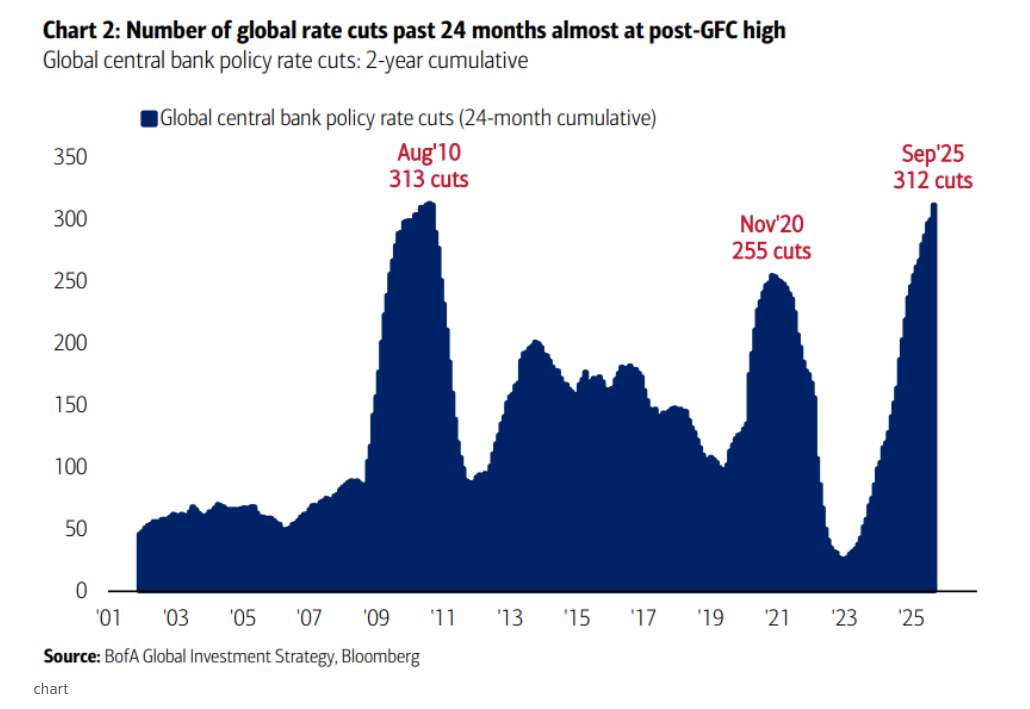
Group 1 - The global interest rate cut cycle may have peaked, raising questions about when or if the currently robust market will begin to feel pressure [1][4] - Over the past 25 months, global central banks have matched the number of interest rate cuts seen during the 2007-09 financial crisis, indicating a significant scale of historical rate hikes implemented to combat inflation in 2022-23 [1][4] - The end of ultra-loose monetary policy suggests that the financial environment will no longer be as accommodating, although major central banks like the Federal Reserve are still expected to cut rates further [4] Group 2 - Analysts from Societe Generale suggest that the peak of the easing cycle could signal a bullish outlook for Wall Street, indicating that profit growth will accelerate and spread across sectors [5] - The peak of the easing cycle traditionally means that the market is confident in accelerating profit growth, as evidenced by strong market performance following previous peaks in August 2020 and September 2009 [5] - Current market valuations are notably different from those periods, as the stock market is at unprecedented highs, raising concerns about potential bubbles [5] Group 3 - Almost all major asset classes have risen this year, driven by various factors, with the AI boom providing a significant boost to Wall Street [6] - Standard Chartered highlights that the common force behind the rise in asset prices is liquidity, which has been abundant [6][7] - The concept of liquidity is influenced by factors beyond monetary policy, including bank reserves, private sector credit availability, and overall risk appetite [7]