盈利驱动行情

Search documents
2026年二季度A股投资策略:盈利驱动行情有望徐徐展开
Huaan Securities· 2026-03-16 05:52
Group 1 - The core conclusion indicates significant price changes and improved profit expectations, emphasizing the importance of the pan-AI and price increase chains [2][4] - The report predicts a gradual recovery in economic growth, with GDP growth expected to reach 4.8% in Q2 2026, driven by effective demand from major project launches and improved PPI [6][10] - The report highlights that the PPI is likely to turn positive in Q2 2026, which could enhance overall market confidence [15][17] Group 2 - The report identifies two main investment themes: the pan-AI industry chain, which is expected to see performance improvements, and the price increase chain [6][8] - The analysis suggests that the geopolitical conflicts, particularly the US-Iran situation, may have a long-term impact but could also see a phase of easing, which would reduce market shocks [6][52] - The report notes that the machinery equipment sector, particularly engineering machinery, is expected to benefit from overseas export demand [6][34] Group 3 - The report anticipates a gradual recovery in consumer spending, with retail sales growth projected at 3.8% in Q1 and 3.3% in Q2 2026, despite a high base effect from the previous year [35][36] - It mentions that the real cost of housing loans has been rising, which may dampen the real estate market, with a projected decline in real estate investment of around 9% in the first half of 2026 [45][46] - The report indicates that the export sector remains robust, with a year-on-year growth rate of 21.8% in January-February 2026, although it expects a decline in March due to seasonal factors [34][27]
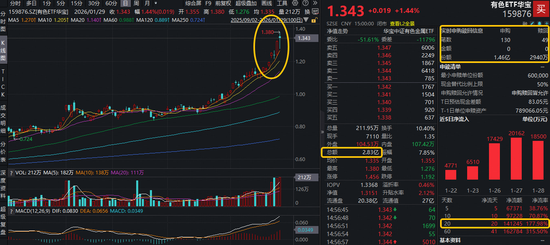
金+铜+稀土携手狂飙,铜陵有色等7股涨停!有色ETF华宝(159876)深V劲涨1.4%,近20日狂揽14亿元!
Xin Lang Cai Jing· 2026-01-29 12:29
Core Viewpoint - The non-ferrous metal sector is experiencing a strong rally, driven by macroeconomic factors, industrial demand, and positive earnings forecasts for listed companies in the sector [3][11]. Group 1: Market Performance - The non-ferrous metal sector saw a surge with multiple stocks hitting the daily limit, including Silver and Hunan Gold [1][9]. - The Huabao Non-Ferrous Metal ETF (159876) reached a historical high, with a peak increase of over 4.1% and a final gain of 1.44%, indicating market resilience [1][9]. - The ETF recorded a trading volume of 283 million yuan, with a net subscription of 117 million units on the day, reflecting strong investor interest [1][9]. Group 2: Macro Factors - The Federal Reserve's pause on interest rate cuts, coupled with expectations for future easing, has enhanced the appeal of precious metals as a hedge against inflation [3][11]. - Analysts from CITIC Securities suggest that as long as the Fed remains in a rate-cutting cycle, there will be upward momentum for non-ferrous metal prices [3][11]. Group 3: Industrial Demand - Significant price increases were noted in key metals: spot gold reached 5,600 USD/ounce, LME copper surged over 7%, and rare earth prices rose, with core products like neodymium and praseodymium exceeding 120,000 yuan/ton [3][11]. - The overall performance of the non-ferrous metal sector is supported by strong industrial demand and price increases across various metals [3][11]. Group 4: Earnings Outlook - As of January 28, 24 out of 60 listed companies covered by the non-ferrous ETF have released earnings forecasts for 2025, with 21 companies expected to be profitable, indicating a positive earnings outlook [3][11]. - The majority of companies forecasted a year-on-year increase in net profits, suggesting a solid fundamental backing for the recent price increases in the sector [3][11]. Group 5: Future Prospects - Southwest Securities anticipates a resource supercycle in the non-ferrous metal industry, with prices for gold, copper, aluminum, tin, and rare earths expected to rise systematically [3][11]. - Huafu Securities believes that the non-ferrous metal sector will significantly benefit from profit-driven trends, supported by economic recovery and policies aimed at expanding domestic demand [3][11].