
涨价链

Search documents
2026年二季度A股投资策略:盈利驱动行情有望徐徐展开
Huaan Securities· 2026-03-16 05:52
Group 1 - The core conclusion indicates significant price changes and improved profit expectations, emphasizing the importance of the pan-AI and price increase chains [2][4] - The report predicts a gradual recovery in economic growth, with GDP growth expected to reach 4.8% in Q2 2026, driven by effective demand from major project launches and improved PPI [6][10] - The report highlights that the PPI is likely to turn positive in Q2 2026, which could enhance overall market confidence [15][17] Group 2 - The report identifies two main investment themes: the pan-AI industry chain, which is expected to see performance improvements, and the price increase chain [6][8] - The analysis suggests that the geopolitical conflicts, particularly the US-Iran situation, may have a long-term impact but could also see a phase of easing, which would reduce market shocks [6][52] - The report notes that the machinery equipment sector, particularly engineering machinery, is expected to benefit from overseas export demand [6][34] Group 3 - The report anticipates a gradual recovery in consumer spending, with retail sales growth projected at 3.8% in Q1 and 3.3% in Q2 2026, despite a high base effect from the previous year [35][36] - It mentions that the real cost of housing loans has been rising, which may dampen the real estate market, with a projected decline in real estate investment of around 9% in the first half of 2026 [45][46] - The report indicates that the export sector remains robust, with a year-on-year growth rate of 21.8% in January-February 2026, although it expects a decline in March due to seasonal factors [34][27]
国海证券晨会纪要-20260313
Guohai Securities· 2026-03-13 03:38
Group 1 - The report addresses key issues such as macroeconomic price transmission, internal pricing differentiation of bulk commodities, and micro-level industry restructuring and regional arbitrage [3][4] - The strategy emphasizes "upstream elasticity and downstream defense," recommending a focus on upstream and midstream sectors, particularly in smelting and black metal sectors, which show strong profit retention characteristics [4] - The report highlights that the pricing dynamics in chemicals and agriculture are more favorable compared to metals, driven by supply chain constraints and rigid demand from biofuel policies [4][5] Group 2 - The report identifies three derivative micro-logics: resource recycling, physical substitution, and pricing arbitrage, emphasizing the growing importance of recycled metals in global supply chains [5] - It notes the irreversible shift in manufacturing towards using aluminum instead of copper due to high copper-aluminum price ratios, and the long-term arbitrage opportunities created by the mismatch in natural gas supply between the US and Europe [5]
未知机构:国海策略赵阳行业拥挤度更新20260303一涨价链情绪仍在-20260304
未知机构· 2026-03-04 02:35
Summary of Industry Update on Sentiment and Price Trends Industry Focus - **Non-ferrous Metals**: Current sentiment has risen to 9.2%, with a focus on the emotional peak range of 10%-11% [1] - **Petrochemicals**: Sentiment shows a significant recovery, with notable peaks during geopolitical conflicts since 2022, previously around 1.8%. The current moving average (MA5) is at 1.7%, suggesting close monitoring of sentiment levels this week [1] - **Chemicals**: Sentiment remains high, around the 90th percentile [1] Core Insights and Arguments - The increase in sentiment across these sectors indicates a potential for price increases, warranting attention to emotional peaks [1] - Historical data suggests that geopolitical events have a substantial impact on sentiment in the petrochemical sector, highlighting the need for vigilance in monitoring sentiment fluctuations [1] Additional Important Points - The report emphasizes the importance of daily monitoring of sentiment positions, particularly in the petrochemical sector, to anticipate market movements [1]
近期涨价链行情观点及3-4月布局思路-20260301
Guohai Securities· 2026-03-01 12:05
Group 1 - The report highlights that the recent price increase trend in the A-share market is primarily driven by sectors related to price hikes, such as fiberglass, rare earths, and copper-clad laminates, with significant price increases observed in February 2026 [6][11] - The report suggests that the sustainability of the price increase trend requires validation from the demand side, noting that external demand appears to have more elasticity compared to internal demand [14][17] - The report anticipates a shift from "theme speculation" to "performance pricing" in the A-share market from late March to April, as the market enters a period of intensive earnings verification [6][20] Group 2 - The report identifies three key investment strategies for March: focusing on large-cap growth sectors that have lagged, such as energy storage and battery materials, and monitoring the performance of export-related stocks during the earnings reporting period [28][30] - The report emphasizes that historically, large-cap value sectors, including financials, white goods, and transportation, tend to perform well in the period following the National People's Congress [40][41] - The report provides statistical data indicating that large-cap stocks have a higher probability of outperforming small-cap stocks during the earnings reporting period, with probabilities ranging from 55% to 70% [20][21]
开市就给碗面
Datayes· 2026-02-24 11:49
Core Viewpoint - The article discusses the recent performance of the stock market, highlighting both positive and negative aspects, including the impact of external factors such as geopolitical tensions and macroeconomic reports on market sentiment [10][12]. Group 1: Market Performance - The three major indices opened positively in the Year of the Horse, with the Shanghai Composite Index rising by 0.87%, the Shenzhen Component Index increasing by 1.36%, and the ChiNext Index up by 0.99% on February 24 [21]. - The total trading volume across the three markets reached 22,184.41 billion yuan, an increase of 2,193.25 billion yuan compared to the previous day, with over 4,000 stocks rising [21]. - Oil service stocks led the market, with companies like Zhun Oil and Shandong Molong hitting the daily limit [21]. Group 2: Sector Analysis - The oil service sector saw significant gains due to rising oil prices, with Brent crude oil surpassing $72 per barrel, the highest since July of the previous year [21]. - The gold sector also performed well, with stocks like Xiaocheng Technology rising over 15% and spot gold reaching $5,200 [22]. - The glass fiber sector remained active, with manufacturers anticipating a second round of price increases of 10%-15% [22]. - The phosphoric chemical sector strengthened significantly, with leading stocks like Chengxing Co. and Chuanfa Longmang hitting the daily limit, driven by concerns over global supply chain restructuring [22]. Group 3: Investment Opportunities - The article highlights potential investment opportunities in sectors experiencing price increases, such as electronic materials and military industry stocks, with specific companies mentioned as beneficiaries [14][15]. - The semiconductor packaging industry is also noted for its growth potential, particularly with the recent IPO of Shenghe Jingwei Semiconductor, which focuses on advanced packaging services [28]. - The article emphasizes the importance of monitoring macroeconomic reports and geopolitical developments, as they can significantly influence market trends and investment strategies [10][12].


三条景气主线,量化数据看资金布局转向
Sou Hu Cai Jing· 2026-02-16 13:43
Core Insights - The A-share ETF market is undergoing a transformation as traditional broad-based ETFs shrink while sectors like chemicals, communications, and non-ferrous metals see significant inflows, driven by company earnings forecasts highlighting three main themes: AI, price increases, and overseas expansion [1][3] Group 1: Institutional Trading Behavior - The perception that stocks heavily held by institutions are guaranteed winners is misleading, as demonstrated by a stock that saw a 20% decline despite being favored by 31 funds, while the Shanghai Composite Index rose by 10% during the same period [3][6] - The real issue lies not in whether institutions are involved, but in their trading activity; stocks with short-lived institutional inventory indicate lack of sustained trading, leading to price declines [6][11] - Continuous institutional activity is crucial for market momentum; a stock that rose 30% in Q2 2025 and an additional 40% in July showed no signs of correction, highlighting the importance of active trading over mere price history [6][9] Group 2: Misinterpretation of Institutional Actions - Stocks that experience institutional selling can still rise if new institutions are actively buying, indicating a transition rather than a negative outlook on the stock's value [11][13] - Many investors misinterpret institutional selling as a bearish signal, leading to panic selling, while the underlying data may reveal ongoing active trading by new institutions [13][14] - The reliance on traditional metrics like "increased or decreased holdings" without understanding the actual trading dynamics can lead to poor investment decisions [14][15] Group 3: Data-Driven Investment Strategy - The use of quantitative data can enhance investment understanding, moving away from subjective speculation and towards a clearer view of actual trading behaviors [14][15] - The current market environment requires a shift from outdated strategies of holding stocks in anticipation of price increases to a more analytical approach that focuses on institutional trading activity [15]
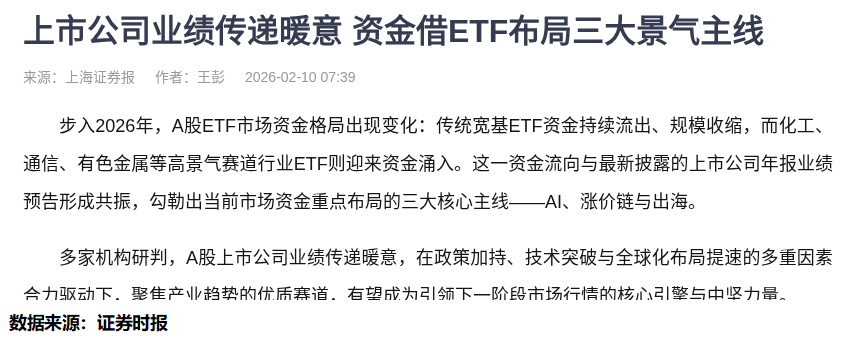
资金借道ETF参与热门板块
Zhong Guo Zheng Quan Bao· 2026-02-11 20:23
Group 1 - The resource sector has strengthened again, with multiple rare metal-themed ETFs rising over 3%, and mining, non-ferrous, gold, rare earth, and chemical ETFs generally increasing over 2% [1] - After significant gains, the film, media, and online consumption-themed ETFs experienced a collective pullback, with the film ETF (159855) dropping nearly 6% [1] - AI application-related sectors saw a surge, with over 1.3 billion yuan net inflow into ETFs tracking the film and media indices on February 10 [1] Group 2 - Huatai Fund suggests gradually shifting focus to post-holiday market trends, emphasizing three main lines: AI hardware driven by overseas influences, high-end manufacturing in new energy and innovative drugs, and domestic price increase chains in chemicals, building materials, and steel [2] - Fuguo Fund recommends focusing on sectors with high elasticity and growth potential, such as electronics, computers, and communications, which are sensitive to liquidity improvements and rising risk appetite [2]
PPI上行验证,继续重视涨价链
Ge Long Hui· 2026-02-11 14:09
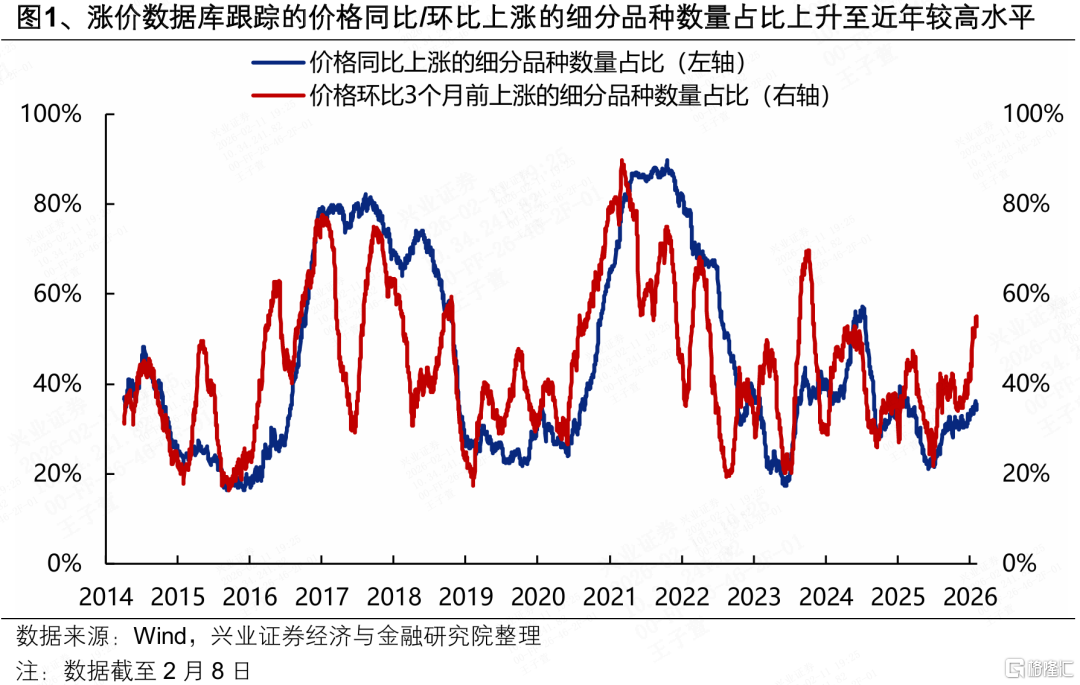
Core Viewpoint - The recovery of prices is identified as the most critical logic supporting corporate profit improvement in 2026, which may also influence market styles [1]. Price Trends and Data Analysis - The first inflation data of the year validates the momentum of price improvement, with the Producer Price Index (PPI) reaching a year-on-year high not seen since August 2024 and a month-on-month high since October 2023 [1]. - The proportion of price-increasing subcategories in the comprehensive price database has risen to a relatively high level, indicating a strong correlation with the month-on-month PPI trends [1]. - Recent price increases are characterized by a broader range and richer clues, driven by international commodity price transmission, favorable policies, and trends in the technology industry [4]. Sector-Specific Insights - The sectors with significant month-on-month PPI increases in January include non-ferrous metals, non-metallic mineral products (such as building materials), black metals, technology manufacturing, chemical fibers, and agricultural processing [4]. - The price increases in these sectors correspond with the high-frequency tracked price subcategories, indicating a robust link between input inflation and domestic price recovery [4]. Price Increase Clues - The proportion of subcategories with price increases over the past three months is at its second-highest level since 2016, only surpassed by the supply-side reform period in 2017 and the significant inflation period in 2021 [4]. - A detailed table shows various subcategories with significant price increases in January, such as oxygen pressure (62.5%), lithium concentrate (52.3%), and DRAM index (35.7%), indicating strong upward price trends across multiple sectors [6][7]. Future Outlook - The post-holiday period is seen as a critical window for validating price increases, with expectations for further price clues to emerge as the spring construction season begins and policies are implemented after the March meetings [9]. - Historical data suggests that the first quarter is typically a key period for PPI acceleration during inflation cycles, indicating a potential for sustained price increases [9]. Sector Performance Expectations - The relative performance of sectors such as TMT (Technology, Media, and Telecommunications), advanced manufacturing, and resource & infrastructure chains is expected to be strong post-Spring Festival, with higher win rates anticipated [10]. - A statistical analysis shows that industries with a positive correlation to PPI include chemicals, steel, building materials, transportation, petrochemicals, non-ferrous metals, and coal, among others [14].
每日市场观察-20260211
Caida Securities· 2026-02-11 02:47
Market Overview - On February 10, the Shanghai Composite Index rose by 0.13%, while the Shenzhen Component increased by 0.02%, and the ChiNext Index fell by 0.37%[3] - The total trading volume on February 10 was 2.12 trillion yuan, a decrease of approximately 150 billion yuan compared to the previous trading day[1] Sector Performance - The media, home appliance, and coal sectors saw significant gains, while real estate, food and beverage, and agriculture sectors experienced declines[1] - Major inflows of capital were observed in the film and television, IT services, and publishing sectors, while outflows were noted in photovoltaic equipment, military electronics, and batteries[3] Market Sentiment - Market strength weakened compared to Monday, reflected in reduced gains and trading volume[1] - The rise in media and entertainment stocks is attributed to the Seedance 2.0 event and the pre-Spring Festival timing, indicating a short-term speculative nature[1] Investment Strategy - Given the market's recent adjustments, a shift away from short-term thinking is advised, focusing on opportunities post-holiday in sectors like technology, non-ferrous metals, and chemicals[1] - Over 60% of private equity firms prefer to hold significant positions during the holiday, with 70% optimistic about post-holiday market performance[12]
华富基金戴弘毅:重视股债平衡与对冲
Zhong Guo Zheng Quan Bao· 2026-02-10 20:22
Core Viewpoint - The bond market has begun to stabilize in early 2026, while the equity market shows increased volatility, presenting challenges for "fixed income +" fund managers [1] Group 1: Equity Market Insights - Key sectors with significant potential include price increase chains, commercial aerospace, artificial intelligence (AI), and dividend assets [1] - The spring season is typically a period with less market resistance, making it a favorable time for emotional market releases [1] - The recent adjustment in popular sectors indicates a shift in market dynamics, with a focus on sectors like price increase chains and commercial aerospace [2] Group 2: Convertible Bonds Analysis - Current valuations of convertible bonds are relatively high, necessitating a strategic adjustment in exposure [1] - The convertible bond market is experiencing increased demand despite a smaller market size, leading to potential valuation spikes [2] - The recent surge in high-priced convertible bonds indicates a speculative trend, with smaller market cap bonds seeing rapid valuation increases [2] Group 3: Bond Market Dynamics - The bond market has shown optimistic performance in early 2026, with short-duration bonds stabilizing while long-duration bonds have weakened [3] - The decline in long-duration bonds is attributed to reduced demand from traditional investors like insurance funds, which are shifting their focus [3] - The widening yield spread in long-duration bonds suggests potential for upward movement, presenting a significant investment opportunity [3] Group 4: New Fund Launch - A new bond fund managed by Dai Hongyi and He Jianan is set to launch on February 24, featuring a localized all-weather strategy tailored to the domestic market [4] - The fund will leverage Dai Hongyi's expertise in asset allocation and various investment directions, while He Jianan will focus on credit bond configurations and duration management [4] - The fund's flexible approach to convertible bonds and investment strategies aims to enhance equity investment efficiency [4]