
研发经费投入

Search documents
我国经济总量首次突破140万亿元 经济底盘更实抗风险能力更强
Zhong Guo Qing Nian Bao· 2026-01-20 00:57
Economic Overview - In 2025, China's GDP reached 140,187.9 billion yuan, marking a 5% increase from the previous year, showcasing a stable and resilient economic growth trajectory [1][2] - The "14th Five-Year Plan" period saw China's economy achieve significant milestones, with GDP surpassing 110 trillion, 120 trillion, 130 trillion, and finally 140 trillion yuan [1] Economic Stability and Growth - The year 2025 is characterized by stability in economic metrics such as total GDP, employment, and foreign trade, with a notable increase in goods trade and foreign exchange reserves exceeding 3.3 trillion USD [2][3] - High-tech manufacturing's value added accounted for 17.1% of industrial output, and final consumption contributed over 50% to economic growth, indicating a shift towards a more optimized economic structure [2] Trade and Innovation - China's exports of high-tech products grew by 13.2% in 2025, with total goods imports and exports increasing by 3.8%, and exports alone rising by 6.1% [3] - Research and development expenditure reached 2.8% of GDP, surpassing the OECD average for the first time, and China's innovation index entered the global top ten [3] Social Welfare and Employment - The average disposable income per capita for residents was 43,377 yuan, reflecting a 5% real growth, with rural incomes growing even faster at 6% [5] - The urban unemployment rate remained stable at an average of 5.2%, with the total number of migrant workers reaching 30.115 million, an increase of 0.5% from the previous year [4][5] Urbanization and Education - By the end of 2025, the urbanization rate in China reached 67.89%, with the average education level for the population aged 16-59 increasing to 11.3 years [6] Future Outlook - Despite external challenges, the foundation for China's economic growth remains strong, with expectations for continued stability and opportunities in 2026 [6][7]
近期生产、价格、预期等都出现积极变化!国家统计局发声
Zhong Guo Zheng Quan Bao· 2026-01-19 04:34
Economic Overview - In 2025, China's GDP reached a new milestone of 140 trillion yuan, growing by 5.0% compared to the previous year, with a stable urban unemployment rate averaging 5.2% [1] - The economic performance in 2025 demonstrated strong resilience and vitality, laying a solid foundation for growth in 2026 [2] Economic Indicators - Positive changes were observed in production, prices, and expectations, with industrial output and service production indices accelerating in December 2025 [2] - The Consumer Price Index (CPI) rose by 0.8%, the highest increase since March 2023, while the Producer Price Index (PPI) saw a narrowing of its year-on-year decline [2] - Manufacturing PMI and non-manufacturing business activity index returned to expansion territory [2] Investment and R&D - R&D expenditure intensity reached 2.8%, surpassing the OECD average for the first time, with high-tech manufacturing value added accounting for 17.1% of total industrial value added [3] - The contribution rates of final consumption expenditure, gross capital formation, and net exports to economic growth were 52.0%, 15.3%, and 32.7% respectively in 2025 [3] Consumer Trends - Resident consumption is shifting from a focus on goods to a balanced emphasis on both goods and services, with service retail sales growing by 5.5%, outpacing goods retail sales [4] - Service consumption accounted for 46.1% of per capita consumption expenditure, indicating a significant shift in consumer behavior [4] - The tourism, transportation, and cultural sectors experienced double-digit growth, with domestic box office revenues increasing by over 20% [4] Future Outlook - Despite facing challenges, there are positive factors supporting continued consumption growth, including the construction of a unified national market and advancements in technology [4]
研发经费总量稳定增长 基础研究投入再获突破
Sou Hu Cai Jing· 2025-09-30 07:54
Core Insights - In 2024, China's total R&D expenditure is projected to exceed 3.6 trillion yuan, reaching 36,326.8 billion yuan, representing an 8.9% increase from the previous year, indicating a stable growth trend [1] - China's R&D expenditure intensity (R&D expenditure as a percentage of GDP) is expected to be 2.69%, an increase of 0.11 percentage points from the previous year, maintaining a rapid upward trend [1] R&D Expenditure Breakdown - In 2024, the breakdown of R&D expenditure includes 2500.9 billion yuan for basic research, 4305.5 billion yuan for applied research, and 29,520.4 billion yuan for experimental development, with respective growth rates of 10.7%, 17.6%, and 7.6% [2] - Basic research funding has reached a historical high, accounting for 6.88% of total R&D expenditure, second only to the United States [2] Contribution by Sector - Enterprises account for over 75% of total R&D funding, contributing 77.1% to the overall growth, making them the primary driver of R&D expenditure in China [3] - R&D funding in high-tech manufacturing and equipment manufacturing sectors grew by 10.2% and 10.5%, respectively, outpacing the overall growth rate of large-scale enterprises [3] Fiscal Support and Regional Development - National fiscal science and technology expenditure for 2024 is set at 12,629.2 billion yuan, a 5.3% increase from the previous year, focusing on basic research and scientific research facilities [4] - R&D expenditure in eastern, central, western, and northeastern regions of China grew by 9.0%, 8.4%, 9.2%, and 8.6%, respectively, indicating effective regional collaborative development [4][6] Regional Highlights - The Beijing-Tianjin-Hebei and Yangtze River Delta regions reported R&D expenditures of 4866.8 billion yuan and 11,238.8 billion yuan, with growth rates of 9.2% and 10.5% [5] - Twelve provinces (or municipalities) have R&D expenditures exceeding 100 billion yuan, with six surpassing 200 billion yuan, maintaining the same level as the previous year [6] Future Directions - The focus will be on expanding R&D funding channels and enhancing tax reduction policies, alongside developing a comprehensive support system for technology finance [7]
数读中国 突破3.6万亿元!我国研发经费总量稳定增长
Ren Min Wang· 2025-09-30 03:22
Core Insights - The 2024 National Science and Technology Funding Statistics Bulletin indicates stable growth in R&D funding in China, with significant increases in funding intensity and breakthroughs in basic research [1][2]. Group 1: R&D Funding Growth - China's R&D funding has an average annual growth rate of 10.5% over the first four years of the 14th Five-Year Plan, exceeding planned targets and ranking among the top in major global economies [4]. - The R&D funding intensity (R&D funding as a percentage of GDP) for 2024 is projected to be 2.69%, placing China 12th globally and consistently above the EU level of 2.13% [8]. Group 2: Basic Research Investment - Basic research funding is expected to grow at a rate of 6.88% in 2024, which is 1.8 percentage points higher than the overall R&D funding growth rate, achieving the highest historical level and accounting for 6.88% of total R&D funding [10]. Group 3: Contribution from Enterprises - Enterprises contribute over 75% of the total social funding for R&D, maintaining this level for several years, and account for 77.1% of the growth in overall funding, making them the primary driver of R&D funding growth [13].

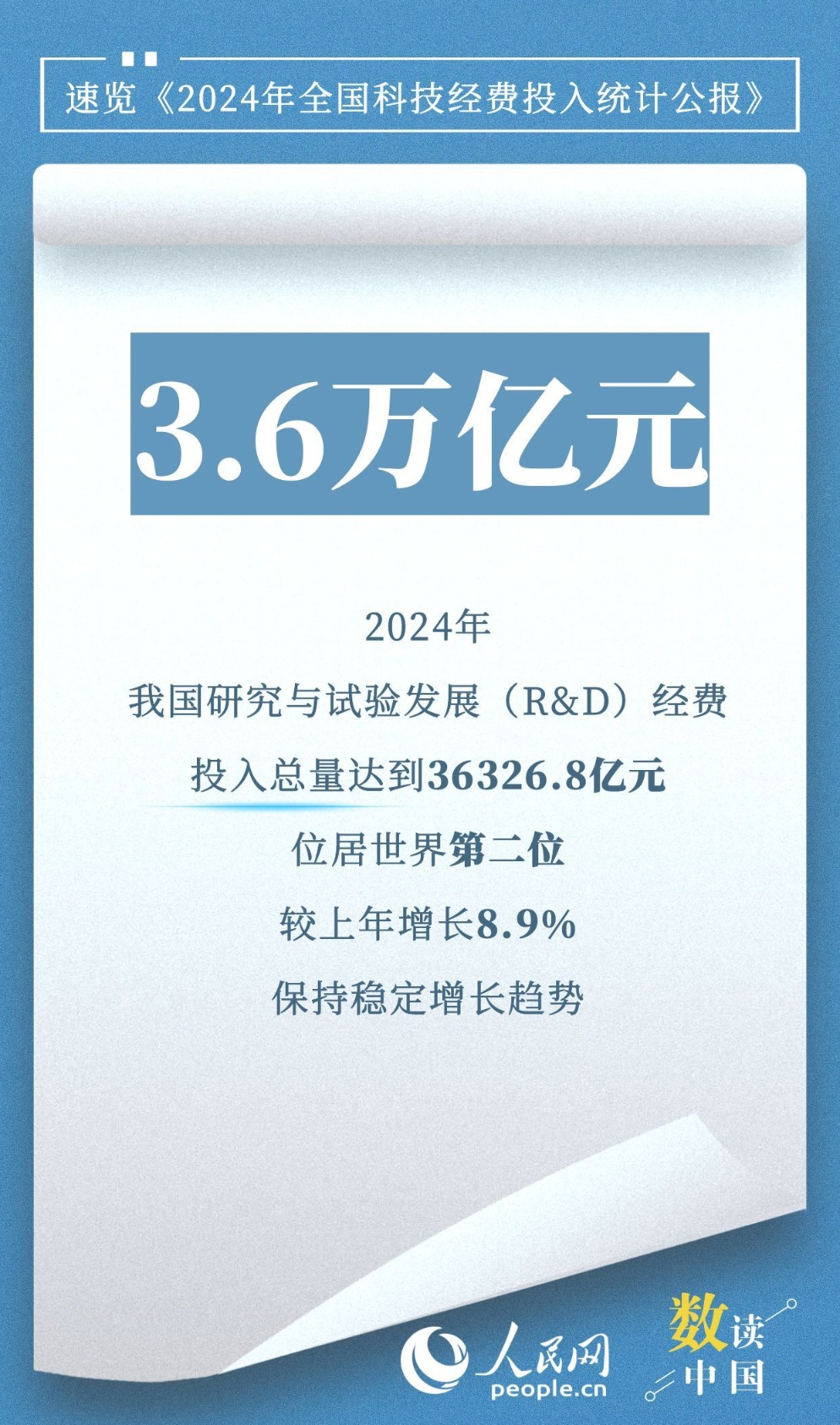
我国全社会研发经费投入达3.6万亿元
news flash· 2025-07-09 03:37
Group 1 - The total R&D expenditure in China is projected to reach 3.6 trillion yuan, ranking second globally [1] - Shenzhen's R&D investment accounts for 6.46% of its GDP, indicating a strong commitment to innovation [1] - China is transitioning from being a global manufacturing hub to becoming a global innovation center [1]
2024年我国全社会研发经费投入规模比“十三五”末增长近50%
news flash· 2025-07-09 02:11
Core Insights - China's R&D investment is set to reach a new high in 2024, with an increase of nearly 50% compared to the end of the 13th Five-Year Plan, amounting to an additional 1.2 trillion yuan [1] R&D Investment Overview - The total R&D expenditure in China for 2024 is projected to grow significantly, reflecting a strong commitment to innovation and development [1] - The R&D intensity is expected to rise to 2.68%, approaching the average level of OECD countries, indicating a shift towards more competitive research capabilities [1]