碳化硅功率器件

Search documents
联讯仪器:连续2年亏损却分红3606万、有2.54亿元现金、8000万理财
Xin Lang Cai Jing· 2025-12-04 11:36
Core Viewpoint - Suzhou Lianxun Instrument Co., Ltd. is facing scrutiny as it pursues an IPO on the Sci-Tech Innovation Board despite continuous losses and increasing accounts receivable and inventory, planning to raise 1.95 billion yuan, which is 1.35 times its total assets and 2.75 times its net assets [2][21]. Group 1: Industry Advantage - Founded in March 2017, the company specializes in the R&D, manufacturing, and sales of electronic measurement instruments and semiconductor testing equipment [4][24]. - The company is positioned to benefit from the surge in demand for high-speed optical communication products and the industrialization of silicon carbide power devices due to the rise of artificial intelligence and global computing power needs [5][25]. - Lianxun Instrument is one of the few manufacturers capable of mass-producing core testing instruments for 400G and 800G high-speed optical modules and is the second company globally to launch all core testing instruments for the industry's highest level 1.6T optical module [5][25]. - According to Frost & Sullivan, the company holds a 9.9% market share in China's optical communication testing instrument market, ranking third and being the only domestic company among the top five [5][25]. - In the semiconductor testing equipment sector, the company leads with a 43.6% market share for its silicon carbide power device wafer-level aging system [6][26]. Group 2: Financial Concerns - Despite being in a lucrative sector, the company's financial performance shows signs of distress, with high customer concentration and significant increases in accounts receivable and inventory [6][27]. - The company relies heavily on a few major clients, with sales to the top five customers accounting for between 42.64% and 62.64% of total revenue from 2022 to Q1 2025 [7][28]. - Accounts receivable surged from 89.63 million yuan at the end of 2022 to 306 million yuan by Q1 2025, while bad debt provisions increased from 7.17 million yuan to 25.62 million yuan [9][30]. - Inventory levels also rose sharply, from 74 million yuan in 2022 to 421 million yuan by Q1 2025 [11][32]. - High accounts receivable and inventory have negatively impacted cash flow, with net cash flow from operating activities turning from a positive 81 million yuan in 2024 to a negative 53 million yuan in Q1 2025 [12][33]. Group 3: Controversial Operations - The company has faced criticism for distributing large cash dividends during years of operating losses, including 21.06 million yuan in dividends in 2022 despite a loss of over 38 million yuan, and approximately 15 million yuan in 2023 with a loss exceeding 55 million yuan [13][34]. - Over two years, total dividends amounted to about 36.06 million yuan, representing approximately 37% of cumulative net losses [13][34]. - The company has 254 million yuan in cash and 8 million yuan in financial investments, yet plans to use 150 million yuan of the 1.95 billion yuan raised in the IPO for working capital, raising concerns about the sustainability of its dividend policy [13][34]. Group 4: Patent Risks - The company faces a lawsuit from Aehr, a major competitor in power device testing equipment, alleging patent infringement on two patents filed in China [15][36]. - Although Lianxun Instrument has applied for the invalidation of the patents and some have been partially declared invalid, the lawsuit is still ongoing [15][36]. - During the litigation, the company received a mysterious order worth 133 million yuan, which has been described as a form of "litigation marketing" [17][37]. Group 5: Capacity Issues - The company plans to invest the 1.95 billion yuan raised in the IPO into six projects related to next-generation optical communication testing equipment and automotive chip testing equipment, which are extensions of its existing business [18][38]. - Notably, the current capacity utilization rate is not at full capacity, with production and sales rates for electronic testing instruments ranging from 60% to 80%, and semiconductor testing equipment at 60% to 70% [19][39]. Group 6: Shareholding Structure - The company's shareholding structure involves complex capital operations, with founder Hu Haiyang initially using a proxy to hold 55% of the shares, later reverting the shares under the guise of "registration convenience" [20][40]. - This shareholding arrangement raises questions about potential intentions to evade asset freezes amid legal disputes, as the proxy had minimal actual capital investment [20][40].

深圳基本半导体股份有限公司(H0194) - 申请版本(第一次呈交)
2025-12-03 16:00
香港交易及結算所有限公司、香港聯合交易所有限公司與證券及期貨事務監察委員會對本申請版本 的內容概不負責,對其準確性或完整性亦不發表任何意見,並明確表示概不就因本申請版本全部或 任何部分內容而產生或因倚賴該等內容而引致的任何損失承擔任何責任。 BASiC Semiconductor Co., Ltd. 深圳基本半導體股份有限公司 (「本公司」) (於中華人民共和國註冊成立的股份有限公司) 的申請版本 警告 本申請版本乃根據香港聯合交易所有限公司(「聯交所」)及證券及期貨事務監察委員會(「證監會」)的 要求而刊發,僅用作提供資料予香港公眾人士。 本申請版本為草擬本,其內所載資料並不完整,亦可能會作出重大變動。 閣下閱覽本文件,即代 表 閣下知悉、接納並向本公司、本公司的聯席保薦人、整體協調人、顧問或承銷團成員表示同 意: 於本公司招股章程根據香港法例第32章《公司(清盤及雜項條文)條例》送呈香港公司註冊處處長登記 前,不會向香港公眾人士提出要約或邀請。倘於適時向香港公眾人士提出要約或邀請,有意投資者 務請僅依據於香港公司註冊處處長登記的本公司招股章程作出投資決定,該文件的文本將於發售期 內向公眾刊發。 (a) 本 ...
新股前瞻|基本半导体:第三代半导体功率器件行业“种子选手”,3年亏损超8亿元
智通财经网· 2025-05-30 02:36
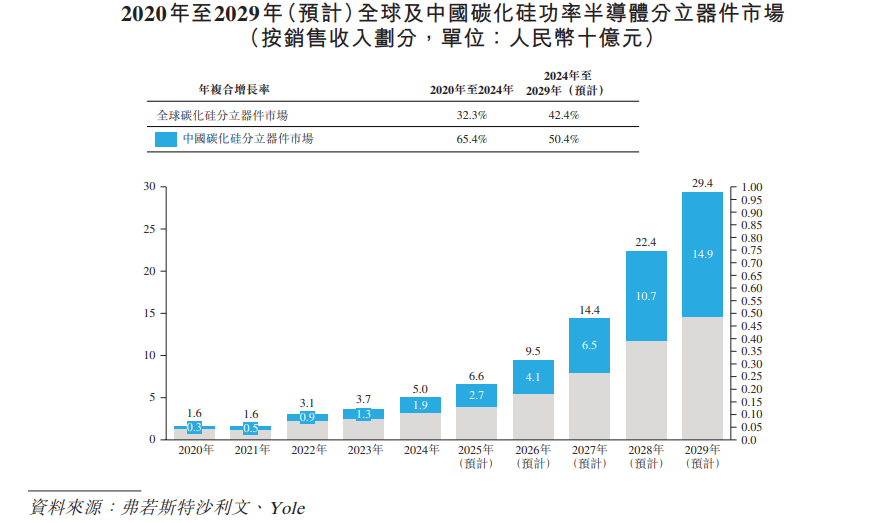
Core Viewpoint - The semiconductor industry is shifting towards third-generation semiconductors, particularly silicon carbide (SiC), which is being widely adopted in high-voltage and high-current applications such as electric vehicles and renewable energy systems [1][2]. Group 1: Industry Trends - The market for third-generation semiconductor materials is experiencing significant growth, driven by the superior properties of SiC, including high breakdown electric field strength, high thermal conductivity, and wide bandgap [1]. - The global market for SiC discrete devices is expected to grow at a compound annual growth rate (CAGR) of 32.2% from 2020 to 2024, with sales revenue projected to increase from 1.6 billion to 5 billion [6]. - The Chinese market for SiC discrete devices is anticipated to grow at a CAGR of 65.4% from 2020 to 2024, with sales revenue expected to rise from 0.3 billion to 1.9 billion, contributing 38.4% to the global market by 2024 [6]. Group 2: Company Overview - Shenzhen Basic Semiconductor Co., Ltd., a leading Chinese company in the SiC chip sector, has submitted its listing application to the Hong Kong Stock Exchange, backed by major securities firms [2][3]. - Established in 2016 by a team of PhDs from Tsinghua University and the University of Cambridge, the company focuses on the research, development, manufacturing, and sales of SiC power devices [2]. - Basic Semiconductor is the only domestic company that integrates SiC chip design, wafer manufacturing, module packaging, and gate driver design and testing capabilities, achieving mass production across all segments [2]. Group 3: Financial Performance - Basic Semiconductor reported revenues of approximately 0.117 billion, 0.221 billion, and 0.299 billion from 2022 to 2024, showing significant year-on-year growth [5]. - The company incurred losses of approximately 0.242 billion, 0.342 billion, and 0.237 billion during the same period, totaling a cumulative loss of 0.821 billion [5]. - Research and development expenses increased from 0.059 billion in 2022 to 0.091 billion in 2024, reflecting the company's commitment to innovation despite ongoing losses [5]. Group 4: Market Position and Challenges - Basic Semiconductor ranks seventh globally and sixth in China in the SiC power module market by revenue as of 2024, positioning itself as a significant player in the domestic third-generation semiconductor sector [4]. - The company faces challenges due to the capital-intensive nature of the semiconductor industry, with rising financing costs and long return cycles impacting cash flow [11]. - Despite the high volatility and long cycles associated with the industry, Basic Semiconductor's potential for long-term growth remains strong, particularly if it successfully capitalizes on technological advancements [11].