磷酸铁锂技术路线

Search documents
独家专访比亚迪CTO孙华军:反超特斯拉,藏着“死磕”磷酸铁锂的20年
21世纪经济报道· 2026-01-13 09:18
Core Viewpoint - BYD has surpassed Tesla in pure electric vehicle sales for the first time, achieving a total of 2.2567 million units in 2025, marking a year-on-year growth of 27.86% [5] Group 1: Historical Development - The journey of BYD began 23 years ago with a focus on lithium iron phosphate (LFP) batteries, which were initially deemed unsuitable for electric vehicles due to low energy density [5][7] - In 2002, BYD's chairman Wang Chuanfu decided to pursue the LFP route, prioritizing safety and resource independence over higher energy density alternatives like nickel-cobalt-aluminum batteries [7][9] - BYD launched its first plug-in hybrid model, the F3DM, in 2008, featuring self-developed LFP batteries, which laid the foundation for subsequent models [8][9] Group 2: Market Challenges and Strategic Decisions - Between 2017 and 2019, the electric vehicle market faced challenges, leading to a temporary shift in focus towards high-energy-density ternary lithium batteries [8][9] - In 2019, during a critical period for the company, BYD made two key strategic decisions: shifting focus from commercial to passenger vehicles and continuing to refine the LFP battery technology despite market pressures [10][11] - The "Qinghai Conference" in 2018 was pivotal in reaffirming the commitment to LFP batteries, focusing on achieving longer ranges [10][19] Group 3: Technological Innovations - The development of the "blade battery" was a significant breakthrough, allowing for improved space utilization and safety, which ultimately enabled LFP batteries to achieve a range of 600 kilometers [10][11][23] - The blade battery's design involved a long, flat structure that increased energy density and safety, overcoming previous limitations of traditional battery shapes [10][24] - BYD's commitment to R&D is evident, with a team of around 10,000 dedicated to battery technology, ensuring a competitive edge in the electric vehicle market [12][27] Group 4: Future Directions - BYD plans to enhance its LFP battery technology further, focusing on safety and charging efficiency, with the introduction of a "megawatt fast-charging battery" expected by 2025 [12][30] - The company aims to maintain its leadership in LFP technology while adapting to new industry standards and safety regulations [30][31] - Future iterations of the blade battery will prioritize faster charging speeds and improved performance in extreme conditions [29][30]



21对话|比亚迪孙华军:反超特斯拉,藏着死磕磷酸铁锂的20年
2 1 Shi Ji Jing Ji Bao Dao· 2026-01-09 14:52
Core Insights - BYD has surpassed Tesla in global electric vehicle sales for the first time, achieving a total of 2.2567 million pure electric vehicles sold in 2025, marking a year-on-year growth of 27.86% [2] - The foundation of BYD's success lies in the development of lithium iron phosphate (LFP) batteries, which were initially considered unsuitable for electric vehicles due to their lower energy density [2][3] - The strategic decision to focus on LFP batteries was driven by safety concerns and the availability of raw materials in China, as opposed to the reliance on cobalt and nickel used in ternary batteries [3][4] Development Timeline - BYD began exploring LFP technology in 2002, with the first LFP battery used in a plug-in hybrid model, the F3DM, launched in 2008 [4] - The company faced challenges between 2017 and 2019 when the electric vehicle market cooled, leading to a temporary shift in focus towards ternary batteries due to their higher energy density [5][6] - In 2019, BYD made a pivotal decision to refocus on LFP technology, leading to the development of the "blade battery" which improved space utilization and safety [6][7] Technological Innovations - The blade battery design allowed for a higher space utilization rate of over 60%, enabling a range of 600 kilometers, which was a significant improvement over previous designs [6][18] - The manufacturing process for the blade battery involved overcoming significant engineering challenges, including precision in stacking and cutting the battery cells [20][21] - BYD's commitment to LFP technology has resulted in a robust R&D team of approximately 10,000 members, emphasizing the company's dedication to innovation in battery technology [21] Market Position and Future Outlook - BYD's sales began to recover in the latter half of 2020, with total electric vehicle sales reaching 190,000 units that year, and over 600,000 units sold in 2021 [7] - The company has established a competitive edge through vertical integration of its supply chain, which became particularly advantageous during global shortages of chips and batteries [7][8] - Looking ahead, BYD plans to continue investing in LFP technology while also addressing challenges such as charging speed and safety standards in response to new regulations [24][25]

爆单了!2025年磷酸铁锂材料厂商已斩获超321.94万吨订单!
Xin Lang Cai Jing· 2025-12-19 15:13
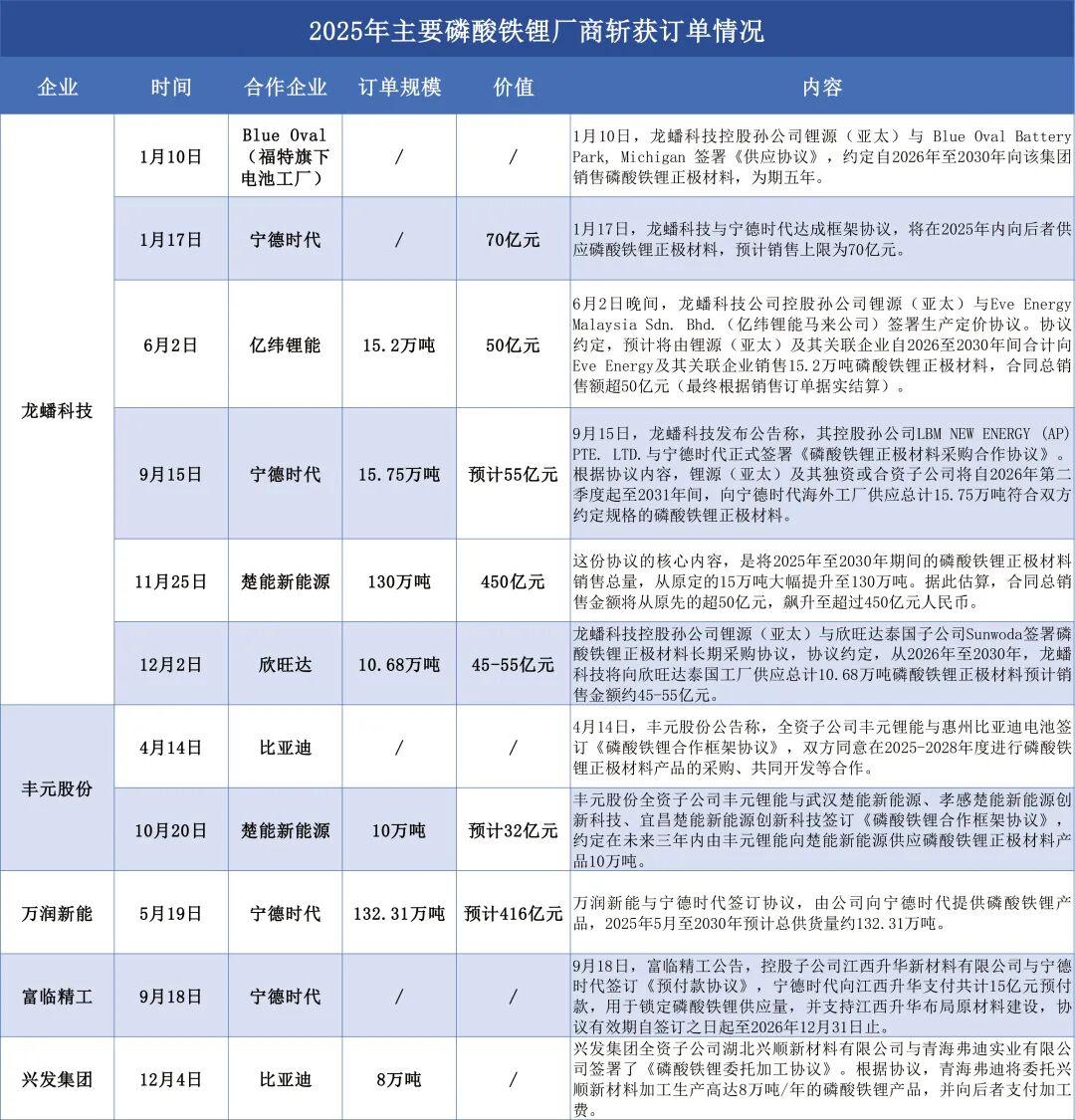
Market Background - The penetration rate of lithium iron phosphate (LFP) batteries in the new energy vehicle sector is continuously increasing as major overseas automakers and battery giants accelerate their shift towards LFP technology [1] - The global energy storage market is experiencing significant growth, leading to unprecedented demand for LFP materials [1] - In 2025, domestic LFP material companies have secured numerous large long-term orders, characterized by "large scale, long cycle, and high value" [1] Order Analysis - In 2025, five representative companies disclosed a total of 11 major orders, amounting to over 321.94 million tons, with an estimated total value exceeding 112.3 billion yuan [1] - Dragon Power Technology leads with six orders covering five customers, with a total order scale of 171.63 million tons and a total value of approximately 67.5 billion yuan [3] - Wanrun New Energy has one significant order of 132.31 million tons from CATL, covering the period from 2025 to 2030 [3] - Fengyuan Co. has two orders, including a three-year agreement to supply 10,000 tons to Chuangneng New Energy [3] Demand Side Concentration - CATL is the largest buyer, with total orders from Dragon Power Technology, Wanrun New Energy, and Jiangxi Shenghua amounting to 148.06 million tons, valued at over 55.6 billion yuan [6] - Chuangneng New Energy has orders totaling approximately 140 million tons from Dragon Power Technology and Fengyuan Co., valued at around 45 billion yuan [7] - Other clients like BYD, Eve Energy, and Sunwoda have relatively limited disclosed order quantities and scales [8] International Expansion - The international recognition of LFP materials is increasing, with three orders from overseas battery plants or Chinese companies' overseas factories, totaling over 25.88 million tons and an estimated value exceeding 10 billion yuan [9] - Lithium Source (Asia Pacific), a subsidiary of Dragon Power Technology, has established a 30,000-ton LFP production capacity in Indonesia, marking a significant transition from "product export" to "capacity export" for Chinese LFP material companies [10] Core Conclusions - The LFP materials order market in 2025 exhibits two main characteristics: high concentration and long-term binding [11] - On the supply side, Dragon Power Technology and Wanrun New Energy account for 94.4% of the total disclosed order scale [11] - On the demand side, CATL and Chuangneng New Energy together account for 89.5% of the total order scale [11] - Over 70% of the orders have a cooperation period extending from 2025 to 2030, reflecting the urgent need for supply chain stability and security among downstream battery companies [11]



备战全球市场 锂电企业资本动作不断
高工锂电· 2025-03-06 11:39
Core Viewpoint - The global lithium battery expansion is entering a critical preparation phase, with significant capital movements in the power battery industry chain, particularly towards overseas markets [1][2]. Group 1: Capital Movements in the Industry - BYD completed a Hong Kong stock placement, raising a total of HKD 43.509 billion (approximately RMB 40.7 billion), marking the largest equity refinancing project in the global automotive industry in the past decade [2]. - Chery Automobile submitted its IPO application to the Hong Kong Stock Exchange, intending to use the funds for R&D, product expansion, and global market strategies [2]. - Major players like CATL and others are actively preparing for listings in Hong Kong, indicating a robust capital expansion effort within the power battery industry [2][3]. Group 2: Trends in Lithium Battery Projects - By the end of 2024 and early 2025, domestic lithium battery project growth is expected to slow due to capacity withdrawal and price wars, while overseas projects continue to thrive [3]. - Companies like CATL and Guoxuan High-Tech plan to invest over RMB 10 billion in overseas battery factories, reflecting a strong trend of domestic companies expanding internationally [3][4]. Group 3: Shift in Overseas Expansion Strategy - The recent overseas expansion of lithium battery companies is driven by the need for capital, as costs for overseas production are significantly higher than domestic operations [7]. - The domestic capital market for lithium battery companies is nearing saturation, while overseas markets still present opportunities for new listings [8]. - The competition in the global lithium battery market is shifting from preparation to direct confrontation, necessitating a robust overseas capital market strategy for Chinese lithium battery companies [8]. Group 4: Future Outlook and Challenges - By 2026, overseas lithium battery production capacity is expected to be released, requiring Chinese companies to secure resources for market expansion during this period [8]. - The technological competition is intensifying, particularly with advancements in solid-state battery technology and shifts in production techniques, necessitating enhanced R&D capabilities among domestic battery manufacturers [8].