神经网络模型

Search documents
能看懂|讲清楚为什么刘延说特斯拉FSD是近200个小场景模型的组合
理想TOP2· 2026-01-21 08:10
Core Viewpoint - The article discusses the architecture and size of neural networks (NNs) in Tesla's Full Self-Driving (FSD) system, particularly focusing on the differences between HW3 and HW4 platforms, and the implications of these changes for the performance and capabilities of Tesla's autonomous driving technology [1][2][4]. Group 1: Neural Network Architecture - Node A in the HW4 platform contains 189 neural networks, while Node B has 110, with 61 networks shared between the two nodes [1][4]. - The total size of Node A in HW3 is 1.2 GB and Node B is 3.1 GB, while in HW4, Node A is 2.3 GB and Node B has increased to 7.5 GB [1][2]. - There are 135 neural networks shared between HW3 and HW4 in the current releases, indicating some level of continuity in the architecture [4]. Group 2: Implications of Neural Network Size - The increase in size of Node B in HW4 from 2.3 GB in v12.x to 7.5 GB in v13 suggests a significant expansion in the complexity and capabilities of the FSD system [2][4]. - The processing speed of HW3, which can run at 36 Hz, indicates that smaller models are being utilized, as larger models would exceed the available memory bandwidth [9]. - The engineering strength of Tesla is highlighted, suggesting that the smooth operation of the FSD system is not solely dependent on computational power but also on the optimization of the vehicle control operating system [9]. Group 3: Reverse Engineering Insights - The insights provided by the user green, who conducts reverse engineering on Tesla's firmware, reveal that there are indeed 189 distinct neural network files, supporting the claims about the architecture [5][6]. - Green's work indicates a complex relationship with Tesla, where his findings can both aid and disrupt Tesla's development rhythm [6]. - The existence of specialized end-to-end (E2E) networks for different driving scenarios suggests that the FSD system may not be as universally adaptable as some might believe [6][8].


【固收】基于堆叠LSTM模型的十年期国债收益率预测——量化学习笔记之一(张旭)
光大证券研究· 2025-12-15 23:07
Core Viewpoint - The article discusses the application of deep learning models, particularly LSTM, in predicting government bond yields, highlighting its advantages in handling complex financial time series data [4][5]. Group 1: Financial Time Series Prediction - Financial time series prediction has evolved through three main stages: traditional econometric models, traditional machine learning models, and deep learning models [4]. - Deep learning models, especially LSTM, are currently among the mainstream methods for financial time series prediction due to their ability to adapt to non-stationary, non-linear, high-noise, and long-memory characteristics [4]. Group 2: LSTM Model for Bond Yield Prediction - A three-layer stacked LSTM model with Dropout regularization was developed to predict the 10-year government bond yield, exploring the application and effectiveness of deep learning in fixed income quantitative analysis [5]. - The model utilized data from early 2021 to December 12, 2025, with approximately 130,000 adjustable parameters, achieving an average absolute error of 1.43 basis points in predictions [5]. - The model predicts a slight decline in the 10-year government bond yield, with a forecasted value of 1.8330% for December 19, 2025, down from 1.8396% on December 12, 2025 [5]. Group 3: Future Optimization Directions - Future optimizations include adjusting the model design regarding time windows, data processing, network architecture, and training strategies [6]. - Expanding input variables to include macroeconomic, market, and sentiment data will enhance the model's predictive accuracy and economic logic [6]. - Combining LSTM with traditional econometric models or other machine learning models to create hybrid models like ARIMAX-LSTM and CNN-LSTM-ATT can improve prediction precision [7].
马斯克官宣特斯拉FSD V14即将推送:分三步走,号称史上第二大更新
Feng Huang Wang· 2025-09-29 08:11
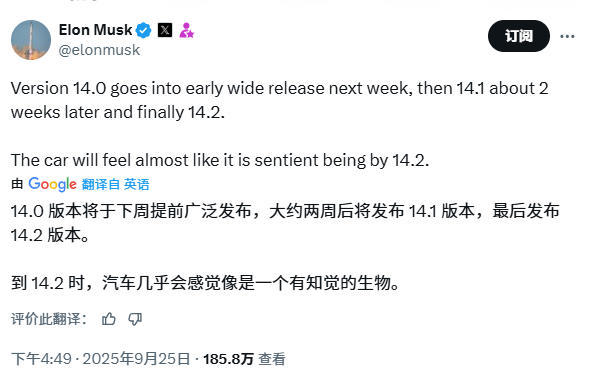
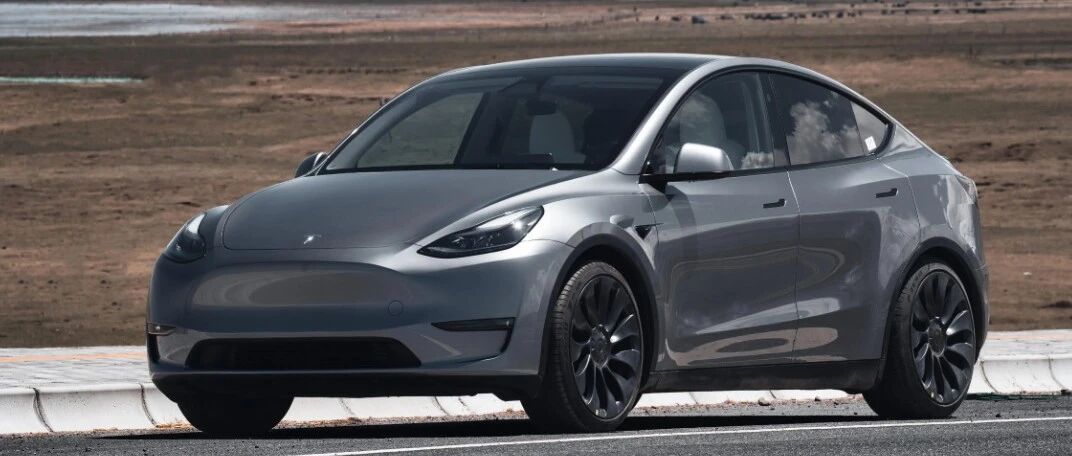
Core Insights - Tesla's CEO Elon Musk announced the detailed rollout plan for the highly anticipated FSD V14 version, with the first deployment expected next week, followed by V14.1 and V14.2 in a staggered update approach [1][2] Group 1: FSD V14 Rollout Plan - The initial release of FSD V14 will be an "early wide release," primarily targeting Tesla's internal employees, early testers, and select industry influencers, rather than all vehicle owners [2] - Approximately two weeks after the initial version, Tesla plans to launch FSD V14.1, which is expected to address various errors identified in the initial release and will likely be the first version pushed to the general public [4] Group 2: Technical Enhancements - The FSD V14 update is characterized as a fundamental architectural upgrade, comparable to V12, and is considered the second-largest update in FSD's history, featuring a neural network model with a tenfold increase in parameters [4] - The new version will reduce video data compression rates, enhancing the vehicle's visual clarity and precision in judgment, while also decreasing the frequency of driver monitoring [4] Group 3: Additional Features and Goals - Features previously listed as "coming soon" in the V13.2.9 update, such as audio input recognition for emergency vehicles and further optimization of "phantom braking," are expected to be implemented in the V14 series [5] - However, the highly requested "destination auto-parking" feature was not mentioned by Musk, indicating it may not be included in the initial V14 release [5] - The core objective of the new architecture in V14 is to provide vehicles with driving intuition closer to that of humans, enabling them to handle more complex road scenarios [5]