端侧硬件

Search documents
模型对话端侧硬件-2026年如何看待端侧落地
2026-02-13 02:17
Summary of Key Points from the Conference Call Industry Overview - The AI eyewear market is experiencing rapid growth, with Meta and Luxottica's collaboration expected to sell over 7 million units in 2025 and reach 15 million units in 2026, doubling year-on-year [2][3] - The AI smartphone market is anticipated to flourish in 2026, with multiple manufacturers actively developing products that demand higher chip processing capabilities, NPU processing power, and memory capacity, potentially triggering a consumer upgrade wave [2][4][5] - OpenAI is making significant strides in edge hardware, including AI PINs, headphones, glasses, and desktop robots, aiming for an annual shipment volume of 100 million units, leveraging its vast user base to boost hardware sales [2][6] Core Insights and Arguments - 2026 is projected to be a pivotal year for AI edge hardware, driven by advancements in model upgrades and multimodal technology, leading to a shift from traditional voice-interactive devices to multimodal interactive hardware [3] - The introduction of new display-enabled AI eyewear is expected by 2027, capable of photography, video recording, and image presentation, enhancing user experience [3] - The demand for consumer electronics in the first half of 2026 may be affected by fluctuations in memory prices, but a recovery in market demand is expected in the second half as more mature models or agents are launched [7] Potential Beneficiaries in the Market - Domestic manufacturers are primarily focused on storage chips, with companies like Baiwei, Jiangbolong, and Zhaoyi Innovation leading the field. Key component suppliers such as Huanxu Electronics, Longqi Technology, and GoerTek are also expected to benefit from the edge hardware market [2][8] - Traditional consumer electronics companies like Luxshare Precision and Lens Technology are deeply involved in this sector and are likely to profit from the emerging opportunities [8] Additional Important Insights - The trend of model miniaturization is crucial for the next two years, enhancing model evaluation and enabling a wider range of applications, particularly in companion and recording devices [4][9] - The development of native multimodal technology is expected to integrate understanding and generative capabilities, leading to breakthroughs within 1-2 years, which will support the rise of larger and more complex devices like smartphones and NAS [9][10] - Record-type devices are seen as having the most explosive potential in the big model era, serving as both data entry points and sources of data generation, with AR/VR glasses and various smart devices poised for significant growth [10]
算力新贵IPO与巨头反垄断:2026年AI投资的“冰火两重天” | 前瞻专题
Sou Hu Cai Jing· 2026-01-23 10:16
Core Insights - The capital market's enthusiasm for AI has shifted from grand narratives to financial performance, marking a significant transition in 2026 [1] - The AI industry has evolved into distinct segments: computing infrastructure, model building, end-user applications, and regulatory reshaping [2] - The A-share market experienced a structural bull market in 2025, with leading companies like Zhongji Xuchuang and Industrial Fulian achieving significant growth [2][3] Group 1: Market Dynamics - In 2025, the AI sector saw a notable split between A-shares and Hong Kong stocks, with companies like Zhongji Xuchuang and Industrial Fulian leading in valuation restructuring [1] - The successful IPOs of companies like Moer Thread and Muxi Co. on the Sci-Tech Innovation Board indicate a shift of domestic GPUs from experimental stages to large-scale production [3] - The Hong Kong market acted as a bellwether for AI applications, with companies like Cloud Wisdom successfully raising funds and positioning themselves in the AI+ healthcare sector [3] Group 2: Regulatory Environment - The beginning of 2026 brought regulatory scrutiny to industries like food delivery and transportation, impacting companies that rely heavily on algorithm-driven profits [2][7] - The case of Ctrip Group highlights the risks associated with algorithmic monopolies, as the company faced an antitrust investigation that affected its stock price [7] Group 3: Technological Advancements - The focus in 2026 is shifting towards "intelligent agents" and edge hardware, with expectations for a significant drop in development costs for AI agents [8] - The anticipated end of Windows 10 support and a decrease in edge computing costs are expected to drive the adoption of AI PCs and smartphones [8] Group 4: Investment Opportunities - Companies specializing in advanced packaging and new storage solutions, such as Zhaoyi Innovation and Changdian Technology, are expected to benefit from the evolving AI infrastructure [9] - The market is optimistic about the potential of domestic computing capabilities, viewing 2026 as a pivotal year for AI infrastructure development in China [9] Group 5: Future Outlook - The AI industry is expected to transition from speculative narratives to tangible productivity enhancements, with companies that can effectively leverage intelligent agents poised for success [10] - The market is likely to favor businesses that operate within regulatory boundaries and demonstrate real value creation through AI [10]

科技硬件:CES 2026 _ AI定义端侧硬件,云端硬件革新重构-19页
2026-01-12 01:40
Summary of Key Points from the Conference Call Industry Overview - The conference discussed the 2026 Consumer Electronics Show (CES) where numerous innovative hardware products were showcased, particularly focusing on AI and consumer electronics [3][4][11]. Key Insights on Edge Hardware - AI integration in consumer electronics is rapidly evolving, with AI-enabled edge hardware becoming a central theme at CES 2026. This includes advancements in AI glasses, AI robots, and various innovative "AI + edge hardware" products [4][11]. - AI glasses are becoming lighter and more functional, with products like the XGIMI MemoMind Air Display weighing only 28.9 grams, approaching traditional eyewear weight. The integration of large models enhances translation, recognition, and interaction speed [12][13]. - The application scenarios for AI glasses are expanding, with capabilities for real-time translation and medical applications, which could accelerate hardware sales growth [13]. Key Insights on Cloud Hardware - Nvidia introduced six new chips, including the Rubin GPU and Vera CPU, forming a complete system called Rubin NVL72. This system features significant hardware restructuring in computing cores, PCB, liquid cooling, and storage [5][24]. - The Rubin GPU offers 50 PFLOPS of inference computing power and 35 PFLOPS for training, with a total bandwidth of 22TB/s, significantly enhancing performance compared to previous generations [29][30]. - The new architecture includes a three-tier storage pipeline to address the "memory wall" bottleneck, allowing for efficient data management and access, which is crucial for AI applications [37][42]. Investment Recommendations - For edge hardware, it is recommended to focus on the supply chain related to terminal brands, ODM, optics, structural components, and batteries [6]. - For cloud hardware, attention should be directed towards GPU, storage, cooling, and PCB sectors [6]. Risks Identified - Potential risks include a sluggish macroeconomic environment, slow progress in AI edge technology, and lower-than-expected sales of AI products [7]. Additional Noteworthy Developments - The CES showcased a variety of AI companion robots, highlighting advancements in "active perception" and "scene segmentation" capabilities, indicating a shift towards more practical applications in everyday life [16][17]. - The introduction of AI in wearable technology is expanding, with products like emotion-sensing pendants and brain-machine interfaces being presented, indicating a growing trend in health monitoring and emotional analysis [22][23]. Conclusion - The conference highlighted significant advancements in both edge and cloud hardware, particularly in the context of AI integration. The developments at CES 2026 suggest a robust growth trajectory for the consumer electronics sector, driven by innovative applications of AI technology.

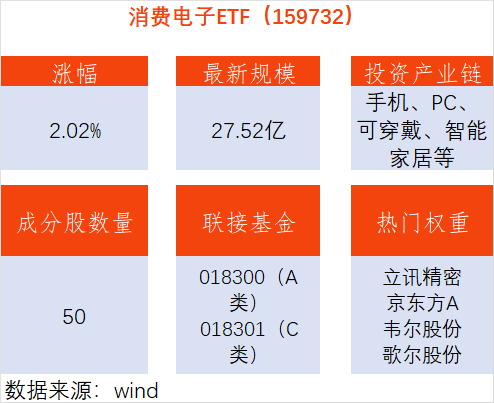
AI模型升级催热端侧硬件预期,消费电子ETF(159732.SZ)上涨2.02%,环旭电子上涨5.58%
Mei Ri Jing Ji Xin Wen· 2025-11-27 03:09
Group 1 - The A-share market saw all three major indices rise, with the Shanghai Composite Index increasing by 0.61%, led by gains in the electronics, communications, and power equipment sectors, while the comprehensive and transportation sectors experienced declines [1] - The Consumer Electronics ETF (159732.SZ) rose by 2.02%, with significant increases in component stocks such as Lianxu Electronics (up 5.58%), Zhaoyi Innovation (up 5.37%), and XWANDA (up 5.07%) [1] Group 2 - Google launched its latest AI model, Gemini3 Pro, which features native multimodal capabilities and strong reasoning abilities, achieving an 81% score on the MMMU-Pro benchmark and 87.6% on the Video-MMMU benchmark [3] - Gemini3 achieved a groundbreaking score of 1501 on the LMArena leaderboard and a high score of 91.9% on GPQADiamond, indicating its advanced reasoning capabilities [3] - According to Guosen Securities, the continuous upgrade of AI models and the maturation of AI agents will enhance user experience through improved connectivity of edge hardware with cloud models, suggesting a potential new surge in the AI sector [3]