
粮食增产

Search documents
下游原料库存偏低 短期玉米期货盘面以震荡为主
Jin Tou Wang· 2026-01-26 07:05
Group 1 - The USDA reported that for the week ending January 15, 2025/2026 corn export net sales were 4.011 million tons, up from 1.14 million tons the previous week, while 2026/2027 corn net sales were 0 tons, down from 0.1 million tons the previous week [1] - Corn shipments for the 2025/2026 marketing year totaled 1.434 million tons, a decrease from 1.556 million tons the prior week [1] - Crop expert Dr. Michael Cordone maintains corn production forecasts for Brazil and Argentina at 137 million tons and 56 million tons, respectively, while AgRural reports that Brazil's second-season corn planting is lagging at 1.1%, compared to 6.7% at the same time last year [1] Group 2 - According to the National Development and Reform Commission, the increase in grain production in 2025 will mainly come from the three northeastern provinces, Inner Mongolia, and Xinjiang, with corn being the primary contributor [3] - The current market sentiment is generally positive, with active trading in the corn market, and the average domestic corn price is 2,326 yuan per ton [4] - There is an increased willingness to sell at the grassroots and trading levels ahead of the holiday, with downstream corn raw material inventories being low, leading to increased replenishment by feed and deep processing enterprises [4]

粮食产量连续两年在1.4万亿斤以上,大面积单产提升明显
Nan Fang Du Shi Bao· 2026-01-22 11:03
Core Viewpoint - China's grain production has reached a historical high, stabilizing above 1.4 trillion jin for two consecutive years, primarily driven by increased autumn grain yields and advancements in agricultural practices [1] Group 1: Grain Production Increase - The increase in grain production is mainly attributed to autumn grain, which accounts for over 90% of the total grain increase by 2025, with an additional 16.36 billion jin expected [1] - The northeastern provinces, Inner Mongolia, and Xinjiang contributed significantly, with a total increase of 11.47 billion jin, representing nearly 70% of the national increase [1] - Corn production saw a substantial rise of 12.64 billion jin, making up 75% of the overall grain increase [1] Group 2: Agricultural Practices and Technology - The stability in grain production is largely due to improvements in large-scale yield per unit area, with over 90% of the increase attributed to this factor [2] - By 2025, the area under integrated water and fertilizer management is expected to exceed 8.8 million acres, enhancing resource allocation based on crop needs [1] - The promotion of high-performance machinery and integrated technology is a key focus for increasing yields [1] Group 3: Future Considerations for Grain Production - The strategy for 2026 includes stabilizing planting areas, enhancing yield per unit area, optimizing production structures, and improving efficiency through policy support [3][4] - Emphasis will be placed on encouraging local governments to implement large-scale yield enhancement projects and utilize new agricultural management entities [3] - Disaster risk management will be prioritized, including infrastructure improvements and pest control measures to minimize losses [4]
农业农村部:玉米增产是2025年粮食增产的主因
Zheng Quan Shi Bao Wang· 2026-01-22 03:04
Core Viewpoint - The increase in grain production by 2025 will primarily come from autumn grain, with significant contributions from the northeastern provinces, Inner Mongolia, and Xinjiang, particularly in corn production [1]. Group 1 - The Ministry of Agriculture and Rural Affairs anticipates that the main source of grain production growth will be autumn grain by 2025 [1] - The regional contributions to this increase are expected to be mainly from the northeastern provinces, Inner Mongolia, and Xinjiang [1] - The specific crop expected to see the most significant increase in production is corn [1]
秋粮“三增”、全省前列!镇江2025年粮食生产交出满意答卷
Yang Zi Wan Bao Wang· 2026-01-20 09:16
Core Viewpoint - In 2025, Zhenjiang City aims to fully implement the municipal government's agricultural policies, achieving significant increases in autumn grain production, with a total area of 1.3115 million acres and a total yield of 722,900 tons, reflecting a positive growth trend in grain production [1] Group 1: Grain Production Achievements - The total grain sowing area for the year reached 2.0729 million acres, with a total yield of 981,700 tons, marking increases of 6,000 acres and 1,600 tons respectively, which are higher than the provincial averages [1] - The growth rates for sowing area and total yield were 0.29% and 0.16%, ranking fifth in the province [1] - The reduction in yield per unit area was the lowest in southern Jiangsu and ranked fourth in the province, indicating stable grain production [1] Group 2: Measures for Production Stability - The city has stabilized and optimized the planting area by maintaining summer grain sowing while exploring the potential of drought-resistant crops and reducing the area for certain crops, thereby laying a foundation for increased autumn grain production [2] - The establishment of six quality grain and oil zones aims to enhance yield per unit area by over 5%, benefiting 676 entities and covering a cumulative area of 233,000 acres [2] - High-yield demonstration fields have achieved wheat yields exceeding 654.1 kg per acre and rice yields surpassing 762 kg per acre [2] Group 3: Production Organization and Support - The municipal agricultural and rural bureau has established a comprehensive service and guidance mechanism for grain and oil production, issuing various operational guidelines throughout the year [3] - Measures such as "autumn supplementing summer" have been implemented, with precise guidance for farmers on fertilizer and pest management [3] - Future plans include strengthening key production areas and yield enhancement, improving modern seed technology and agricultural equipment, and ensuring disaster prevention and technical support for the upcoming harvest [3]
视频丨2025年全年全国粮食总产量71488万吨 比上年增加838万吨
Yang Shi Xin Wen Ke Hu Duan· 2026-01-19 05:57
Core Insights - The National Bureau of Statistics reported a total grain production of 714.88 million tons in 2025, an increase of 8.38 million tons or 1.2% compared to the previous year [2] Grain Production - Summer grain production reached 149.75 million tons, a slight decrease of 0.1% - Early rice production was 28.51 million tons, up by 1.2% - Autumn grain production totaled 536.62 million tons, an increase of 1.5% - By crop type, wheat production was 140.07 million tons, remaining stable; corn production was 301.24 million tons, up by 2.1%; rice production was 209.04 million tons, increasing by 0.7%; soybean production was 20.91 million tons, up by 1.3% [2] Livestock Production - Total meat production from pigs, cattle, sheep, and poultry reached 100.72 million tons, a growth of 4.2%, surpassing 100 million tons for the first time - Pork production was 59.38 million tons, increasing by 4.1%; beef production was 8.01 million tons, up by 2.8%; sheep meat production was 4.96 million tons, down by 4.2%; poultry meat production was 28.37 million tons, increasing by 6.7% [2] Dairy and Egg Production - Milk production reached 40.91 million tons, a growth of 0.3% - Egg production was 34.98 million tons, showing a decline of 2.5% [2] Swine Statistics - The total number of pigs slaughtered was 719.73 million, an increase of 2.4% - The year-end pig stock was 429.67 million, up by 0.5% [2]
沈阳:2025年粮食总产量首次突破84亿斤,实现了“二十二连丰”
Zheng Quan Shi Bao Wang· 2026-01-12 13:17
Core Insights - Shenyang's total grain production in 2025 is projected to exceed 8.4 billion jin for the first time, marking the 22nd consecutive year of increased yields [1] - The total grain output reached 8.4 billion jin, an increase of 390 million jin or 4.9% from the previous year, ranking third in growth rate within the province [1] - The city maintains its position as the top grain producer in the province, surpassing the previous record of 8.392 billion jin set in 2023 by 80 million jin [1] Grain Production Growth - Major grain crops in Shenyang showed growth in 2025: corn production reached 6.697 billion jin (up 370 million jin, 5.8% increase), rice production at 1.571 billion jin (up 11 million jin, 0.7% increase), and soybean production at 50 million jin (up 4 million jin, 7.6% increase) [1] - The total grain planting area was 8.2441 million mu, the highest in the province, with an increase of 49,900 mu or 0.6% from the previous year, ranking second in growth rate [1] Yield Per Mu - The comprehensive grain yield reached 509.46 kg/mu, an increase of 20.68 kg/mu or 4.2%, contributing positively to the goal of surpassing 500 kg/mu during the 14th Five-Year Plan [2] - Specific crop yields include corn at 532.47 kg/mu (up 24.44 kg/mu, 4.8% increase), rice at 473.70 kg/mu (up 2.15 kg/mu, 0.5% increase), and soybean at 143.70 kg/mu (up 10.01 kg/mu, 7.5% increase) [2]
国务院国资委:聚焦生物育种等领域,加强农业关键核心技术攻关和科技成果高效转化应用
Zheng Quan Shi Bao Wang· 2026-01-05 10:25
Core Viewpoint - The State-owned Assets Supervision and Administration Commission (SASAC) emphasizes the importance of supporting rural revitalization and enhancing county-level industries to boost farmers' participation in industrial development [1] Group 1: Rural Revitalization and County-Level Industries - The meeting highlights the need to cultivate and strengthen county-level industries that benefit the local population [1] - It calls for expanding channels and methods for farmers to engage in industrial development [1] - The establishment and effective utilization of platforms like "He Mei Xiang Tu" and "He Mei Xiang Pin" are encouraged to support these initiatives [1] Group 2: Investment in Underdeveloped Areas - Increased investment efforts are directed towards revolutionary old areas, ethnic regions, border areas, and underdeveloped regions [1] - The focus is on enhancing agricultural capabilities and ensuring food security through targeted investments [1] Group 3: Agricultural Development and Technology - The meeting stresses the importance of serving the construction of an agricultural powerhouse, particularly in areas such as biological breeding, agricultural machinery, pesticides, and fertilizers [1] - There is a call for strengthening key agricultural technologies and the efficient transformation and application of scientific achievements [1] - The aim is to improve agricultural supply security, technological innovation capacity, sustainable development ability, and the utilization of international resource markets [1]
总产量1640.06亿斤!黑龙江粮食“二十二连丰”的密码
Xin Hua Wang· 2026-01-01 04:14
Core Insights - Heilongjiang Province achieved a record grain production of 1640.06 billion jin in 2025, marking the 22nd consecutive year of increased output and maintaining its position as the top grain-producing region in China [1][3] - The province's grain output increased by 39.7 billion jin, accounting for 23.6% of the national grain increase, which is a 4.4 percentage point rise from 2024 [1][3] Group 1: Grain Production and Technology - Heilongjiang's agricultural sector focuses on both quantity and quality, with significant advancements in grain yield and production technology [1][3] - The province has implemented advanced agricultural machinery, with 4,757 pneumatic seeders and 8,634 tractors of 100 horsepower or more purchased by November 2025, enhancing mechanization levels [3][5] - The average yield of soybeans in the Beidahuang Group's cooperative reached an increase of 50 jin per mu, translating to over 2 million yuan in additional income [3] Group 2: Agricultural Infrastructure and Pest Control - Heilongjiang has established 120 million mu of high-standard farmland, with significant investments in infrastructure to support grain production [5] - The province has set up 10,000 pest monitoring points and 32,000 monitoring devices, achieving real-time coverage of 39 major crops and over 130 pests, resulting in the lowest pest-related losses in recent years [5] - The provincial government plans to implement a new round of grain production increase initiatives during the 14th Five-Year Plan period to further enhance supply capabilities [5]
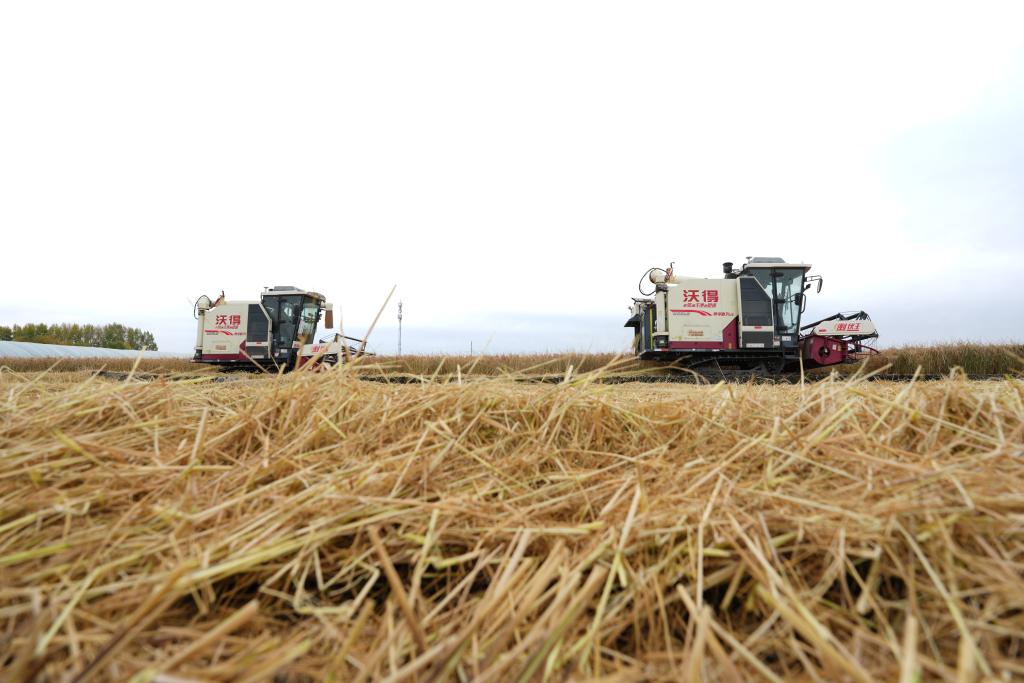
打通豫东水网“大动脉” 河南省第一大灌区工程通过竣工验收
He Nan Ri Bao· 2025-12-29 13:55
Core Points - The Zhao Kou Yellow River Irrigation District Phase II project has officially passed completion acceptance, marking the start of comprehensive operational management [1][2] - The project is a significant water conservancy initiative under the State Council, aimed at enhancing water resource allocation in Eastern Henan and supporting agricultural irrigation [1][2] Group 1: Project Overview - The Zhao Kou Yellow River Irrigation District is the largest irrigation area in Henan Province, with a designed irrigation area of 5.87 million acres [1] - The Phase II project, which began construction in 2019 and achieved water delivery in June 2024, covers an irrigation area of 2.205 million acres [1][2] - The project includes a complete irrigation and drainage system, addressing agricultural, rural, and industrial water needs in multiple counties [1] Group 2: Economic and Environmental Impact - The project is expected to add 409 million pounds of grain annually to the Eastern Henan region and facilitate the annual allocation of 651 million cubic meters of water resources [2] - The average annual water intake from the Yellow River is projected to be 237 million cubic meters, enhancing the region's flood disaster prevention capabilities [2] - The irrigation area will cover 14 counties in five cities, contributing to the vision of making the Yellow River a source of prosperity for the people [2]
打通豫东水网“大动脉” 河南省第一大灌区通过竣工验收
He Nan Ri Bao· 2025-12-28 23:20
Core Viewpoint - The completion and acceptance of the Zhao Kou Yellow River Irrigation District Phase II project marks a significant advancement in water resource management for the eastern Henan region, enhancing agricultural irrigation and water supply capabilities [1][2]. Group 1: Project Overview - The Zhao Kou Yellow River Irrigation District Phase II project has passed its completion acceptance, officially entering a new phase of comprehensive operational management [1][2]. - This project is part of the national initiative to enhance water conservation and supply, included in the planning for an additional 1 billion jin of grain production capacity [1]. Group 2: Agricultural Impact - The project is expected to add 4.09 billion jin of grain annually for the eastern Henan region, significantly improving local agricultural productivity [2]. - The total irrigated area of the Zhao Kou Yellow River Irrigation District will reach 5.87 million acres, covering 14 counties in five cities, including Zhengzhou and Kaifeng [2]. Group 3: Water Resource Management - The project will facilitate an annual water resource allocation of 651 million cubic meters, with an average annual intake of 237 million cubic meters from the Yellow River [2]. - It also has the capability to supplement groundwater through coordinated channel management and can provide ecological replenishment to local rivers, enhancing flood disaster prevention in the region [2].