系统技术协同优化(STCO)

Search documents
3D封装,怎么散热?
半导体行业观察· 2026-03-26 00:36
Core Insights - The article discusses the increasing challenges of heat dissipation in high-performance computing (HPC) and AI accelerators, as power density exceeds 1 kW, necessitating advanced thermal management techniques [1] - Companies are adopting adaptive mesh finite element modeling and new experimental methods to optimize multi-chip packaging designs and improve longevity [1][2] Group 1: Thermal Management Techniques - Engineers are transitioning from simplified thermal resistance calculations to more complex thermal simulations that incorporate multiple chip configurations and their interactions [2] - The use of active thermal testing wafers allows for direct measurement of temperature distribution and heat dissipation processes, enhancing the accuracy of thermal simulations [1][6] - AMD has developed a software-programmable thermal evaluation platform to assess thermal distribution and cooling needs during chip development [1][2] Group 2: Importance of Early Thermal Simulation - Early thermal simulation during the prototype phase is crucial to avoid significant design errors and additional cooling costs in advanced packaging [5] - The peak temperature, rather than just average temperature, is critical for assessing thermal risks in chip designs [5][6] - AI can help predict hotspot locations, allowing for more efficient mesh generation in thermal simulations, thus reducing simulation time [4][5] Group 3: Challenges in Thermal Simulation - Real workload factors are often overlooked in thermal simulations, as chip heating is directly related to data processing activities [6] - The need for long sequences of real chip load data complicates the simulation process, requiring hardware emulators for accurate modeling [6] - The integration of programmable heating modules and high-resolution sensors in thermal testing platforms can simulate real chip loads and improve model calibration [7][8] Group 4: Multi-Chip Packaging and Thermal Behavior - The thermal behavior of multi-chip systems is increasingly important throughout the product lifecycle, necessitating continuous evaluation of thermal characteristics from initial planning to deployment [10][11] - The interaction of heat between chips can escalate chip-level issues to system-level problems, emphasizing the need for comprehensive thermal management strategies [10][11] Group 5: Mechanical Factors in Thermal Management - Mechanical stress due to mismatched thermal expansion coefficients in multi-chip stacks must also be modeled alongside thermal effects to ensure reliability [13] - The IMEC team demonstrated that optimizing thermal management strategies can significantly reduce peak temperatures in stacked GPU architectures [14] Group 6: Future Directions in Thermal Simulation - The industry is moving towards advanced techniques such as hybrid bonding and back-side power delivery networks, which increase thermal management challenges [8][14] - The reliance on adaptive mesh thermal simulation software is expected to grow, balancing computational time with model accuracy while addressing coupled thermal and mechanical behaviors [14][15]



Chiplet革命,西门子EDA如何赋能商业化落地?
Xin Lang Cai Jing· 2026-01-26 01:55
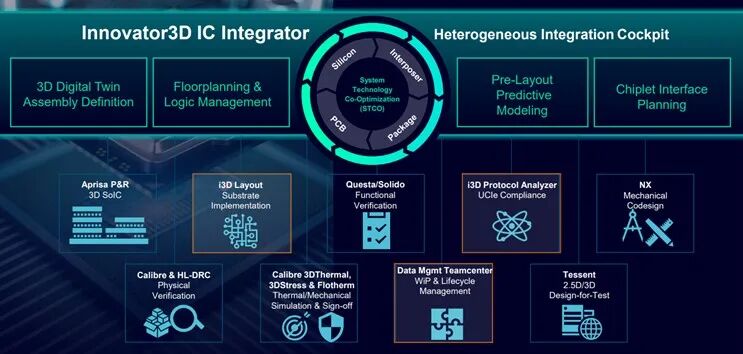
Core Insights - The global semiconductor industry is shifting from a prolonged race to a new paradigm centered on innovation, with Chiplet technology taking the spotlight as it advocates for modular small chips to achieve higher performance density through advanced packaging techniques [1][17]. Group 1: Chiplet Technology and EDA Software - Chiplet technology necessitates deep collaboration among EDA software, IP suppliers, wafer fabs, and packaging plants due to the exponential increase in design complexity [1][17]. - The rise of Chiplet technology represents an ecological innovation focused on "system-level optimization," requiring EDA software to evolve beyond single-point tool innovations to comprehensive solutions addressing systemic challenges [1][17]. Group 2: System-Level Collaboration - Traditional design processes follow a linear approach that hinders early cross-domain trade-offs, making it essential to break these barriers to fully unleash the potential of Chiplet technology [18][19]. - Siemens EDA's design process is based on the System Technology Collaborative Optimization (STCO) concept, aiming for overall system-level optimization throughout the 3D IC design, verification, and manufacturing processes [19]. Group 3: Comprehensive Design Solutions - Siemens EDA provides a full-process solution for Chiplet design, including architecture planning, logic verification, physical design, physical verification, and physical testing [21][22][23]. - The Innovator3D IC Integrator (i3DI) allows for the creation of 3D digital twins, supporting early architectural exploration and pre-simulation assessments [21]. - The Calibre platform extends single-chip "golden" DRC/LVS standards to multi-chip and 3D stacking scenarios, ensuring comprehensive testing solutions for system reliability [22][23]. Group 4: Advanced Packaging and Manufacturing Collaboration - Advanced packaging technology is crucial for transforming Chiplet concepts into reality, with each iteration of packaging processes driving Chiplet architectures towards greater efficiency and complexity [28]. - Siemens EDA collaborates closely with wafer fabs and packaging houses to ensure that the toolchain delivered to chip design companies is synchronized with target manufacturing processes [28][29]. Group 5: Ecosystem Development and Standards - Siemens EDA actively participates in the Open Compute Project (OCP) to help establish Chiplet industry standards, promoting efficient and orderly development across the industry [31][12]. - The company aims to be a key node in the industry interconnection, contributing to standard formulation, industry linkage, and academic collaboration to solidify the technical foundation for Chiplet design and manufacturing [31]. Group 6: Continuous Industry Collaboration - To ensure its toolchain can respond accurately to rapidly evolving manufacturing processes, Siemens EDA has established a regular industry collaboration mechanism, maintaining deep technical exchanges with leading IC design companies [34]. - The company also emphasizes partnerships with academic institutions to stay ahead of future technology trends, ensuring its tools can meet upcoming challenges in Chiplet technology [35].
Chiplet革命,西门子EDA如何赋能商业化落地?
半导体行业观察· 2026-01-26 01:42
Core Viewpoint - The semiconductor industry is shifting from a prolonged race to a new paradigm centered on innovation, with Chiplet technology emerging as a key focus for enhancing performance density through modular integration [4]. Group 1: Chiplet Technology and EDA Software - Chiplet technology advocates for breaking down complex systems into modular small chips, requiring deep collaboration among EDA software, IP suppliers, foundries, and packaging companies to achieve system-level optimization [4]. - The traditional design process follows a linear approach that limits early cross-domain trade-offs, necessitating a shift to a holistic view to fully leverage Chiplet potential [5]. - Siemens EDA's design process is based on System Technology Collaborative Optimization (STCO), aiming for overall system-level optimization throughout the 3D IC design, verification, and manufacturing processes [6]. Group 2: Comprehensive Solutions for Chiplet Design - Siemens EDA provides a full-process solution for Chiplet design, including architecture planning, logic verification, physical design, physical verification, and physical testing [8][9][10][11][12]. - The Innovator3D IC Integrator (i3DI) enables early architectural exploration and pre-simulation assessments by creating a 3D digital twin of the design [8]. - The Calibre platform extends single-chip verification standards to multi-chip and 3D stacked designs, ensuring comprehensive validation [11]. Group 3: Advanced Packaging and Collaboration - Advanced packaging technology is crucial for the realization of Chiplet concepts, with EDA tools needing to respond proactively to manufacturing demands [19]. - Siemens EDA collaborates closely with foundries and packaging companies to ensure that the tools delivered to chip design companies are synchronized with target manufacturing processes [19]. - As a founding member of TSMC's 3D Fabric Alliance, Siemens EDA participates in establishing design processes and standards, adapting tools to TSMC's advanced packaging technologies [19][20]. Group 4: Ecosystem Development and Industry Standards - Siemens EDA actively participates in the development of Chiplet industry standards through the Open Compute Project (OCP), promoting efficient and orderly industry growth [23]. - The company maintains regular technical exchanges with leading IC design firms to understand future tool requirements and address design challenges [25]. - Collaboration with academic institutions and research organizations is emphasized to stay ahead of future technology trends and ensure tools can meet upcoming challenges [25]. Group 5: Strategic Support for Chiplet Commercialization - Siemens EDA's multi-dimensional strategy, focusing on system-level collaboration, manufacturing empowerment, and ecosystem building, provides robust support for the commercialization of Chiplet technology [26]. - This approach reflects the company's foresight as an industry leader, ensuring that its toolchain effectively supports the semiconductor industry's transition to heterogeneous integration [26].

芯片的大难题
半导体芯闻· 2025-06-19 10:32
Core Viewpoint - The semiconductor industry faces unprecedented challenges in power delivery and thermal management due to the increasing complexity and power demands of AI workloads, necessitating innovative design and manufacturing approaches [1][2][20]. Power Delivery Challenges - AI-specific chips are pushing transistor density to new limits, leading to significant power demands, with NVIDIA's Blackwell consuming between 700W to 1400W [1]. - Dynamic power consumption, primarily influenced by data movement between memory and computation units, dominates power usage, creating design constraints from memory hierarchy decisions to power delivery networks [1][2]. Thermal Management Issues - The transition to 3D stacking and localized heat generation complicates thermal dissipation, increasing challenges like electromigration and localized hotspots [2]. - Advanced packaging techniques are essential for effective thermal management, with materials like indium alloy TIM being effective due to their high thermal conductivity [8]. Vertical Power Delivery Innovations - The semiconductor industry is exploring vertical power delivery techniques to overcome limitations of traditional horizontal power delivery, which suffers from significant power loss and overheating [4]. - By embedding power rails directly beneath chips, vertical delivery reduces voltage drop and noise while freeing up space for critical signal transmission [4][5]. Material Innovations - Molybdenum is emerging as a key alternative to tungsten and copper for interconnects, offering lower contact resistance and better performance in densely packed chip designs [11][12]. - The shift to molybdenum aligns with industry efforts to mitigate electromigration risks associated with high current densities in AI workloads [12][13]. Backside Power Delivery Networks (BSPDN) - BSPDN represents a transformative shift in chip architecture, separating power and signal routing to enhance efficiency and layout flexibility [15][16]. - This approach allows for dual-side cooling strategies, although it introduces new challenges in terms of mechanical reliability and yield optimization [16]. System-Level Design Optimization - The integration of power delivery, thermal distribution, and mechanical stress modeling is becoming crucial for next-generation AI chips, requiring collaboration across design teams [18][19]. - Enhancing power delivery efficiency directly correlates with reduced heat generation and cooling costs, which is vital for large-scale data centers [20]. Conclusion - The future of AI chip power delivery will require deep interdisciplinary collaboration, with innovations like BSPDN, molybdenum interconnects, and vertical integration paving the way for improved performance and scalability [20].