纯视觉技术路线

Search documents
288万辆车被查,特斯拉在全球面临调查诉讼,FSD却迎重大升级,国内车主已开始OTA?
3 6 Ke· 2025-10-13 10:40
Core Points - The National Highway Traffic Safety Administration (NHTSA) has initiated an investigation into approximately 2.88 million Tesla vehicles equipped with the Full-Self Driving (FSD) system due to over 50 reports of traffic safety violations and accidents [1] - The investigation includes 58 reports, with 14 accidents resulting in 23 injuries, raising concerns about the FSD system's ability to recognize traffic signals and stop at red lights [1] - Tesla's stock price fell by 5.06% on October 10, resulting in a market value loss of approximately $7.322 billion [1] Group 1: Investigation and Legal Challenges - Tesla's FSD system has faced scrutiny due to safety concerns, with an average of one accident occurring every 6.69 million miles when using FSD, compared to one accident every 0.963 million miles without it [2] - The NHTSA has been investigating Tesla's Autopilot system since August 2021, with at least 322 accidents reported, highlighting "critical safety gaps" [3] - Tesla has faced multiple lawsuits in China regarding the FSD feature's advertised capabilities versus actual performance, with claims of fraud from customers [3][4] Group 2: Technological Developments - Tesla has released a significant update to the FSD system (version 14.1), which includes ten new features aimed at improving environmental perception and handling various scenarios [5] - The FSD system's reliance on a "pure vision" technology approach has sparked debate regarding its safety and effectiveness compared to multi-sensor systems [7] - The recent FSD update has been approved for use in North America, indicating potential for broader deployment in China, although the timeline for HW3.0 hardware models remains uncertain [8]


关键功能出问题,美国政府出手调查288万辆特斯拉
Mei Ri Jing Ji Xin Wen· 2025-10-13 10:17
Core Points - The National Highway Traffic Safety Administration (NHTSA) has initiated an investigation into approximately 2.88 million Tesla vehicles equipped with the Full-Self Driving (FSD) system due to over 50 reports of traffic safety violations and accidents [1] - The investigation includes 58 reports, with 14 accidents resulting in 23 injuries, raising concerns about the FSD system's ability to recognize traffic signals and stop at red lights [1] - Tesla's stock price fell by 5.06% on October 10, resulting in a market value loss of approximately $7.322 billion [1] Group 1: Investigation and Legal Challenges - The NHTSA's investigation is in the preliminary assessment stage, and if unreasonable safety risks are identified, Tesla may be required to conduct a recall [1] - Tesla has faced ongoing scrutiny and legal challenges regarding the safety and maturity of its Autopilot and FSD technologies, with a significant number of accident reports and lawsuits globally [2] - A jury in Florida ruled that Tesla was responsible for a 2019 accident involving the Autopilot system, ordering the company to pay $240 million in damages [3] Group 2: Consumer Complaints and Regulatory Issues - Tesla has been accused of misleading consumers regarding the capabilities of its FSD system, with legal experts suggesting potential violations of advertising laws in China [4] - Multiple lawsuits have been filed in China, with consumers claiming that Tesla's hardware cannot support the advertised FSD capabilities, seeking compensation [3][4] - The recent upgrade to FSD V14.1 includes ten new features aimed at improving environmental perception and response to various scenarios, despite ongoing controversies [5] Group 3: Technical Challenges and Industry Perspectives - Tesla's reliance on a "pure vision" technology approach, which uses cameras and neural networks without lidar, has raised concerns about its ability to ensure safety in all driving conditions [7] - Industry experts highlight the limitations of the pure vision approach, particularly in low-light situations and challenging environmental conditions [7] - The debate over the optimal technical route for autonomous driving continues, with no consensus reached within the industry [7] Group 4: Market and Future Developments - The FSD V14.1 update is currently available only to North American users, but there are indications that it may soon be rolled out in China [8] - The recent software update suggests that Tesla's FSD has passed regulatory approval in China, marking a significant step towards broader deployment [8] - The rollout of FSD features for vehicles with HW3.0 hardware remains uncertain, indicating a cautious approach to market expansion in China [8]


一场关于特斯拉2亿天价罚单的闭门会:前特斯拉工程师、LiDAR高管和顶级律师说了什么?
3 6 Ke· 2025-08-04 12:11
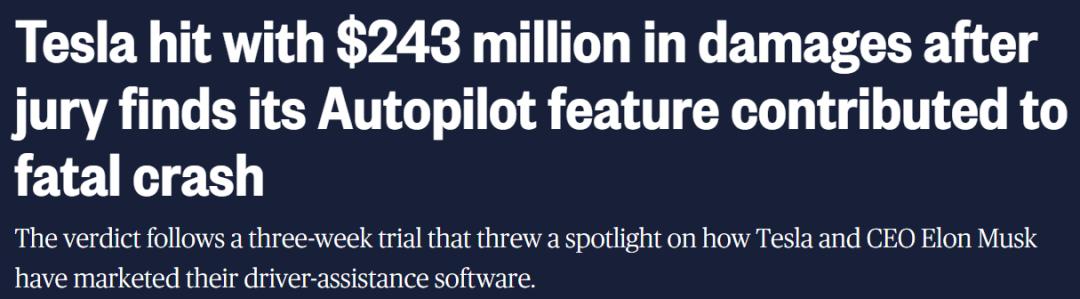
Legal and Financial Implications - The $243 million judgment includes $200 million in punitive damages, which could set a precedent for future cases against automotive companies regarding autonomous driving systems [2][5] - The punitive damages are seen as a "legal virus" that could influence future lawsuits, establishing a psychological anchor for juries in similar cases [5][6] - Companies involved in Level 2/Level 3 autonomous driving must reassess their valuation models to account for potential legal liabilities and risks, which could significantly impact long-term value [6][7] Technological Route Divergence - The judgment may force Tesla to reconsider its "pure vision" technology approach, as the legal implications of accidents during the development of AI models become more pronounced [8][10] - The cost of LiDAR technology may become more attractive to automotive companies as potential legal liabilities increase, shifting the focus from cost-saving to safety redundancy [10][12] - The competitive landscape will evolve, with safety redundancy and all-weather perception capabilities becoming key marketing points for vehicles [12] Commercial Narrative Disruption - The ruling poses a significant threat to Tesla's Full Self-Driving (FSD) business model, which relies on the assumption that the technology will improve over time [13][15] - Legal obligations associated with the term "Full Self-Driving" may increase the company's liability in product liability lawsuits, complicating its market positioning [15] - The next battleground may involve data privacy and AI ethics, challenging the core narrative of AI-driven automotive innovation [15][16]