
FSD)

Search documents
创造力是人类不可替代的竞争力
Xin Lang Cai Jing· 2026-02-26 21:46
Group 1: Artificial Intelligence and Competition - The rise of artificial intelligence (AI) technology is diminishing human competitiveness, as exemplified by Google's AlphaGo defeating world champion Lee Sedol in a 4:1 match in 2016 [2] - AlphaGo integrates several technologies, utilizing deep learning to master a vast number of Go games and continuously applying reinforcement learning to outperform top human players [2] - The emergence of autonomous driving technology, such as Baidu's "萝卜快跑" and Tesla's Full Self-Driving, raises concerns about job displacement for millions of taxi and ride-hailing drivers [3] Group 2: Creativity as a Core Competitiveness - In the face of AI advancements, the future of human competitiveness lies in creativity, which is deemed irreplaceable and essential [3] - Research on individual creativity, conducted during a tenure at Tsinghua University, highlights the importance of nurturing creativity in children rather than conforming them to strict behavioral norms [4] - Studies indicate that external diversity, such as allowing children to express their individuality, enhances internal cognitive flexibility and boosts creativity [5]


马斯克“自动驾驶狂热”难掩销量寒冬!特斯拉2026年面临更严峻考验
Zhi Tong Cai Jing· 2026-01-02 00:05
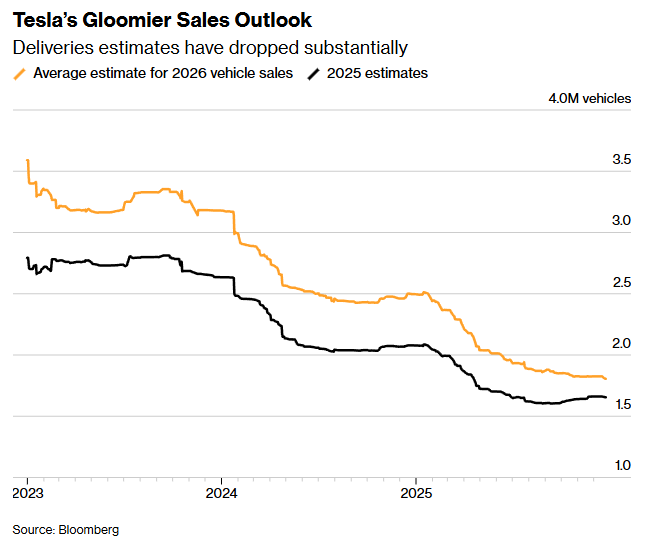
Core Insights - Tesla's stock surged over 11% by the end of 2025, driven by investor confidence in Elon Musk's vision for autonomous vehicles and advancements in AI and robotics [1] - Despite record delivery numbers in Q3, Tesla's overall vehicle sales in the past six months are likely lower than the same period last year, indicating a disconnect between investor sentiment and consumer demand [1][6] - Analysts have significantly downgraded their forecasts for Tesla's vehicle deliveries in 2026, with estimates dropping from over 3 million to around 1.8 million [1][2] Group 1: Sales Performance - Tesla is expected to announce approximately 440,900 vehicle deliveries for Q4, reflecting an 11% year-over-year decline, with some estimates predicting a 15% drop [1] - The company's sales outlook for 2025 has been bleak, with early-year performance hampered by factory upgrades and external political backlash against Musk [4][10] - Analysts predict that Tesla will face further challenges in 2026, particularly after the U.S. ceased federal tax credits for electric vehicle purchases [10] Group 2: Investor Sentiment - Investors are focused on Tesla's long-term vision rather than short-term performance, but concerns about financial headwinds are growing [2] - Musk's efforts to pivot towards a long-term goal of launching a fully autonomous ride-hailing service have helped stabilize stock prices after a significant drop earlier in the year [5] - The introduction of a new compensation plan for Musk, tied to ambitious delivery milestones, has contributed to a rebound in Tesla's stock price [5] Group 3: Competitive Landscape - Tesla's attempts to differentiate itself in the crowded EV market through advanced driver-assistance features have not resonated with consumers as expected, especially in China [6] - Competitors like BYD are outperforming Tesla in sales, with analysts forecasting that BYD will surpass Tesla's global electric vehicle sales for the fifth consecutive quarter [6][9] - The withdrawal of U.S. policy support for electric vehicles may create opportunities for Tesla as other manufacturers scale back their EV investments [10]

288万辆车被查,特斯拉在全球面临调查诉讼,FSD却迎重大升级,国内车主已开始OTA?
3 6 Ke· 2025-10-13 10:40
Core Points - The National Highway Traffic Safety Administration (NHTSA) has initiated an investigation into approximately 2.88 million Tesla vehicles equipped with the Full-Self Driving (FSD) system due to over 50 reports of traffic safety violations and accidents [1] - The investigation includes 58 reports, with 14 accidents resulting in 23 injuries, raising concerns about the FSD system's ability to recognize traffic signals and stop at red lights [1] - Tesla's stock price fell by 5.06% on October 10, resulting in a market value loss of approximately $7.322 billion [1] Group 1: Investigation and Legal Challenges - Tesla's FSD system has faced scrutiny due to safety concerns, with an average of one accident occurring every 6.69 million miles when using FSD, compared to one accident every 0.963 million miles without it [2] - The NHTSA has been investigating Tesla's Autopilot system since August 2021, with at least 322 accidents reported, highlighting "critical safety gaps" [3] - Tesla has faced multiple lawsuits in China regarding the FSD feature's advertised capabilities versus actual performance, with claims of fraud from customers [3][4] Group 2: Technological Developments - Tesla has released a significant update to the FSD system (version 14.1), which includes ten new features aimed at improving environmental perception and handling various scenarios [5] - The FSD system's reliance on a "pure vision" technology approach has sparked debate regarding its safety and effectiveness compared to multi-sensor systems [7] - The recent FSD update has been approved for use in North America, indicating potential for broader deployment in China, although the timeline for HW3.0 hardware models remains uncertain [8]

关键功能出问题,美国政府出手调查288万辆特斯拉
Mei Ri Jing Ji Xin Wen· 2025-10-13 10:17
Core Points - The National Highway Traffic Safety Administration (NHTSA) has initiated an investigation into approximately 2.88 million Tesla vehicles equipped with the Full-Self Driving (FSD) system due to over 50 reports of traffic safety violations and accidents [1] - The investigation includes 58 reports, with 14 accidents resulting in 23 injuries, raising concerns about the FSD system's ability to recognize traffic signals and stop at red lights [1] - Tesla's stock price fell by 5.06% on October 10, resulting in a market value loss of approximately $7.322 billion [1] Group 1: Investigation and Legal Challenges - The NHTSA's investigation is in the preliminary assessment stage, and if unreasonable safety risks are identified, Tesla may be required to conduct a recall [1] - Tesla has faced ongoing scrutiny and legal challenges regarding the safety and maturity of its Autopilot and FSD technologies, with a significant number of accident reports and lawsuits globally [2] - A jury in Florida ruled that Tesla was responsible for a 2019 accident involving the Autopilot system, ordering the company to pay $240 million in damages [3] Group 2: Consumer Complaints and Regulatory Issues - Tesla has been accused of misleading consumers regarding the capabilities of its FSD system, with legal experts suggesting potential violations of advertising laws in China [4] - Multiple lawsuits have been filed in China, with consumers claiming that Tesla's hardware cannot support the advertised FSD capabilities, seeking compensation [3][4] - The recent upgrade to FSD V14.1 includes ten new features aimed at improving environmental perception and response to various scenarios, despite ongoing controversies [5] Group 3: Technical Challenges and Industry Perspectives - Tesla's reliance on a "pure vision" technology approach, which uses cameras and neural networks without lidar, has raised concerns about its ability to ensure safety in all driving conditions [7] - Industry experts highlight the limitations of the pure vision approach, particularly in low-light situations and challenging environmental conditions [7] - The debate over the optimal technical route for autonomous driving continues, with no consensus reached within the industry [7] Group 4: Market and Future Developments - The FSD V14.1 update is currently available only to North American users, but there are indications that it may soon be rolled out in China [8] - The recent software update suggests that Tesla's FSD has passed regulatory approval in China, marking a significant step towards broader deployment [8] - The rollout of FSD features for vehicles with HW3.0 hardware remains uncertain, indicating a cautious approach to market expansion in China [8]
