
财政刺激政策

Search documents
德国通胀率降至2% 年初经济复苏步伐缓慢
Sou Hu Cai Jing· 2026-02-27 14:49
Core Viewpoint - Germany's inflation rate unexpectedly fell to the European Central Bank's target level, indicating a slow economic recovery expected by early 2026 [1] Economic Indicators - February consumer prices increased by 2% year-on-year, lower than January's 2.1%, defying economists' expectations of stability [1] - The German economy shows signs of recovery after years of stagnation, but the central bank describes the momentum as "weak" [1] Fiscal Policy and Economic Growth - Fiscal stimulus measures are anticipated to become more effective in spring, potentially driving economic growth to at least 1% this year and stabilizing inflation at 2% [1] - European Central Bank officials express satisfaction with the price increases and borrowing costs in the Eurozone [1] Interest Rate Outlook - Economists predict no adjustments to interest rates until at least the end of next year, despite current inflation being below target levels [1] - Eurozone inflation data is set to be released next Tuesday, with analysts expecting a figure of 1.7% [1]
消费板块回调,关注港股通消费ETF易方达(513070)、消费ETF易方达(159798)等产品布局机会
Sou Hu Cai Jing· 2026-02-27 11:38
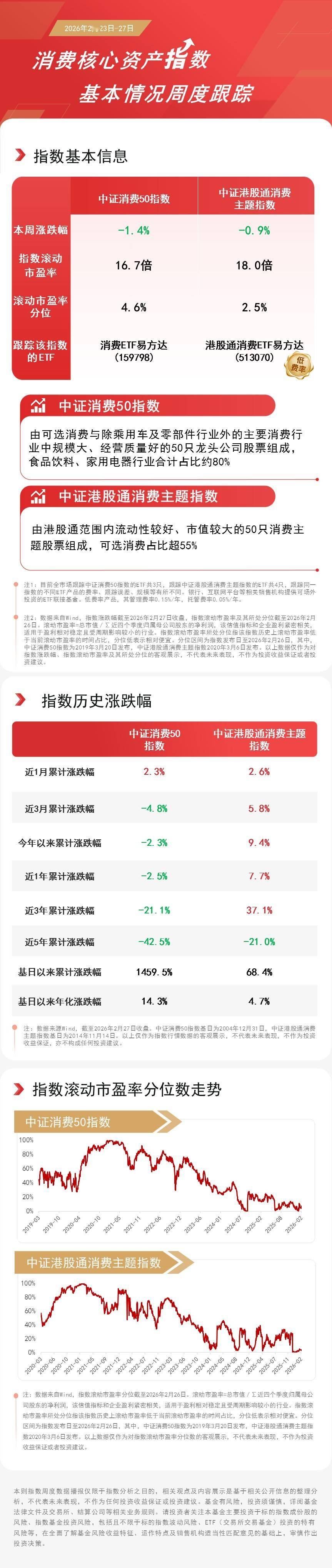
Core Viewpoint - The consumer indices in the Hong Kong stock market have shown a decline, with the CSI Consumer 50 Index down by 1.4% and the CSI Hong Kong Stock Connect Consumer Theme Index down by 0.9%. Despite this, the consumption ETFs have attracted significant capital, indicating ongoing investor interest [1][3]. Group 1: Index Performance - The CSI Consumer 50 Index has a rolling P/E ratio of 16.7 times, while the CSI Hong Kong Stock Connect Consumer Theme Index has a rolling P/E ratio of 18.0 times [3]. - In the past month, the CSI Consumer 50 Index has seen a cumulative decline of 2.3%, while the CSI Hong Kong Stock Connect Consumer Theme Index has increased by 2.6% [6]. - Year-to-date, the CSI Consumer 50 Index is down by 2.3%, whereas the CSI Hong Kong Stock Connect Consumer Theme Index has risen by 9.4% [6]. Group 2: Sector Insights - The consumption performance during the Year of the Rabbit's Spring Festival has shown a mixed trend, with hotels, scenic spots, and high-end liquor performing well, while retail and box office revenues have been generally average [1]. - The macroeconomic environment remains weak, suggesting that the recovery of consumer sentiment may take time, with potential short-term opportunities linked to fiscal stimulus policies [1]. Group 3: ETF Information - The E Fund Consumption ETF (513070) has attracted over 1.5 billion yuan in the past month, indicating strong investor interest in consumption-related assets [1]. - There are currently three ETFs tracking the CSI Consumer 50 Index and four ETFs tracking the CSI Hong Kong Stock Connect Consumer Theme Index, with varying fee structures and tracking errors [4].

消费板块走弱,关注港股通消费ETF易方达(513070)、消费ETF易方达(159798)等产品投资机会
Sou Hu Cai Jing· 2026-02-26 11:04
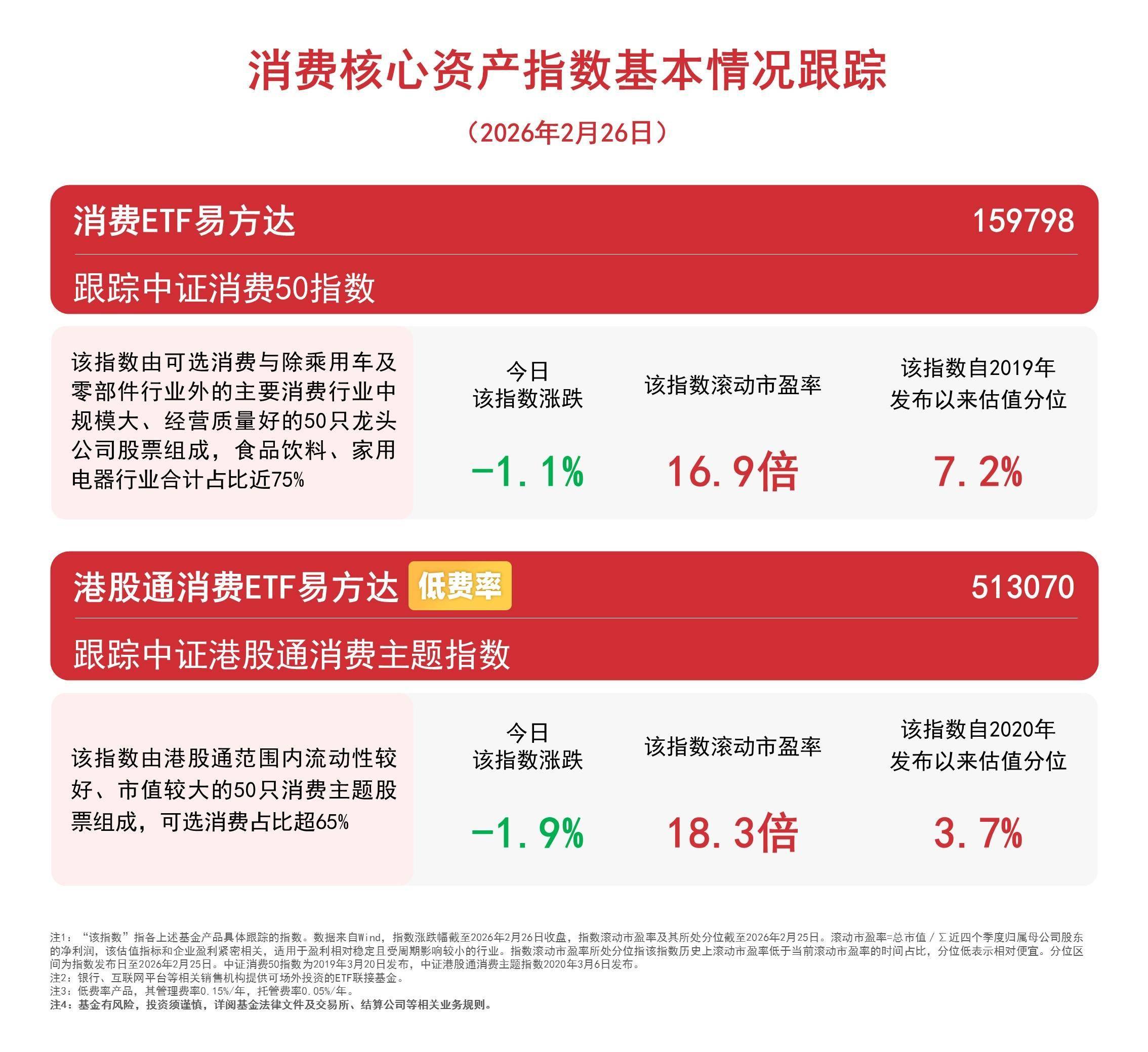
Group 1 - The core viewpoint of the articles indicates a decline in consumer indices, with the CSI Consumer 50 Index down by 1.1% and the CSI Hong Kong Stock Connect Consumer Theme Index down by 1.9% [1] - The E Fund Hong Kong Stock Connect Consumer ETF (513070) has attracted over 1.2 billion yuan in capital over the past 10 trading days, indicating strong investor interest [1] - According to CITIC Securities, the consumption performance during the Year of the Horse Spring Festival shows a mixed trend, aligning with expectations, where sectors like hotels, scenic spots, and high-end liquor exhibit better performance, while retail and box office results are generally average [1] Group 2 - The current macroeconomic environment remains weak, suggesting that the recovery of consumer sentiment may take time [1] - Short-term investment opportunities in consumption may arise from potential fiscal stimulus policies [1]
中信证券:白酒存在贝塔修复机会 建议重点增配品牌龙头
Xin Lang Cai Jing· 2026-02-25 00:50
Group 1 - The core viewpoint of the report indicates that the consumption during the Year of the Horse Spring Festival shows a differentiated performance, aligning with expectations [1] - Sectors such as hotels, scenic spots, and high-end liquor exhibit a favorable level of prosperity, while retail and box office performances are generally average due to the impact of travel diversion [1] - The company maintains the perspective that consumption is in a process of self-recovery, stabilizing with differentiation, and suggests that short-term consumption opportunities may arise from potential fiscal stimulus policies [1] Group 2 - For 2026, the report emphasizes focusing on the wealth effect transmission in the equity market and the operational turning point opportunities driven by supply-side optimization [1] - Long-term allocations should continue to pay attention to structural changes within the market [1]

中信证券:春节消费分化,出行服务亮眼
Xin Lang Cai Jing· 2026-02-25 00:19
Group 1 - The core viewpoint of the report indicates that the consumption during the Year of the Horse Spring Festival shows a differentiated performance, aligning with expectations [1] - Sectors such as hotels, scenic spots, and high-end liquor exhibit favorable market conditions, while retail and box office performances are generally average due to the impact of travel diversion [1] - The report maintains the perspective that consumption is in a process of self-recovery, with stabilization showing differentiation, and highlights the potential for beta opportunities in consumption driven by possible fiscal stimulus policies in the short term [1] Group 2 - The report suggests focusing on wealth effect transmission in the equity market and early operational turning point opportunities driven by supply-side optimization in 2026 [1] - Long-term investment strategies should continue to emphasize structural changes within the market [1]
为何关税未导致2025年美国通胀飙升
Di Yi Cai Jing· 2026-02-04 05:38
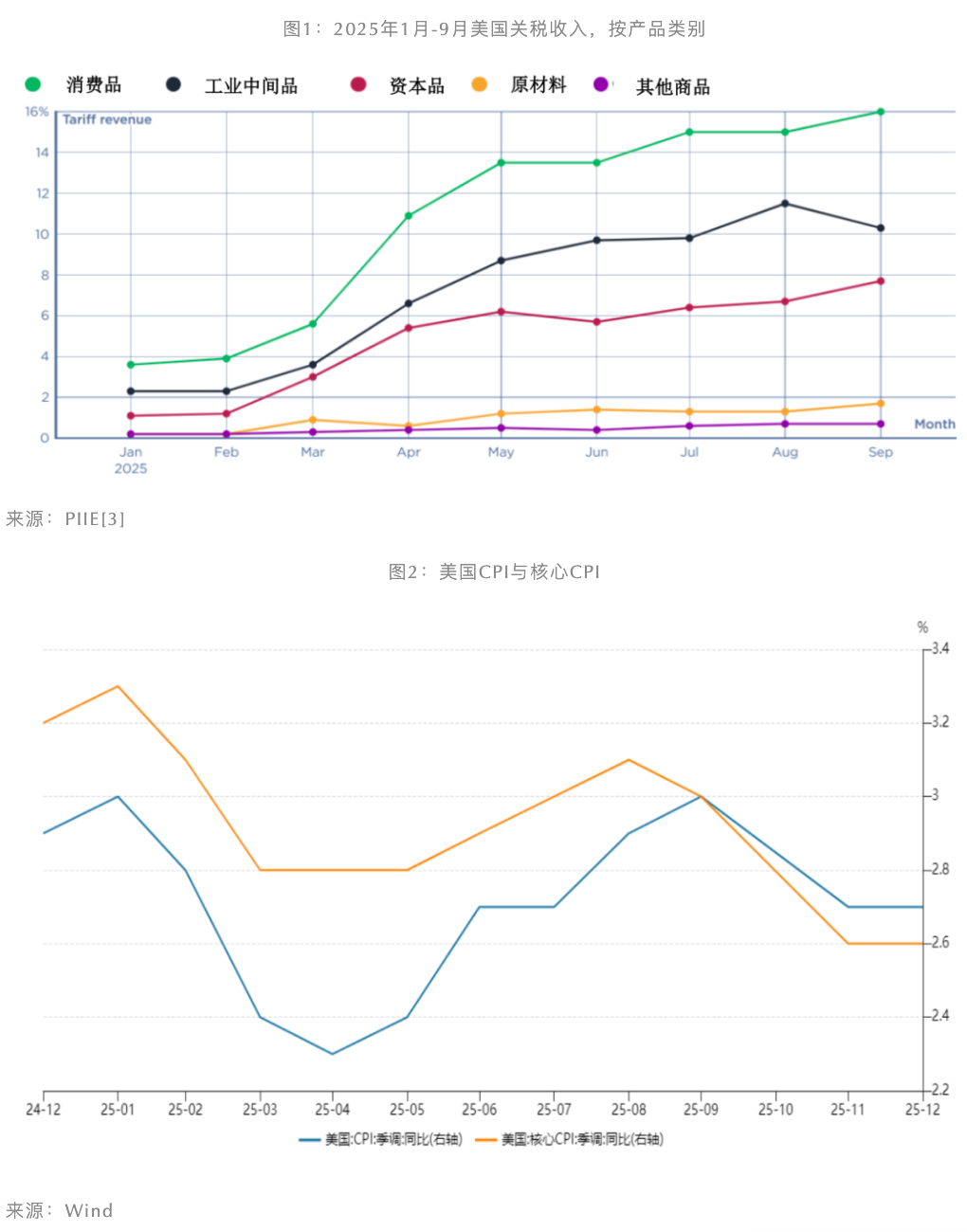
Core Viewpoint - The cost of tariffs in 2025 is primarily borne by U.S. companies, with a significant increase in tariff revenue and a delayed macroeconomic impact on inflation [1][5][15]. Tariff Revenue and Inflation - In 2025, the U.S. Department of Homeland Security collected $287 billion in tariffs, a 192% increase year-on-year, with one-third of this revenue generated in Q4, reflecting a 5.2% increase from the previous quarter [1]. - The Consumer Price Index (CPI) stabilized at 2.7% by the end of 2025, with core CPI growth at 2.6%, lower than the expected 3% [1]. Reasons for Limited Inflation Impact - **Actual Tariff Rates Lower than Statutory Rates**: Research indicates that the effective tariff rates are significantly lower than the official rates, with the average trade-weighted tariff peaking at 32.8% but the actual rate only reaching 14.1% by September 2025 [5][6]. - **Inventory Strategies**: Companies imported goods in advance and built up inventories, allowing them to delay price increases even after tariffs took effect [8][9]. - **Cost Absorption by U.S. Companies**: Studies show that U.S. companies have absorbed nearly all tariff costs, with exporters not significantly lowering prices to share the burden [11][12]. - **Gradual Transmission of Tariff Effects**: The impact of tariffs on retail prices has been gradual, with significant price increases only expected when tariffs reach around 20% [12][13]. Future Implications of Tariffs - **Cost Transfer to Consumers**: As companies deplete their low-cost inventories in 2026, they will likely begin passing on tariff costs to consumers, leading to potential price increases [16][17]. - **Inflation Data Reflection**: Analysts predict that the effects of tariffs will become more apparent in inflation data in 2026, with some expecting CPI to rise significantly due to cost transfers and supply constraints [18][19].
花旗:韩国最早可能于3月推出规模约10万亿韩元的刺激计划
Xin Lang Cai Jing· 2026-01-22 04:45
Core Viewpoint - Citigroup reports that South Korea may introduce a new round of fiscal stimulus worth approximately 10 trillion won (about 6.8 billion USD) as early as March to address uneven economic growth, with potential support for cultural and artistic sectors [1] Group 1: Economic Context - South Korea's economy unexpectedly contracted in the fourth quarter of 2025 due to a comprehensive demand shrinkage, highlighting the challenges faced by policymakers [1] - The weakening of the Korean won and rising financial stability risks have constrained the policy space for stimulating economic growth [1] Group 2: Fiscal Policy Insights - The government is likely to utilize excess tax revenue to increase budget spending without issuing additional bonds [1] - Conflicting signals have emerged regarding the potential for new fiscal stimulus, with the head of the presidential policy office stating that there are currently no plans for an additional budget [1] - Conversely, President Yoon Suk-yeol indicated during a cabinet meeting that there may be opportunities for additional spending in the future and has requested the Minister of Culture to review budget needs in the cultural sector [1]
中信证券:可选消费有所回暖 服务零售成为拉动消费抓手
Xin Lang Cai Jing· 2026-01-21 00:42
Core Viewpoint - The report from CITIC Securities indicates that China's retail sales in December 2025 are projected to reach 45,136 billion yuan, reflecting a year-on-year increase of 0.9%, while retail sales of above-limit goods are expected to be 18,084 billion yuan, showing a decline of 2.0% [1] Group 1: Retail Sales Performance - Excluding automobiles and petroleum, the retail sales growth rate for above-limit goods is expected to be +1.4% [1] - The decline in automobile sales is attributed to a high base effect and the reduction of subsidies, leading to a more pronounced drop [1] - The food and daily necessities sectors are performing steadily, with the growth rate for daily necessities turning positive [1] Group 2: Consumer Behavior and Trends - There is a notable recovery in optional consumption, although the growth rate for national supplementary categories has decreased due to base effects [1] - December's retail sales figures are weaker than expected, with overall commodity sales remaining flat, but there are signs of recovery in optional consumption [1] - Service retail is becoming a key driver for consumption [1] Group 3: Future Outlook - Given the current weak macroeconomic environment, the self-recovery of consumer sentiment is expected to take time, and short-term consumption opportunities may hinge on potential fiscal stimulus policies [1] - For 2026, the focus should be on opportunities driven by wealth effect transmission and supply-side optimization [1] - Long-term investment strategies should emphasize the changes in consumer structure [1]
人民币快涨到7了!
Sou Hu Cai Jing· 2025-12-21 23:57
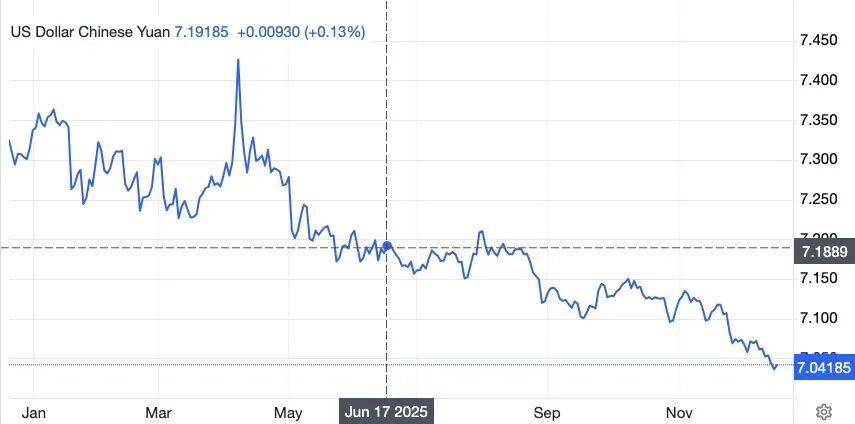
Core Viewpoint - The Chinese Yuan has unexpectedly appreciated this year, contrary to initial expectations of depreciation due to trade tensions and economic pressures [1][10]. Group 1: Factors Influencing Yuan's Appreciation - The Yuan's appreciation can be attributed to two main factors: a weak US dollar contributing approximately 30% and supportive policies contributing around 70% [3][9]. - The US dollar index fell nearly 10% in the first half of the year, stabilizing around 98 in the second half, which influenced the Yuan's performance [5][6]. - Despite the US dollar's weakness, the Yuan's strength in the second half cannot be solely explained by this factor, indicating the importance of domestic policies [6][9]. Group 2: Policy Support and Economic Context - The Chinese government has implemented stronger export tax rebates, with a year-on-year increase of 11.6% in the first half, which has helped maintain foreign exchange earnings [9]. - The Yuan's middle rate has often been adjusted to release appreciation pressure during periods of US dollar weakness, contributing to a net inflow of cross-border capital [9][10]. - The overall economic strategy has shifted to support both exports and prevent capital outflow, leading to a reversal in capital flows compared to previous years [7][9]. Group 3: Future Outlook for the Yuan - The Yuan is expected to appreciate slightly and potentially break the 7 mark, influenced by market expectations of US Federal Reserve rate cuts and upcoming political events in the US [11][12]. - Optimistic scenarios suggest the Yuan could rise to around 6.8, while a baseline scenario indicates fluctuations around 7 [13]. - A pessimistic outlook could see the Yuan return above 7, particularly if domestic demand pressures persist or trade conflicts escalate [14]. Group 4: Long-term Trends - There is a belief that the Yuan may enter a long-term appreciation cycle, driven by increasing trade surpluses and external political factors [15][16]. - The need to expand domestic demand and the upgrading of export structures are seen as supportive of Yuan appreciation, as a stronger Yuan can enhance purchasing power and attract foreign investment [17][18]. - Historical examples from Japan and Switzerland suggest that a stable financial system and significant overseas net assets can support a strong currency, indicating a potential for the Yuan to appreciate despite low domestic interest rates [18][19].
明年市场的焦点,特朗普将为中选出什么招?高盛:降关税和财政刺激!
Hua Er Jie Jian Wen· 2025-12-17 02:00
Core Viewpoint - Goldman Sachs anticipates that the Trump administration is likely to implement tariff reductions and fiscal stimulus measures before the upcoming midterm elections to boost voter sentiment [1][2]. Tariff Reductions - Goldman Sachs predicts that by the end of 2026, the effective tariff rate in the U.S. will decrease by approximately 2 percentage points from current levels, although it will still be 9.5 percentage points higher than early 2025 [1][10]. - The Supreme Court is expected to rule that tariffs imposed by the Trump administration under the International Emergency Economic Powers Act (IEEPA) exceed its legal authority, which could lead to a significant reduction in tariffs [3][10]. - If the Supreme Court rules against the IEEPA tariffs, the Trump administration may need to rely on other legal authorizations, such as the Trade Act of 1974, which allows for tariffs of up to 15% for a period of 150 days [3][4]. - Current IEEPA tariffs contribute approximately 7.5 percentage points to the effective tariff rate, with a potential reduction of about 1.6 percentage points if tariffs are capped at 15% [4]. Fiscal Stimulus Measures - The Trump administration may also utilize fiscal policy to improve economic sentiment ahead of the midterm elections, with a potential second round of fiscal stimulus facing significant hurdles [5][8]. - Goldman Sachs estimates that the first round of fiscal measures will peak in its impact on growth by the second quarter of 2026, with tax refunds expected to increase by nearly $100 billion from February to April [5][6]. - There is a 50% probability that at least $1,000 in stimulus checks will be issued to Americans by the end of 2026, despite challenges in passing a comprehensive fiscal plan [6][8]. Housing Policy and Regulatory Reforms - Goldman Sachs believes that administrative measures related to housing are likely to be implemented, focusing on government-sponsored enterprises (GSEs) such as Fannie Mae and Freddie Mac [9][10]. - Potential options include adjustments in loan pricing, the introduction of 50-year mortgage products, and possibly expanding the GSEs' balance sheets to hold more mortgage-backed securities [9]. - Legislative reforms to simplify the National Environmental Policy Act (NEPA) are also expected to have a significant chance of becoming law in the coming months, which would streamline federal reviews of major infrastructure projects [10].
