
贸易业

Search documents
加央行维稳立场经济疲软博弈凸显
Jin Tou Wang· 2026-02-25 02:34
Core Viewpoint - The Canadian dollar (CAD) is experiencing a weak overall trend with short-term support from the Bank of Canada's steady interest rates, but medium-term prospects are constrained by economic weakness and external trade uncertainties. Group 1: Short-term Factors - The Bank of Canada maintained the benchmark interest rate at 2.25% on January 28, the lowest since July 2022, indicating no rate cuts are expected before March unless significant changes occur [1] - Strengthening economic cooperation between Canada and China, along with a signed cooperation roadmap, is anticipated to boost exports and indirectly support the CAD [1] Group 2: Medium-term Economic Outlook - The Bank of Canada forecasts a GDP growth rate of only 1.1% for 2026, attributed to declining exports, insufficient business investment, and weak labor markets, which also negatively impact consumer spending [1] - Previous significant interest rate cuts in 2025 have lingering effects, continuing to suppress the CAD [1] Group 3: External Environment - Uncertainties in U.S. trade policies, including past tariffs imposed by the Trump administration on Canadian goods, continue to affect the CAD [1] - A slight increase in the U.S. dollar index on February 24 further pressures the CAD exchange rate [1] - As a resource-linked currency, the CAD's performance is also correlated with the prices of commodities like oil [1] Group 4: Technical Analysis - The CAD/USD price center has slightly shifted downward, with a narrowing trading range and no clear trend formation, indicating a digestion of interest rate cuts and a need for indicator recovery [2] - The exchange rate has been fluctuating within the 0.7280-0.7350 range, with key resistance at 0.7350-0.7360 and support at 0.7280 [2] - Predictions for 2026 suggest cautious expectations, with most analysts believing that the Bank of Canada's steady rates will limit downward movement, while economic weakness and export pressures will restrict upward potential [2] Group 5: Investor Focus - Investors are advised to monitor Canadian inflation, unemployment rates, and U.S. trade developments in the short term, while tracking economic recovery, central bank policies, and commodity trends in the medium term [2] - Current exchange rate fluctuations suggest a cautious approach to trading, with recommendations to control positions and hedge effectively [2]
印度尼西亚经济加速回暖
Jing Ji Ri Bao· 2026-02-24 22:12
Core Viewpoint - Indonesia's GDP is projected to grow by 5.11% in 2025, marking a recovery from previous years' slowdown and achieving the highest growth rate since 2022 [1][2][3] Economic Performance - The GDP growth rate for 2025 is higher than 5.03% in 2024 and 5.05% in 2023, indicating a positive trend after two years of decline [1] - Quarterly growth shows a consistent acceleration: Q1 at 4.87%, Q2 at 5.12%, Q3 at 5.04%, and Q4 reaching 5.39%, the highest since Q3 2022 [1][2] Inflation and External Stability - Inflation is projected at a moderate 2.92% for 2025, with core inflation at 2.38%, well within the central bank's target range [2] - As of December 2025, Indonesia's foreign exchange reserves are expected to reach $156.5 billion, sufficient for 6.4 months of imports, indicating strong external account stability [2] Regional Economic Comparison - Indonesia's economic growth of 4.9% in 2025 leads the ASEAN region, surpassing the average growth rate of 4.1% for the five ASEAN countries [3] Growth Drivers - The economic recovery is supported by a balanced contribution from consumption, investment, and exports, with household consumption accounting for 53.14% of GDP [4] - Fixed capital formation is expected to grow by 6.12% in Q4 2025, indicating a new investment cycle [4] - Non-oil and gas manufacturing exports reached $187.82 billion from January to October 2025, representing 80.25% of total exports and a 15.75% year-on-year increase [4] Challenges and Outlook - Despite the positive growth, the 5.11% rate falls short of the government's target of 5.2%, raising concerns about growth potential [5] - Moody's downgraded Indonesia's sovereign credit outlook to negative, reflecting concerns over policy predictability and fiscal sustainability [6] - The government remains optimistic, setting a 2026 growth target of 5.4%, with various institutions predicting growth between 5.0% and 5.1% for 2026 [6][7]
广开首席产研院展望2026年全球经济金融趋势:世界经济面临“四重变局”
Sou Hu Cai Jing· 2026-02-09 09:27
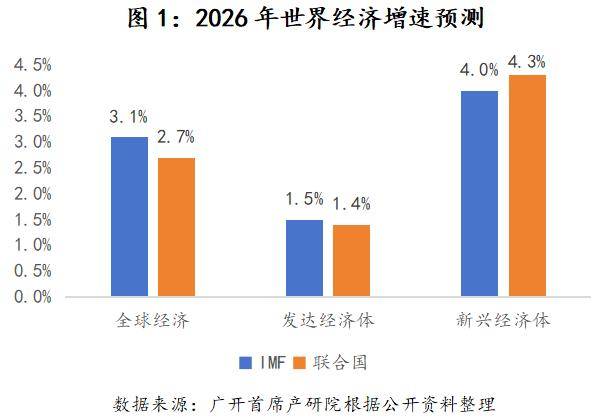
Group 1 - The global economy is expected to face challenges in 2026 due to geopolitical tensions, trade protectionism, and inflationary pressures, leading to a projected growth rate of 2.7%-3.1%, slightly down from 2025 [2][3] - Emerging economies, particularly in Asia, are anticipated to show stronger growth, with East Asia, South Asia, and Africa projected to grow at rates of 4.4%, 5.6%, and 4.0% respectively [3] - The U.S. economy is projected to grow at 1.8%-2.2%, while the Eurozone and Japan are expected to see much lower growth rates of 0.9%-1.2% and 0.7%-0.9% respectively, indicating a slowdown in developed economies [3][5] Group 2 - Inflation is expected to moderate globally, decreasing from 3.4% in 2025 to 3.1% in 2026, although some developed economies may still face inflationary pressures due to sticky service prices and delayed tariff impacts [5][6] - The Federal Reserve's monetary policy may experience significant volatility, with potential for both aggressive rate cuts and rapid shifts to rate hikes depending on inflation trends [7] Group 3 - U.S.-China trade relations are expected to enter a phase of relative easing in 2026, moving towards selective cooperation in non-sensitive areas, as indicated by recent U.S. policy adjustments [10][11] - China is actively promoting dialogue and cooperation in emerging industries, which may enhance bilateral trade interactions and stabilize economic expectations [11] Group 4 - The global trade environment is showing signs of structural recovery, with the U.S. likely to pragmatically adjust its trade protection measures and engage in multilateral cooperation [15][16] - "South-South trade" is expected to gain importance, with emerging economies seeking to reduce reliance on developed markets, projected to grow at 8% in 2025 and continue strengthening in 2026 [16][19] Group 5 - The international financial markets are anticipated to experience increased volatility, with U.S. stocks entering a phase of "structural bull market" characterized by high valuations and weak growth [20][21] - Emerging market stocks are expected to attract more investment due to favorable conditions such as a weaker dollar and improved trade environments, particularly in Asian economies [22] Group 6 - The U.S. dollar is projected to remain weak in 2026, influenced by rising government debt and a potential shift towards "de-dollarization" [23][25] - Non-dollar currencies are expected to show divergence, with the Chinese yuan likely to appreciate moderately against the dollar, while the euro and yen may experience fluctuations based on economic conditions [26] Group 7 - Gold prices are expected to remain strong amid geopolitical risks and a weakening dollar, with projections indicating a price range of $4,500 to $5,500 per ounce in 2026 [27]

【环球财经】印尼2025年GDP同比增长5.11%
Xin Hua Cai Jing· 2026-02-05 12:25
Core Insights - Indonesia's GDP is projected to grow by 5.11% in 2025, marking a three-year high but slightly below the government's target of 5.2% [1] Economic Performance - The manufacturing sector is the core driver of economic growth, contributing 19.07% to the GDP [1] - The combined contribution of five key industries—manufacturing, trade, agriculture, construction, and mining—accounts for over 60% of the economic growth [1] Supporting Factors - Despite external challenges, Indonesia's economy remains stable, supported by improved consumer spending and increased investment [1]
咸亨国际:多名股东拟减持股份3%
Ge Long Hui A P P· 2026-02-05 09:36
Core Viewpoint - Xianheng International announced plans for a share reduction by five limited partnership entities, which will collectively reduce their holdings by up to 12.2818 million shares, representing 3% of the company's total share capital [1] Group 1: Share Reduction Details - The planned share reduction will occur between March 10, 2026, and June 9, 2026, through centralized bidding and block trading [1] - The maximum number of shares to be reduced via centralized bidding is 4.0939 million shares, while the maximum for block trading is 8.1879 million shares [1] Group 2: Current Shareholding Status - As of the announcement date, the five limited partnership entities hold a total of 231 million shares, which accounts for 56.53% of the company's total share capital [1]

南非努力巩固强劲复苏势头
Jing Ji Ri Bao· 2026-02-04 22:17
Economic Growth and Recovery - South Africa's economy has shown strong recovery with GDP growth exceeding expectations for four consecutive quarters, improved consumer confidence, and increased capital investment [1] - The unemployment rate is steadily declining, and poverty and inequality have significantly reduced, reflecting the positive impact of collective efforts to rebuild the economy [1] Infrastructure Investment - The Presidential Economic Advisory Council recommends increasing public infrastructure spending and reducing business operating costs to transform recent economic progress into sustainable growth [2] - Key infrastructure sectors such as electricity, logistics, and water are undergoing structural transformation, which is expected to enhance market competition and lower overall economic costs [2][3] Electricity and Logistics Reforms - Reforming the electricity sector is crucial for economic growth, as a competitive electricity market is necessary to lower costs, which is vital for inclusive growth and social development [3] - Enhancing the efficiency of railways, ports, and freight corridors is essential for exports, industrialization, and job creation [3] Government Commitment and Challenges - The South African government has committed to investing over 1 trillion rand in public infrastructure projects over the next three years, signaling strong support for infrastructure investment [3][5] - Despite positive economic indicators, South Africa faces ongoing challenges, including addressing employment pressures, balancing economic rights for black citizens, and combating crime and corruption [5] Global Economic Context - South Africa must continue to drive investment growth and job creation amid global economic uncertainty and rising protectionism, emphasizing the need to strengthen competitiveness and expand market access, particularly in Africa [4] - The recent appreciation of the rand against the dollar indicates resilience in South Africa's trade amidst global trade shifts [5]
德国1月失业人数突破300万创12年新高
Sou Hu Cai Jing· 2026-01-31 12:07
Group 1 - The number of registered unemployed in Germany reached 3.085 million in January, an increase of 177,000 from the previous month, marking the highest level in 12 years [1] - The unemployment rate in Germany rose to 6.6% in January [1] - The German government has implemented several economic support measures, but their effectiveness remains limited, indicating that economic recovery must be a core issue this year [1] Group 2 - The German labor market is currently experiencing insufficient momentum, with the rise in unemployment primarily attributed to seasonal factors [1] - Germany's economy is projected to shrink consecutively in 2023 and 2024, with a slight growth of 0.2% expected in 2025 [1] - The German federal government's annual economic report has downgraded the growth forecast for 2026 to 1%, a reduction of 0.3 percentage points from last autumn's predictions, highlighting ongoing pressures on economic recovery [1] Group 3 - Analysts point out that Germany's economy faces long-term challenges such as high energy prices, weak global demand, and slow progress in structural reforms [2] - In 2025, Germany's exports to the U.S. are expected to be significantly impacted by external factors like increased tariffs, leading to a decline in overall exports for the third consecutive year [2] - While large-scale investments in infrastructure and defense are anticipated to provide some support to the economy, a lack of accompanying structural reforms may delay a noticeable economic recovery [2]
又一国宣布:对华免签!
Shen Zhen Shang Bao· 2026-01-15 08:12
Group 1 - The core point of the article is that starting from January 16, 2026, Chinese citizens will be allowed to enter the Philippines visa-free for a maximum stay of 14 days, applicable only to those entering through Manila and Cebu airports [1] - The Philippine Department of Foreign Affairs stated that this measure aligns with the President's goals of promoting trade, investment, tourism, and enhancing cultural exchanges between the two countries [1]

全国商务工作会议深入实施提振消费行动 推动零售业创新发展
Xin Lang Cai Jing· 2026-01-12 03:15
Group 1 - The national business conference held on January 10-11 outlined eight key tasks for the national business system by 2026, focusing on consumption, market systems, trade innovation, foreign investment, international trade rules, foreign investment management, bilateral trade cooperation, and security in openness [1] - The conference emphasized the implementation of a special action to boost consumption, aiming to create the "Buy in China" brand, enhance service consumption, and optimize policies for upgrading consumer goods [1] - The goal is to develop a modern market and circulation system, promoting a unified national market and advancing the integration of domestic and foreign trade [1] Group 2 - Trade innovation will be promoted through the "Export China" brand, with a focus on optimizing goods trade, developing service trade, and encouraging digital and green trade [2] - The strategy includes enhancing foreign investment attractiveness by expanding service sector openness and improving investment promotion and service systems [2] - Effective foreign investment management will involve guiding cross-border supply chain layouts and enhancing overseas service systems, particularly in the context of the Belt and Road Initiative [2] Group 3 - The conference aims to deepen multilateral and bilateral economic cooperation, implement global initiatives, and reform global economic governance [2] - There is a focus on risk prevention and establishing a robust security network for openness, including improving legal frameworks and trade risk management [2]
深入实施提振消费行动 推动零售业创新发展
Xin Lang Cai Jing· 2026-01-11 17:16
Group 1 - The national business conference outlined eight key tasks for the business system by 2026, focusing on enhancing consumption, modern market systems, trade innovation, foreign investment, international trade rules, foreign investment management, bilateral cooperation, and security in openness [1] - The conference emphasized the implementation of a consumption boost initiative, aiming to create the "Buy in China" brand, enhance service consumption, and optimize policies for upgrading consumer goods [1] - The development of a modern market and circulation system is prioritized, with efforts to promote a unified national market and innovate in the retail sector [1] Group 2 - Trade innovation will be promoted through the "Export China" brand, with a focus on optimizing goods trade, developing service trade, and encouraging digital and green trade [2] - The conference aims to enhance foreign investment attractiveness by promoting the "Invest in China" brand and improving the foreign investment service guarantee system [2] - Effective foreign investment management will be implemented to guide cross-border supply chain layouts and enhance overseas service systems, particularly in the context of the Belt and Road Initiative [2]
