经销商体系变革

Search documents
宗馥莉卸任娃哈哈集团董事长 年仅31岁许思敏接任全面掌舵
Sou Hu Cai Jing· 2025-11-27 06:56
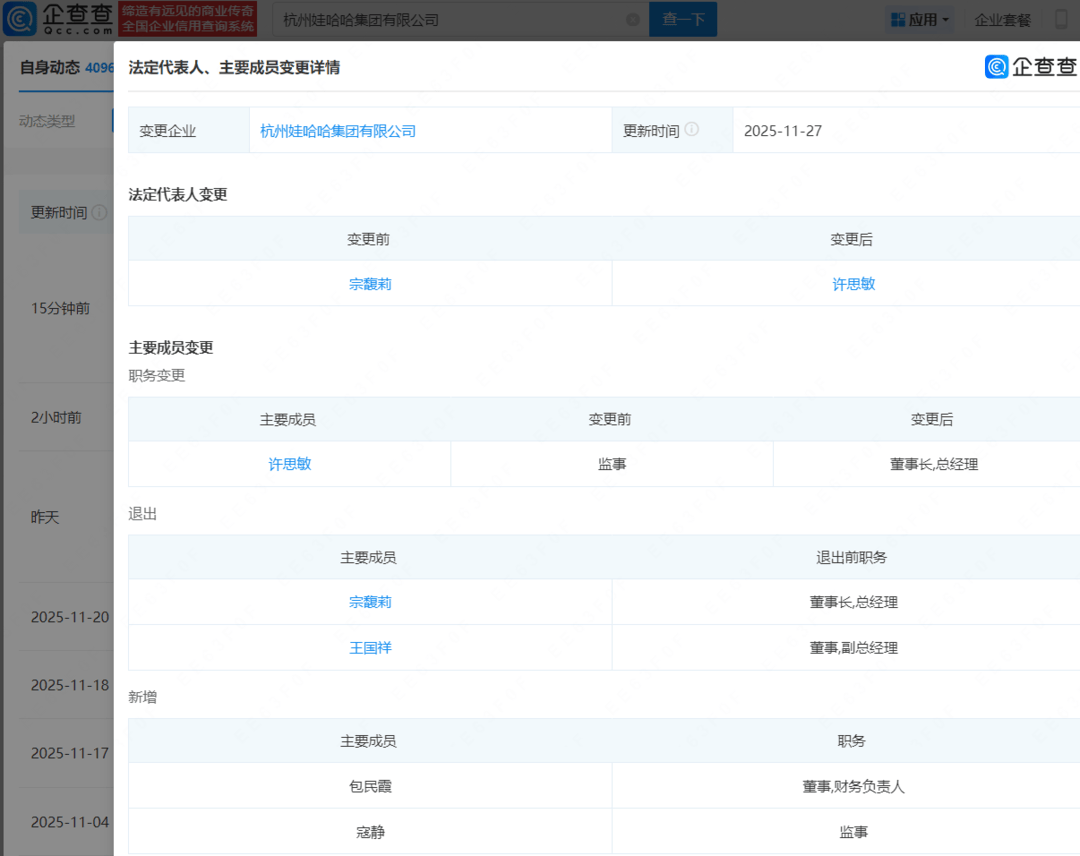
Group 1 - The core point of the article is the leadership transition at Wahaha Group, with founder Zong Qinghou's daughter, Zong Fuli, officially resigning from all management positions, and Xu Simin taking over as the new legal representative, chairman, and general manager [1][2][3] - Zong Fuli submitted her resignation on September 12, and the changes were formalized with a significant management reshuffle, including the resignation of Wang Guoxiang and the appointment of Bao Minxia and Kou Jing to key positions [1][2] - Xu Simin, born in 1994 and a Zhejiang University law graduate, has a background in legal affairs and was promoted to the core management team under Zong Fuli's leadership [3][4] Group 2 - Under Zong Fuli's leadership, Wahaha achieved a revenue of 70 billion yuan in 2024, marking a 40% increase from the previous year [4] - The company is undergoing a transformation in its distribution system, with a new high threshold for distributors, leading to the exit of some smaller distributors [8] - Zong Fuli remains a significant shareholder with 29.4% ownership, while the largest shareholder is Hangzhou Shangcheng District Wen Shang Lv Investment Holding Group Co., Ltd. with 46% [5][6] Group 3 - Following her resignation, Zong Fuli has shifted her focus to Hongsheng Beverage Group, where she is expected to leverage her industry experience [9] - The management change signifies a new era for Wahaha Group, with Xu Simin at the helm, while Zong Fuli's influence continues through her substantial shareholding [9]

宗馥莉请辞这个月,娃哈哈经历了什么
Xin Lang Cai Jing· 2025-10-12 09:55
Core Viewpoint - The recent leadership changes and brand strategy shifts at Wahaha Group, following the death of founder Zong Qinghou, indicate a significant transformation in the company's direction and operations, particularly under the leadership of his daughter, Zong Fuli [1][6]. Group 1: Leadership Changes - Zong Fuli resigned from her positions as legal representative, director, and chairman of Wahaha Group on September 12, 2023, marking her second resignation, which was approved by the shareholders' meeting and board of directors [1][2]. - Following Zong Fuli's resignation, Xu Simin was appointed as the new general manager of Wahaha Group, leaving the chairman position vacant [1][2]. Group 2: Brand and Trademark Issues - The ownership structure of Wahaha Group complicates the use of the "Wahaha" trademark, requiring unanimous consent from all shareholders for its use, which could hinder Zong Fuli's new company, Hongsheng, from utilizing the trademark [5][6]. - Wahaha Group plans to transition to a new brand, "Wawa Xiaozong," starting from the 2026 sales year, as part of its strategy to resolve historical trademark issues [6][9]. Group 3: Business Operations and Strategy - The distribution network of Wahaha is undergoing significant changes, with reports indicating that the company is terminating relationships with distributors generating less than 3 million yuan in annual sales [9]. - Zong Fuli has implemented a series of reforms aimed at standardizing and digitizing operations, including transferring employee contracts to Hongsheng Group and discontinuing profit-sharing arrangements [9][11]. Group 4: Company Name Changes and Restructuring - Several companies previously associated with Wahaha have been renamed to include "Hongsheng," indicating a shift in branding and operational focus [11][13]. - The Shanghai and Zhejiang Wahaha factories have experienced operational changes, including the potential closure of the Shanghai factory and the transfer of sales rights to companies controlled by Zong Fuli [11][13]. Group 5: Internal Dynamics and Challenges - Internal dynamics within Wahaha Group have been affected by the leadership transition, with reports of key personnel changes and investigations into associates of Zong Fuli [15][16]. - Employees express concerns about the rapid changes and the potential impact on the company's legacy and brand value, highlighting the challenges of establishing a new brand in the fast-moving consumer goods sector [9][16].
昔日超级大白马,掉队了
格隆汇APP· 2025-09-07 07:57
Core Viewpoint - Gree Electric Appliances, once a leading player in the air conditioning market, is experiencing a decline in growth and market share, facing intense competition from companies like Xiaomi and Midea [2][8][19]. Group 1: Market Position and Competition - In July, Xiaomi surpassed Gree in online market share for air conditioners, with Xiaomi at 16.71% and Gree at 15.22% [2]. - Gree's market capitalization has dropped significantly, losing over 20 billion yuan, and currently stands at just over 230 billion yuan, ranking third among white goods leaders [4][5]. - The air conditioning market is becoming increasingly competitive, with Midea and Haier also posing significant challenges to Gree [7][19]. Group 2: Financial Performance - Gree's revenue for the first half of the year decreased by 2.46% compared to the previous year, while net profit increased by 1.95% [13]. - The company's cash flow from operating activities saw a substantial increase of 453.06% [13]. - Gree's air conditioning business, which accounts for nearly 80% of its revenue, reported a negative growth of 5.09% [14][44]. Group 3: Strategic Challenges - Gree's reluctance to engage in price wars has resulted in a higher average selling price for its air conditioners, but this strategy has led to a decline in market share, now around 18% [21][24]. - The company's traditional dealer system is becoming a hindrance in adapting to the changing sales landscape dominated by online channels [29][34]. - Gree's overseas business remains weak, contributing only about 15% to its main revenue, compared to over 40% for its competitors [46]. Group 4: Future Outlook - Gree's new brand initiative, "Dong Mingzhu Health Home," aims to diversify its product offerings beyond air conditioning, but its effectiveness remains uncertain [50][51]. - The company faces a significant challenge in maintaining its market position as competitors like Xiaomi rapidly expand their market presence [15][18]. - Despite a stable profit margin and cash flow, Gree's low valuation of 7 times earnings reflects investor skepticism about its future growth prospects [72].