
网络化联接

Search documents
浙江诸暨:一个县级市 何以拥有两个“产业冠军”?
Xin Lang Cai Jing· 2026-01-06 17:29
Core Insights - Zhuji, a county-level city in eastern China, dominates the pearl and sock industries, controlling over 80% of China's pearl trade and 70% of the global market [1][2] - The city has transformed from a "nameless factory" to a "world showcase" for pearls and socks, with significant government support and innovation driving growth [1][4] Pearl Industry - Zhuji's pearl industry, known as the "Pearl Capital of China," has an annual output value exceeding 50 billion yuan, with over 9,000 businesses involved in the entire pearl supply chain [1][4] - The establishment of the East China International Jewelry City in 2008 significantly enhanced the reputation of Zhuji pearls [1][4] - The industry has embraced digital transformation, with online sales reaching 26 billion yuan in 2023, supported by live streaming and e-commerce platforms [6][7] Sock Industry - Zhuji's sock industry, led by Datang, is the largest sock production cluster globally, with a scale exceeding 70 billion yuan and thousands of enterprises forming a complete industrial ecosystem [3][4] - The industry has undergone significant innovation, including the development of customized socks for athletes, showcasing the ability to adapt to market demands [3][4] - Digital and intelligent upgrades in production have improved efficiency, reducing labor by 45% and shortening order cycles by 10 days [6][7] Government Support and Market Expansion - The local government has implemented policies to support both the pearl and sock industries, focusing on smart transformation and digital connectivity [5][9] - Zhuji has organized international exhibitions to promote its brands, with over 1,000 companies participating in global trade initiatives [9] - The emphasis on quality and innovation is seen as crucial for sustaining long-term growth in both industries, with companies focusing on product development and craftsmanship [9]
我省出台智改数转网联指南推动大飞机铸件加“数”提升
Xin Hua Ri Bao· 2025-12-26 23:24
Core Insights - Jiangsu Province has introduced the "Implementation Guide for Intelligent Transformation, Digital Upgrade, and Network Connection in the Precision Casting Industry of Large Aircraft Components," aiming for a digitalization rate of 40% and a connectivity rate of 30% by the end of 2027 [1] - The guide emphasizes a tiered development of smart factories, targeting 65% at the basic level, 25% at the standard level, and 10% at the advanced level [1] - The domestic production level of castings, which are core components of aircraft engines, directly impacts the integrity and collaborative efficiency of the large aircraft industry chain [1] Industry Overview - Jiangsu has a significant advantage in the precision casting of large aircraft engine components, with 276 silica sol lost foam casting enterprises, of which 141 are above designated size, forming a comprehensive regional industrial chain [1] - The guide focuses on the intelligent transformation, digital upgrade, and network connection development status in the precision casting industry, addressing key aspects of the product lifecycle including factory construction, process design, quality control, scheduling, production operations, warehousing logistics, equipment management, safety control, energy management, and environmental control [1] Implementation Strategy - The guide analyzes existing issues in the intelligent transformation and digital upgrade process, selecting transformable scenarios and solutions, supplemented by typical case studies [1] - It proposes system architecture design and implementation path planning suggestions, along with examples of successful enterprise practices to guide companies in advancing their intelligent transformation and digital upgrade efforts [1]
推动大飞机铸件加“数”提升
Xin Hua Ri Bao· 2025-12-26 22:01
Core Viewpoint - Jiangsu Province has introduced a guideline for the intelligent transformation, digital upgrade, and network connectivity of the precision casting industry for large aircraft components, aiming for significant improvements in digitalization and connectivity by the end of 2027 [1] Group 1: Digitalization and Connectivity Goals - By the end of 2027, the digitalization rate of equipment in the precision casting industry for large aircraft components is expected to reach 40%, while the connectivity rate is targeted at 30% [1] - The construction of smart factories is planned to develop in a tiered manner, with 65% at the basic level, 25% at the standard level, and 10% at the advanced level or above [1] Group 2: Industry Context and Advantages - Castings are fundamental components of aircraft engines, and their domestic production level directly impacts the integrity and collaborative efficiency of the large aircraft industry chain [1] - Jiangsu has a strong advantage in the precision casting of aircraft engine components, with 276 silica sol lost foam casting enterprises, of which 141 are above designated size, forming a comprehensive regional industrial chain [1] Group 3: Focus Areas of the Guideline - The guideline focuses on key aspects of the product lifecycle, including factory construction, process design, quality control, scheduling, production operations, warehousing logistics, equipment management, safety control, energy management, and environmental control [1] - It analyzes existing issues in the intelligent transformation, digital upgrade, and network connectivity, selects scenarios for improvement, and provides solutions along with typical case studies [1] Group 4: Implementation and Best Practices - Recommendations for system architecture design and implementation path planning are included, along with examples of successful enterprise practices to guide companies in advancing their intelligent transformation and digital upgrades [1]
权威数读|一组数据 读懂我国服务业发展新趋势
Xin Hua She· 2025-09-19 13:47
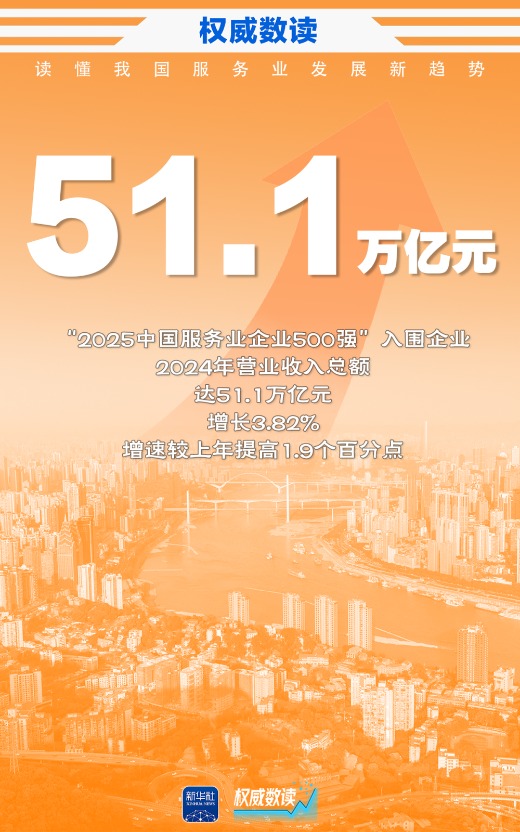
Core Insights - The "2025 China Service Industry Top 500" report was released, indicating a significant increase in total revenue for the listed companies, reaching 51.1 trillion yuan, with an average revenue exceeding 1 billion yuan for the first time at 1,022.2 million yuan [1][8] - The revenue growth rate for the top 500 service companies has accelerated, and the operational efficiency has shown structural improvement, particularly in emerging service sectors [1][8] Revenue and Profitability - The net profit for the 2025 China Service Industry Top 500 reached 834 billion yuan, reflecting a growth of 6.71% [3] - The average revenue per employee is reported at 828.1 thousand yuan, while the average profit per employee stands at 21.5 thousand yuan [3] Industry Composition - Among the top 500 service companies, there are 276 state-owned enterprises and 224 private enterprises, indicating a balanced representation of ownership types [6] - The number of companies in the modern service sector, such as the internet industry, has increased to 184, up by 12 from the previous year [4] Research and Development - Information technology service companies account for 48.67% of the total R&D expenses among the top 500, with an average R&D intensity of 3.80%, supporting the digital transformation and intelligent upgrades across various industries [5]

权威数读丨一组数据,读懂我国服务业发展新趋势
Xin Hua Wang· 2025-09-19 12:32
Core Insights - The "2025 China Service Industry Top 500" report was released, indicating a significant increase in total revenue for the listed companies, reaching 51.1 trillion yuan in 2024, with an average revenue surpassing 1 billion yuan for the first time at 1.0222 billion yuan [1][2][3]. Revenue Growth - The total revenue of the top 500 service companies grew by 3.82% compared to the previous year, with the growth rate improving by 1.0 percentage point [2][3]. - The net profit for these companies reached 8.34 trillion yuan, reflecting an increase of 8.71% [3]. Company Composition - Among the top 500 service companies, the number of traditional service companies in real estate decreased by 14, while the number of modern service companies, particularly in the internet sector, increased by 12 to a total of 184 [4][8]. - State-owned enterprises accounted for 276 of the top 500, while private enterprises made up 224 [8]. R&D Investment - The information technology service sector's R&D expenses constituted 48.67% of total expenditures, with an average R&D intensity of 3.80%, supporting the digital transformation and intelligent upgrades across various industries [5].
2025中国服务业企业500强营收总额突破50万亿元 平均营业收入规模首次突破千亿元
Ren Min Ri Bao· 2025-09-18 21:52
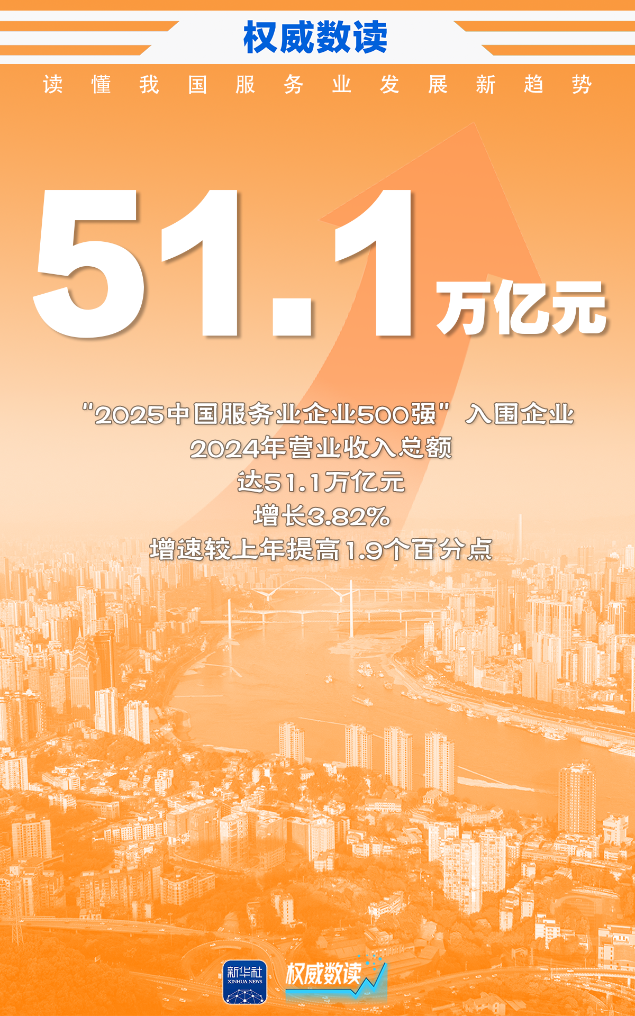
Group 1 - The core viewpoint of the article highlights the significant growth and transformation of China's service industry, as evidenced by the 2025 China Service Industry Enterprises Top 500 list, which shows increased revenue, assets, and overall scale compared to previous years [1][3] - The total revenue of the 2025 China Service Industry Enterprises Top 500 surpassed 51 trillion yuan, marking a 3.82% increase, with the average revenue per company exceeding 1 billion yuan for the first time, reaching 1.022 trillion yuan [1] - The entry threshold for the Top 500 increased by 10.71% to 7.98 billion yuan, indicating a more competitive landscape [1] Group 2 - The net profit of the 2025 China Service Industry Enterprises Top 500 reached 3.34 trillion yuan, reflecting a growth of 6.71%, with per capita revenue and net profit hitting historical highs of 3.281 million yuan and 215,000 yuan, respectively [1] - Emerging services such as internet and information technology services, finance, and business services are rapidly rising, with 184 companies from these sectors included in the Top 500, an increase of 12 from the previous year [1] - The information technology service sector is investing heavily in research and development, with R&D expenses accounting for 48.67% of total expenses and an average R&D intensity of 3.80%, supporting digital transformation and connectivity [2]
徐州深化制造业智改数转网联
Jiang Nan Shi Bao· 2025-05-26 08:35
Group 1 - The core viewpoint of the news is the issuance of the "Xuzhou Action Plan for Deepening the Intelligent Transformation and Digital Transformation of Manufacturing Industry (2025-2027)" aimed at promoting the integration of the real economy and digital economy [1] - By 2027, Xuzhou aims to achieve a level of 72 in the integration of two industries and an intelligent manufacturing development index of 85, with all industrial enterprises above designated size completing their transformation [1] - The plan includes the establishment of 100 intelligent factories and a comprehensive support capability in equipment, networks, software, data, and security to drive the construction of a nationally advanced manufacturing city [1] Group 2 - The digital transformation acceleration action encourages leading enterprises to enhance industry chain collaboration efficiency and supply chain integration, guiding upstream and downstream enterprises to open manufacturing capabilities and design creativity [2] - By 2027, each sector and cluster is expected to cultivate more than 10 benchmark enterprises for digital transformation, achieving full coverage of initial, standardized, and integrated digital transformation for innovative small and medium-sized industrial enterprises [2] - The network connection upgrade action aims to accelerate the deployment of 10G optical networks and the application of technologies like 50G-PON in factories and parks, with 60% of provincial-level development zones expected to become "10G parks" by 2027 [2] Group 3 - The artificial intelligence empowerment action will promote the application of AI across all manufacturing processes, including production, equipment maintenance, marketing services, and supply chain management, while supporting the development of data circulation trading platforms [2] - The industrial ecosystem optimization action will support enterprises in establishing Chief Data Officer (CDO) and Chief Information Officer (CIO) roles, enhancing security management and emergency response capabilities [3] - These measures aim to create a "point-line-surface" linkage for manufacturing upgrades, providing a model for the construction of a nationally advanced manufacturing city [3]