罕见病药

Search documents
又一款罕见病药将退出中国市场,有患者称“吃掉100万”
Di Yi Cai Jing· 2026-01-17 11:11
Group 1 - The high cost of developing rare disease drugs, combined with a limited patient base and high pricing, creates a challenging environment for small to medium-sized enterprises compared to larger pharmaceutical companies [1][4] - Recordati's Chinese subsidiary, Ruikangdi, has officially filed for deregistration, marking its complete exit from the Chinese market, which will result in the discontinuation of several rare disease drugs, including the only oral medication for Cushing's syndrome, Osilodrostat [1][3] - Osilodrostat was approved in China in September 2024 and commercialized in April 2025, but its sales have been limited, with only about 50 patients purchasing the drug in domestic pharmacies [3][4] Group 2 - The average annual treatment cost for Osilodrostat in China is approximately 200,000 yuan, despite the drug being priced at 8,000 yuan per box, which is among the lowest in the world [3][4] - The drug was expected to be included in the national medical insurance directory, which would have reduced out-of-pocket expenses for patients to below 2,000 yuan per month, but it ultimately did not make it into the final directory [3][4] - The exit of Recordati from the Chinese market is not an isolated incident, as other companies like BioMarin have also withdrawn their rare disease treatments, highlighting the ongoing challenges faced by rare disease drug manufacturers in China [4]


新版医保明年1月起执行:114种药品杀入目录,百万抗癌药破冰
Guan Cha Zhe Wang· 2025-12-13 04:01
Core Insights - The 2025 National Medical Insurance Drug List has been officially released, adding 114 new drugs, including 50 innovative Class 1 drugs, with a negotiation success rate of 88%, the highest in seven years [1][3] - The first version of the commercial insurance innovative drug list has been introduced, featuring 5 CAR-T cell therapies and 19 high-priced innovative drugs, marking a significant expansion in coverage [1][5] - The adjustment reflects a strategic upgrade in China's medical insurance from "basic coverage" to "basic + high-end coverage," addressing the demand for accessible and affordable innovative drugs [1][9] Drug Additions and Market Impact - The new drug list includes 114 drugs, with 44% being Class 1 innovative drugs, and a total of 3,253 drugs now covered under the insurance [3] - Notable winners include Heng Rui Pharma, which secured 20 new drug approvals, and Eli Lilly, whose drug Tirzepatide has entered the Chinese market, benefiting 140 million diabetes patients [3][4] - The inclusion of CAR-T therapies in the commercial insurance list allows for reimbursement of high-cost treatments, which were previously inaccessible to many patients [5][7] Innovations in Treatment - The new list includes significant advancements in treatments for Alzheimer's disease, with two new drugs targeting amyloid beta accumulation, providing options for over 10 million patients in China [7] - The addition of 13 rare disease drugs fills coverage gaps in four rare disease areas, expanding the total number of rare disease drugs covered to approximately 100 [8] - The adjustment also emphasizes pediatric medications, with a separate review channel for children's formulations, indicating a positive shift in addressing children's healthcare needs [9] Strategic Implications - The 2025 adjustment signifies a shift towards a dual-track medical payment system in China, combining basic medical insurance with commercial insurance to meet both fundamental and advanced healthcare needs [9] - The rapid inclusion of innovative drugs into the insurance system reflects a decade of progress in China's pharmaceutical landscape, transitioning from rare domestic innovations to a robust pipeline of new therapies [9]



双目录初审公示:6个药品发生变化 多款创新药、罕见病药引关注
2 1 Shi Ji Jing Ji Bao Dao· 2025-08-28 11:41
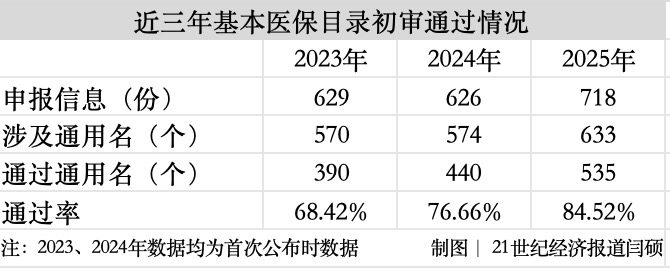
Core Insights - The National Healthcare Security Administration (NHSA) has published the preliminary review results for the 2025 medical insurance and commercial insurance innovative drug directory, with significant changes in the approval status of six drugs compared to the previous version [1][2]. Summary by Categories Drug Approval Changes - Six drugs have had their approval status changed, with two drugs (Injectable Risperidone Microspheres and Injectable Triptorelin Acetate) being disapproved, while two others (Levodopa Injection and Calcium Gluconate Sodium Chloride Injection) have been approved [1][3]. - The oral suspension of Ursodeoxycholic Acid remains approved, but the conditions for approval have been adjusted [1][3]. Application Statistics - For the 2025 directory adjustment, the NHSA received 718 applications, involving 633 drug generic names, with 535 passing the preliminary review [1][2]. - The approval rate has increased significantly, reaching 84.52% this year, compared to 68.42% in 2023 and 76.66% in 2024 [2]. Notable Drugs - Levodopa Injection, used for Parkinson's disease, has been approved and is not an exclusive product, indicating its potential for broader market access [4]. - Injectable Ceftriaxone Sodium Sulbactam, another approved drug, is noted for its broad antibacterial spectrum and safety profile [4]. - The oral suspension of Ursodeoxycholic Acid has had its approval conditions modified to include rare disease categories [6]. Innovative Drug Directory - The commercial insurance innovative drug directory has been introduced alongside the basic medical insurance directory, with 141 applications received, of which 121 passed the preliminary review [2]. - A significant number of drugs in both directories are new, with 303 in the basic medical insurance directory meeting specific conditions for approval [7]. Rare Disease Drugs - The directories include a total of 37 rare disease drugs in the basic medical insurance directory and 35 in the commercial insurance innovative drug directory, with 19 drugs approved in both [10][11]. - Notable rare disease drugs include those from Merck and other companies, which have gained attention for their potential market impact [11][12]. Market Trends - The introduction of the commercial insurance innovative drug directory is expected to enhance market access for several high-profile drugs, including CAR-T therapies that have previously struggled to gain approval [9][12]. - The performance of rare disease drug companies has seen significant stock price increases, indicating strong market interest and potential for growth [13].
双目录初审公示:6个药品发生变化,多款创新药、罕见病药引关注
2 1 Shi Ji Jing Ji Bao Dao· 2025-08-28 11:19
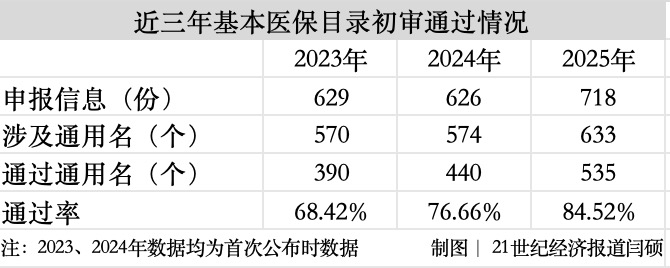
Core Viewpoint - The National Healthcare Security Administration (NHSA) has officially announced the preliminary review results for the adjustment of the 2025 medical insurance and commercial insurance innovative drug catalog, indicating an increase in the number of drugs passing the review and the overall approval rate compared to previous years [1][2]. Summary by Relevant Sections Drug Review Changes - Six drugs underwent changes in their review status, with two drugs, injectable risperidone microspheres and injectable triptorelin, being disapproved, while injectable levodopa and calcium gluconate sodium injection were approved [1][5][6]. - The injectable risperidone microspheres, an exclusive product of Shengzhao Pharmaceuticals, was first launched in mainland China in February 2025 for treating mental disorders [6][7]. - The injectable triptorelin, also an exclusive product, was launched in 2023 for treating prostate cancer and precocious puberty [7]. Approval Statistics - A total of 718 applications were received for the 2025 catalog adjustment, involving 633 drug generic names, with 535 passing the preliminary review, resulting in an approval rate of 84.52% [1][2]. - The approval rates have shown a significant increase over the past three years, with 68.42% in 2023, 76.66% in 2024, and 84.52% in 2025 [2]. Innovative Drug Catalog - The commercial insurance innovative drug catalog was introduced for the first time, with 141 applications received, involving 141 drug generic names, and 121 passing the review [3]. - Among the drugs, 79 were submitted for both the basic medical insurance catalog and the commercial insurance innovative drug catalog [3]. Notable Products - Several notable products are highlighted, including CAR-T products that have previously failed to enter the medical insurance catalog but are now included in the commercial insurance innovative drug catalog [11][12]. - Unique products such as the first and only AKT inhibitor and the only Trop-2 ADC for breast cancer treatment are also included in the catalogs, indicating a focus on innovative therapies [13][14]. Rare Disease Medications - The review process has also included rare disease medications, with 37 drugs in the basic medical insurance catalog and 35 in the commercial insurance innovative drug catalog, of which 19 are approved in both [15][16]. - The approval of rare disease drugs is seen as a significant development, with companies like Beihai Kangcheng gaining attention for their innovative products [20].