奥唑司他

Search documents
8点1氪:贾国龙再发声:“从来不存在两岁的西蓝花”;欧盟多国考虑对930亿欧元输欧美国商品加征关税;12306推出旅客误购限时免费退票服务
36氪· 2026-01-19 00:07
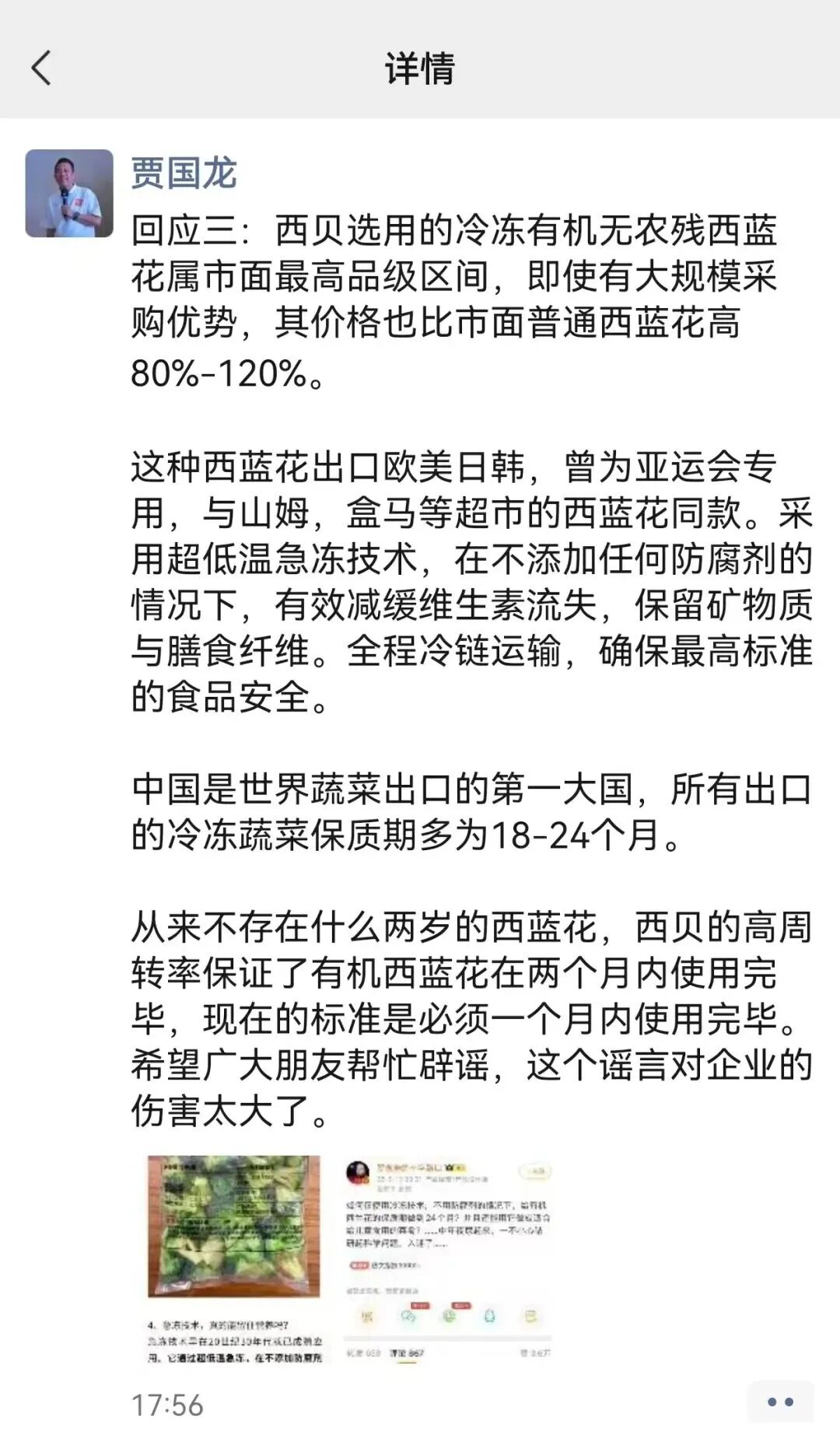
Group 1 - The core viewpoint of the article is that Xibei's frozen organic broccoli is of the highest quality on the market, with prices 80% to 120% higher than regular broccoli, and there has never been a case of "two-year-old broccoli" in their supply chain [4][5]. - Xibei's frozen broccoli is exported to Europe, the United States, Japan, and South Korea, and was previously used for the Asian Games, ensuring high standards of food safety through ultra-low temperature freezing technology and cold chain transportation [5]. - The shelf life of exported frozen vegetables is typically 18 to 24 months, but Xibei ensures that their organic broccoli is used within two months, with a current standard of one month [5]. Group 2 - The article mentions that Bilibili (B站) expects users to watch over 83 billion minutes of content from its top 100 creators by 2025, indicating significant engagement on the platform [17]. - AMD has committed to keeping the prices of its Radeon graphics cards within a range that is affordable for average consumers, addressing the issue of skyrocketing prices due to DRAM shortages [10]. - The article highlights that the global largest automotive supplier Bosch is facing financial pressure, with a projected profit margin below 2% for 2025, largely due to restructuring costs [16].

8点1氪丨贾国龙再发声:“西贝从来不存在两岁的西蓝花”;特朗普宣布将对欧洲8国加征关税;铁路12306平台推出旅客误购限时免费退票服务
3 6 Ke· 2026-01-19 00:07
Group 1 - Bilibili announced that by 2025, the total viewing time of content from the top 100 creators will exceed 83 billion minutes, with an average of over 250 million minutes viewed per video [12] - AMD committed to keeping the prices of its Radeon graphics cards within a range that is acceptable to ordinary consumers, aiming to stabilize memory supply through long-term partnerships with DRAM suppliers [6][7] - The People's Bank of China announced that the minimum down payment ratio for commercial property loans will be adjusted to no less than 30%, adapting to changes in the real estate market [7] Group 2 - Star River Dynamics apologized for the failure of the first flight test of its commercial rocket, the Vesta II, and is currently analyzing the cause of the anomaly [5] - The European Union is considering imposing tariffs on €93 billion worth of goods imported from the US in response to US tariffs on eight European countries [4] - Recordati's subsidiary, Recordati China, has officially filed for deregistration, marking its exit from the Chinese market, which will affect the supply of rare disease medications [8]
跨国罕见病药企退出中国,有患者几年吃了100万
Jing Ji Guan Cha Bao· 2026-01-18 05:07
Core Viewpoint - Recordati's subsidiary in China, Ruikangdi, has officially filed for deregistration and will completely exit the Chinese market, ceasing all business activities and supply of rare disease medications, including the only oral drug for Cushing's syndrome, Osilodrostat [1][2] Group 1: Company Actions - Ruikangdi announced the completion of its liquidation process on December 11, 2025, and will terminate all operations shortly [1] - The exit will result in the discontinuation of several rare disease drugs, including Osilodrostat, which was only recently commercialized in China [1][2] - Recordati had high expectations for Osilodrostat's sales in China, where it was priced at approximately 8,000 yuan per box, with an average annual treatment cost of around 200,000 yuan [1] Group 2: Market Challenges - The failure to include Osilodrostat in the national medical insurance directory has been cited as a significant factor in Ruikangdi's decision to exit [3][4] - The market for rare disease drugs in China faces challenges such as high development costs, limited patient populations, and reliance on multi-tiered payment systems, which complicate access to these medications [2][3] - The number of patients purchasing Osilodrostat in domestic pharmacies is estimated to be around 50, highlighting the limited market penetration [2] Group 3: Industry Trends - Ruikangdi's exit reflects a broader trend of multinational pharmaceutical companies reassessing their strategies in the Chinese market, with several companies restructuring or divesting their operations [4][6] - The exit of Ruikangdi and other companies may lead to increased opportunities for domestic pharmaceutical firms and could drive innovation and upgrades within the local industry [6]
新浪财经资讯AI速递:昨夜今晨财经热点一览 丨2026年1月18日
Xin Lang Cai Jing· 2026-01-17 23:25
Group 1: Policy Changes and Industry Impact - The Ministry of Finance and the State Taxation Administration announced the cancellation of export tax rebates for photovoltaic products starting April 1, 2026, with battery product rebates gradually phasing out, aimed at curbing low-price competition in overseas markets [1][10] - The photovoltaic industry is currently not profitable, and this policy is expected to directly reduce company revenues, causing short-term pain [1][10] - Experts believe that while the policy may help rationalize overseas market prices, addressing the issue of "involution" requires technological breakthroughs and industry self-discipline [1][10] Group 2: Commodity Price Fluctuations - Recent significant increases in tomato prices across multiple regions in China have been observed, with retail prices ranging from 5 to 18 yuan per pound, and wholesale prices rising over 80% year-on-year [1][11] - The price surge is attributed to continuous rainfall during the summer and autumn seasons, leading to plant damage and reduced yields [1][11] - It is expected that prices will significantly decline by late January as new batches of tomatoes come to market [1][11] Group 3: Market Challenges and Company Responses - Shenzhen's Shui Bei and Cheng Xing Silver Tower have been accused of delivery delays, with some merchants claiming losses exceeding 300,000 yuan, and over 350 people in a rights protection group [1][12] - The past year saw a 214% increase in spot silver prices, leading many silver merchants to adopt a "payment before delivery" model, which has raised credit risks due to market volatility [1][12] - Legal experts advise investors to verify qualifications and clarify delivery and refund terms when signing contracts, emphasizing the importance of preserving evidence [1][12] Group 4: Resource Supply and Industry Development - The first shipment of 200,000 tons of iron ore from the world's largest iron ore project, Simandou, has arrived at Zhejiang Shengsi Port, marking the full integration of its supply chain [1][13] - The project, located in Guinea, has a massive reserve and is expected to supply 120 million tons annually once fully operational, significantly enhancing China's direct supply and security of iron ore resources for the steel industry [1][13] Group 5: Economic Indicators and Trends - China's total electricity consumption is projected to exceed 10 trillion kilowatt-hours for the first time in 2025, reaching 10.4 trillion kilowatt-hours, a 5% year-on-year increase, setting a new global record for a single country [1][14][15] - This milestone reflects the strong resilience and large scale of the Chinese economy, driven by stable macroeconomic conditions, increased electrification, and sustained high temperatures [1][14][15] - Notably, electricity consumption in emerging industries such as new energy vehicles and the digital economy is growing rapidly, while high-energy-consuming industries are experiencing a slowdown, indicating a shift towards high-tech and high-value-added sectors [1][14][15] Group 6: Corporate Financial Health - Bosch, the world's largest automotive supplier, has warned that its operating profit margin will fall below 2% in 2025, significantly lower than its long-term target of 7% [1][4][15] - The company's revenue is approximately 91 billion euros, but actual revenue has declined when excluding acquisition impacts [1][4][15] - The profit reduction is primarily due to restructuring costs of 3.1 billion euros and market challenges, prompting Bosch to initiate layoffs to cope with the pressures of electrification, weak demand, and intense competition [1][4][15]
又一款罕见病药将退出中国市场
Xin Lang Cai Jing· 2026-01-17 15:37
Core Viewpoint - Recordati's subsidiary in China, Ruikangdi, has officially filed for deregistration, marking its complete exit from the Chinese market, which will result in the discontinuation of several rare disease medications, including the only oral drug for Cushing's syndrome, Osilodrostat [1][3]. Group 1: Company Actions - Ruikangdi's exit from the Chinese market will lead to the cessation of supply for its rare disease drugs, significantly impacting patients reliant on these medications [1]. - Osilodrostat was approved in China in September 2024 and commercialized in April 2025, but has been available since 2021 as part of a pilot program in Boao Lecheng [3]. Group 2: Patient Impact - The withdrawal of Ruikangdi is seen as a critical loss for Cushing's syndrome patients, as Osilodrostat is considered a "lifesaving drug" [3]. - A patient who has been on Osilodrostat for four years reported spending approximately 1 million yuan on the medication [3]. Group 3: Market Dynamics - Osilodrostat's price in China is around 8,000 yuan per box, with an average annual treatment cost of about 200,000 yuan, despite being one of the lowest-priced markets globally [3]. - The drug was expected to be included in the national medical insurance directory, which would have reduced out-of-pocket costs for patients to below 2,000 yuan per month, but it ultimately was not included [3]. Group 4: Industry Challenges - The high cost of developing rare disease drugs and the limited patient population make pricing and reimbursement a significant challenge, particularly in China where commercial insurance is still developing [4]. - The market for rare disease drugs is further complicated by the fact that only about 50 patients in China have purchased Osilodrostat, indicating low market penetration [4]. - The exit of Recordati is not an isolated incident, as other companies like BioMarin have also withdrawn rare disease treatments from the Chinese market, highlighting the difficulties faced by small to mid-sized firms in this sector [4][5].

又一款罕见病药将退出中国市场,有患者称“吃掉100万”
第一财经· 2026-01-17 12:15
Core Viewpoint - Recordati's subsidiary in China, Ruikangdi, has officially filed for deregistration, marking its complete exit from the Chinese market, which will result in the discontinuation of several rare disease medications, including the only oral drug for Cushing's syndrome, Osilodrostat [3][5]. Group 1: Company Actions - Ruikangdi's exit signifies a significant loss for Cushing's syndrome patients, as it is considered a "lifesaving drug" [5]. - Osilodrostat was approved in China in September 2024 and commercialized in April 2025, but has been available since 2021 as part of a pilot program [5]. - Recordati had high sales expectations for Osilodrostat in China, where it was priced at approximately 8,000 yuan per box, with annual treatment costs averaging around 200,000 yuan [5]. Group 2: Market Challenges - The drug's potential inclusion in the national medical insurance directory was anticipated, which could have reduced out-of-pocket costs for patients to below 2,000 yuan per month, but it ultimately was not included [5]. - The high cost of rare disease drug development and the limited patient population make pricing and reimbursement a significant challenge, especially in China where commercial insurance is still developing [6]. - Only about 50 patients in China are estimated to have purchased Osilodrostat, highlighting the drug's limited market penetration due to affordability issues [6]. Group 3: Industry Context - Recordati's exit is not an isolated incident; BioMarin also withdrew a rare disease treatment from the Chinese market in 2024, leaving patients without available options [7]. - The challenges faced by rare disease pharmaceutical companies include lengthy and costly market education and the financial burden on patients, many of whom struggle economically [7]. - Even drugs that are included in insurance plans can face supply issues, as seen with the drug Nitisinone, which experienced shortages despite being on the market for two years [7].

又一款罕见病药将退出中国市场,有患者称“吃掉100万”
Di Yi Cai Jing· 2026-01-17 11:11
Group 1 - The high cost of developing rare disease drugs, combined with a limited patient base and high pricing, creates a challenging environment for small to medium-sized enterprises compared to larger pharmaceutical companies [1][4] - Recordati's Chinese subsidiary, Ruikangdi, has officially filed for deregistration, marking its complete exit from the Chinese market, which will result in the discontinuation of several rare disease drugs, including the only oral medication for Cushing's syndrome, Osilodrostat [1][3] - Osilodrostat was approved in China in September 2024 and commercialized in April 2025, but its sales have been limited, with only about 50 patients purchasing the drug in domestic pharmacies [3][4] Group 2 - The average annual treatment cost for Osilodrostat in China is approximately 200,000 yuan, despite the drug being priced at 8,000 yuan per box, which is among the lowest in the world [3][4] - The drug was expected to be included in the national medical insurance directory, which would have reduced out-of-pocket expenses for patients to below 2,000 yuan per month, but it ultimately did not make it into the final directory [3][4] - The exit of Recordati from the Chinese market is not an isolated incident, as other companies like BioMarin have also withdrawn their rare disease treatments, highlighting the ongoing challenges faced by rare disease drug manufacturers in China [4]

他们的救命药,退出了中国市场
经济观察报· 2026-01-15 03:54
Core Viewpoint - Recordati's subsidiary, Recondi, unexpectedly announced its exit from the Chinese market, citing recent market and regulatory dynamics, including the rejection of its drug Ozagrel for inclusion in the national medical insurance drug list [1][2]. Company Overview - Recondi, established in 2021, focused on rare diseases and had three approved drugs in China, with two commercialized. The company experienced rapid expansion but faced challenges in achieving profitability [3][16]. - The company had been actively hiring and promoting its products for inclusion in medical insurance while conducting education for doctors and patients [2][3]. Market Dynamics - The National Healthcare Security Administration has been increasing support for rare diseases, with approximately 100 rare disease drugs included in the national medical insurance drug list since 2018 [3]. - Despite the growing support for rare diseases, Recondi's products, including Ozagrel, did not make it into the insurance list, leading to their withdrawal from the market [3][7]. Product Details - Ozagrel, a key product for treating Cushing's syndrome, was priced at 8,008 yuan per box, significantly lower than global prices but still high for patients [6][7]. - The other product, Karglutan, had limited sales due to the availability of generic alternatives and high costs, making it unaffordable for many patients [6][10]. Patient Impact - The exit of Recondi has left many patients without access to critical medications, with some patients expressing regret and concern over the lack of alternatives [2][11]. - The high cost of Ozagrel and the absence of insurance coverage have made it difficult for patients to afford the treatment, with many waiting for it to be included in the insurance list [10][11]. Industry Challenges - The rare disease sector faces significant challenges, including high research and development costs, limited patient populations, and the need for extensive education and market cultivation [16][18]. - Recondi's experience reflects broader industry difficulties, as companies specializing in rare diseases often struggle to achieve sustainable business models without the support of insurance coverage [17][18].

他们的救命药,退出了中国市场
Jing Ji Guan Cha Wang· 2026-01-15 03:37
Core Viewpoint - Recordati's subsidiary, Recondi, has announced its exit from the Chinese market, ceasing all operations and services, which has raised concerns among patients and healthcare professionals regarding the availability of rare disease medications [2][3][4]. Company Overview - Recondi, established in 2021, focused on rare diseases and had three approved drugs in China, two of which were commercialized [19][20]. - The company experienced rapid expansion but faced challenges in achieving profitability, leading to its decision to exit the market [4][21]. Market Dynamics - The exit was influenced by recent market and regulatory developments, particularly the rejection of the application for the inclusion of the drug Ozolisat in the national medical insurance directory [2][3][9]. - Despite the government's efforts to increase support for rare diseases, including the inclusion of approximately 100 rare disease drugs in the national insurance directory since 2018, Recondi's products did not gain entry [9][19]. Product Details - Ozolisat, a key product for treating Cushing's syndrome, was priced at 8,008 yuan per box, significantly lower than global prices but still unaffordable for many patients [8][10]. - The other product, Kaguamin, had already faced competition from generic alternatives, impacting its sales performance [4][7]. Patient Impact - The withdrawal of Recondi has left many patients without access to critical medications, with some expressing disappointment and concern over the lack of alternatives [2][4][14]. - The high costs of available treatments have made it difficult for patients to afford necessary care, with many relying on insurance coverage that has not materialized [10][11][12]. Future Considerations - Recondi's exit highlights the challenges faced by companies in the rare disease sector, including high development costs, limited patient populations, and the need for effective market education [21][22]. - The company has stated it will continue to collaborate with healthcare professionals and patient advocacy groups to mitigate the impact of its exit on patients [18].