
职工养老保险

Search documents
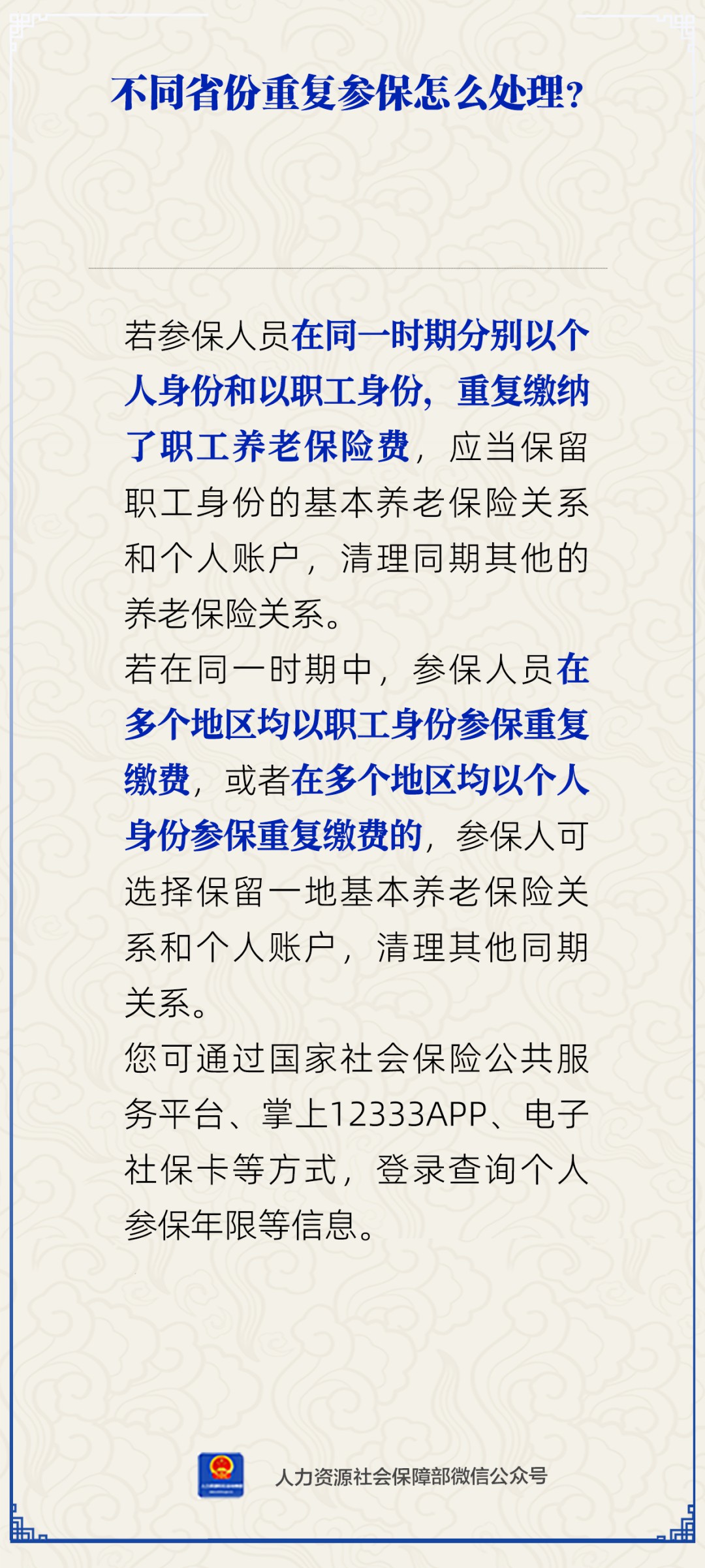
不同省份重复参保怎么处理?人社部解答
Zhong Guo Xin Wen Wang· 2026-01-21 06:40
Group 1 - The Ministry of Human Resources and Social Security addressed how to handle duplicate insurance contributions across different provinces [1] - If an insured person has paid pension insurance fees both as an individual and as an employee during the same period, the employee status should be retained along with the basic pension insurance relationship and personal account, while clearing other pension insurance relationships for the same period [1] - In cases where an insured person has multiple employee contributions or multiple individual contributions in different regions during the same period, they can choose to retain one basic pension insurance relationship and personal account from one location, clearing other concurrent relationships [1] Group 2 - Individuals can check their insurance contribution years and other information through the National Social Insurance Public Service Platform, the 12333 APP, and electronic social security cards [1]

人社部部长王晓萍:将进一步扩大社会保险覆盖面,支持灵活就业人员、新就业形态人员参加职工养老保险
Jin Rong Jie· 2026-01-20 12:35
Core Viewpoint - The Ministry of Human Resources and Social Security emphasizes the importance of flexible employment and new employment forms as significant channels for job absorption, focusing on the rights protection of these groups [1] Group 1: Social Insurance Expansion - The Ministry plans to expand the coverage of social insurance, particularly for flexible and new employment forms, to ensure higher quality social security for these workers [1] - There will be a push to include more new employment form workers in occupational injury insurance and to expand unemployment and work injury insurance coverage [1] Group 2: Social Security Reform - Continuous deepening of key social security reforms is planned, including ensuring timely and full pension payments and improving the mechanism for determining and adjusting benefits [1] - There will be an emphasis on increasing support for low-income groups and expanding the coverage of enterprise annuities while implementing a personal pension system [1] - Strengthening fund regulatory systems and investment operation oversight is also a priority, along with establishing long-term assessment mechanisms and improving actuarial systems [1] Group 3: Service Management Optimization - The Ministry aims to create more convenient management services by optimizing national human resources and social security service platforms [1] - Initiatives will include promoting efficient processing of flexible employment insurance, social security card services, and retirement services, as well as enhancing policy communication and consultation services [1]
多地农民养老金缴费上限迎来新一轮上涨
经济观察报· 2026-01-10 13:25
Core Viewpoint - The article highlights the significant disparity between the pension levels of farmers and urban retirees, emphasizing the recent adjustments in the contribution limits for rural pensions aimed at improving the financial security of farmers in retirement [1][2][3]. Summary by Sections Pension Disparity - In 2023, the average monthly pension for urban retirees was 3162 yuan, while for farmers it was only 214 yuan, a difference of 14.8 times [2]. Recent Changes in Contribution Limits - Several provinces, including Yunnan, Anhui, Guizhou, and Liaoning, announced increases in the maximum contribution limits for rural pensions, with Yunnan's limit reaching 10,000 yuan per year, the highest in the country [2][15]. - The new contribution limits are designed to encourage higher personal contributions, which can significantly enhance future pension benefits [7][10]. Structure of Rural Pensions - Rural pensions consist of a basic pension funded by government subsidies and a personal account pension based on individual contributions. The contribution limits set a cap on how much individuals can contribute annually [2][3]. - The increase in contribution limits is closely tied to the goal of raising the average pension level for farmers, addressing the long-standing issue of low pension benefits [7][8]. Factors Influencing Contribution Choices - Many residents still prefer to contribute at lower levels due to immediate financial constraints, despite the potential long-term benefits of higher contributions [18][21]. - Experts suggest that improving current income levels and increasing awareness about the pension system could encourage more individuals to opt for higher contribution tiers [3][21]. Government Policy and Future Outlook - The adjustments in contribution limits align with government policies aimed at enhancing social security and addressing the needs of an aging population [13][16]. - There is a likelihood that more provinces will follow suit in raising contribution limits, as many still have room for adjustments based on local economic conditions [16].

多地农民养老金缴费上限迎来新一轮上涨
Sou Hu Cai Jing· 2026-01-10 10:16
Core Viewpoint - Recent announcements from provinces such as Yunnan, Anhui, Guizhou, and Liaoning indicate that the maximum contribution levels for rural residents' basic pension insurance will increase by 2026, marking a significant rise after several years of stagnation [2][8]. Group 1: Pension Contribution Changes - The rural pension system consists of a "basic pension + personal account pension," with the basic pension funded by central and local government subsidies, while personal account pensions are primarily derived from individual contributions [2]. - Contribution limits for rural pensions have been set to rise significantly, with Yunnan's limit reaching 10,000 yuan per year, making it the first province to exceed this threshold [2][9]. - The average pension for rural residents remains significantly lower than that of urban retirees, with the average monthly pension for rural residents at 214 yuan compared to 3,162 yuan for urban retirees, a disparity of 14.8 times [2][3]. Group 2: Implications of Contribution Increases - The increase in contribution limits aims to enhance the average pension levels for rural residents, responding to the growing income levels of urban and rural residents [8][12]. - Experts suggest that higher contribution levels can lead to better retirement benefits, but many residents still prefer lower contribution tiers due to immediate financial constraints [4][17]. - The adjustment of contribution limits is seen as a necessary step to align with the rising disposable income of residents and to address the long-standing issue of low pension levels [16][19]. Group 3: Participation and Awareness - As of 2024, approximately 5.4 billion people are enrolled in the rural pension system, with 1.8 billion actually receiving benefits [7]. - Despite the rising contribution limits, many residents continue to opt for the lowest contribution levels, with about 80% of rural participants choosing the minimum tier [18][19]. - There is a need for increased awareness and understanding of the pension system among residents, as many are concerned about the reliability of future pension payouts [20].
蔡昉:养老三支柱不是“三足鼎立”|直击外滩年会
Jing Ji Guan Cha Bao· 2025-10-24 06:52
Core Viewpoint - The current pension system in China requires exploration of new insurance models, emphasizing the importance of including urban and rural residents in discussions about pension reforms [1][2]. Group 1: Current Pension Landscape - Over 50% of pension recipients are receiving urban and rural resident pension insurance, indicating a need to include this demographic in pension reform discussions [2]. - There are over 300 million private laborers and individual workers, along with more than 200 million flexible employment individuals, who have low pension insurance coverage [2]. - The rise of digital economy and flexible employment is leading to a shift in traditional employment patterns, necessitating new approaches to pension coverage [2]. Group 2: Structural Insights - The status of the resident pension insurance system should be a key criterion for evaluating the first pillar of the pension system [4]. - The three pillars of pension insurance should not be viewed as equal or independent; rather, the first pillar is foundational, and without it, the second and third pillars cannot effectively function [4]. - The development of artificial intelligence is expected to bring revolutionary changes, necessitating a rethinking of pension insurance models and the establishment of effective sharing mechanisms for productivity gains [4].