
股债同跌

Search documents
债基波动考验稳健信仰,年末“易跌难涨”如何破局
Di Yi Cai Jing· 2025-12-10 13:08
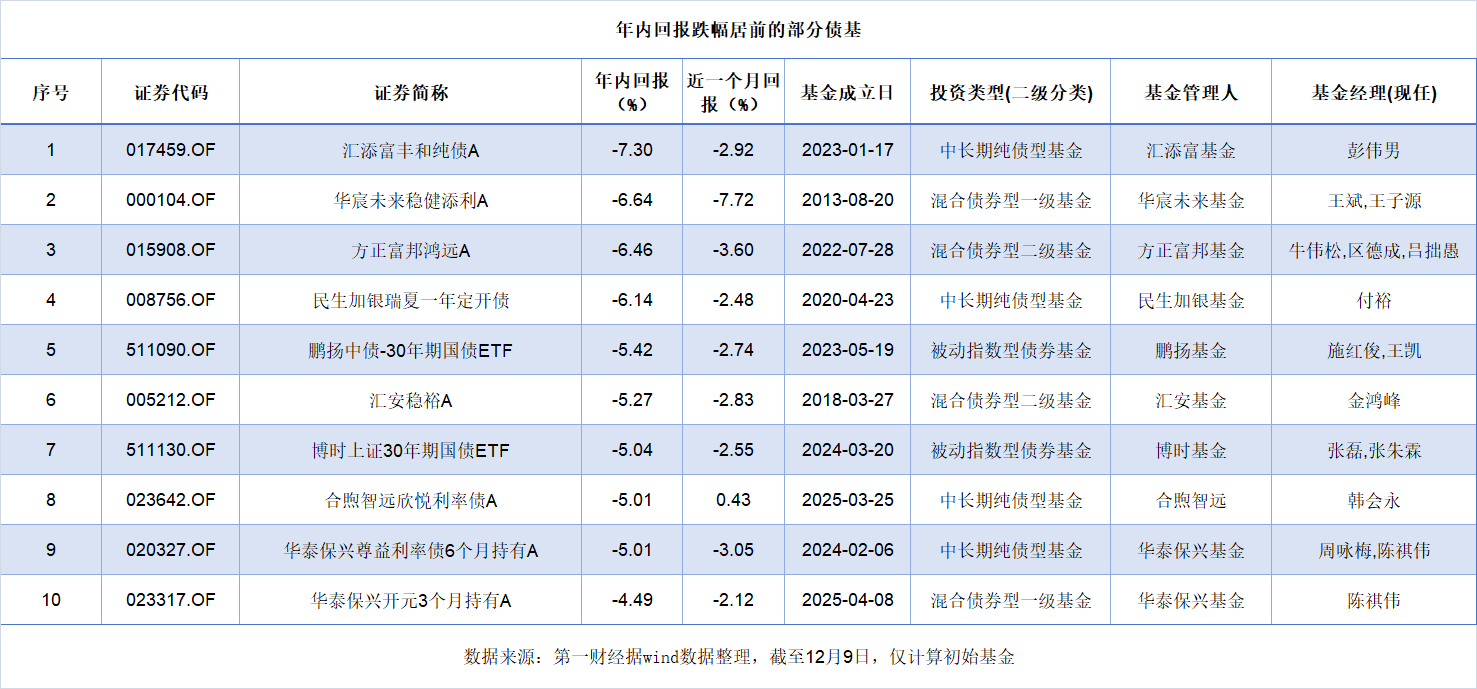
Group 1 - The core viewpoint of the articles indicates that bond funds are facing significant challenges, with a notable decline in net values due to rising yields and market sentiment fluctuations [1][3][5] - As of December 9, over 60% of bond funds experienced a decline in value, with 2396 out of 3961 funds showing negative returns in the past month [3][4] - Major bond funds like Huacheng Future Stable Benefit A and Huitianfu Fenghe Pure Bond A have seen year-to-date losses exceeding 6%, with some funds returning to levels not seen in two years [1][4][5] Group 2 - The recent market adjustments are attributed to emotional market fluctuations rather than fundamental or liquidity changes, as stated by industry experts [1][7] - There is a growing concern regarding the impact of policy expectations and regulatory uncertainties on market behavior, leading to increased caution among institutional investors [7][8] - The bond market is currently characterized by a "difficult to rise" feature, with trading activity declining as institutions adopt a defensive strategy [8][9] Group 3 - Despite the challenges, there is a noted stabilization in redemption pressures for pure bond products, with overall net inflows being maintained due to year-end marketing efforts [1][6] - "Fixed income +" products are highlighted as key marketing projects during this period, appealing to investors seeking a balance of stability and risk [9] - The market is expected to remain volatile in the short term, with a cautious outlook until clearer policy directions are established [8][9]

国泰海通|固收:如何理解近期“股跌、期债跟跌”现象
国泰海通证券研究· 2025-11-23 13:47
Core Viewpoint - The recent phenomenon of simultaneous declines in both the stock and bond markets is primarily attributed to the bond market absorbing some of the redemption pressure and deleveraging demands caused by the stock market's pullback, with speculative funds in TL contracts further amplifying this volatility [1][2]. Group 1: Market Dynamics - The bond market's motivation to go long has not increased due to the stock market's pullback, as the current environment is characterized by low odds and ongoing concerns about potential new fund fee regulations [1]. - The stock market's decline may have triggered a chain reaction among multi-asset funds, leading the bond market to bear some selling pressure and deleveraging demands, evidenced by low divergence indices among brokers and funds [1]. - TL contracts have a high proportion of speculative funds, which tend to engage in short-term trading rather than long-term allocation, making them more susceptible to market sentiment and cyclical trading behaviors [2]. Group 2: Historical Context - Historical patterns indicate that the phenomenon of "simultaneous declines in stocks and bonds" with "greater declines in futures than in cash bonds" has occurred previously, specifically in late October 2023 and mid-March 2024, typically lasting no more than 10 days before a synchronized recovery in both markets [2].

如何理解近期“股跌、期债跟跌”现象
GUOTAI HAITONG SECURITIES· 2025-11-23 12:40
Group 1 - The report highlights the recent phenomenon of simultaneous declines in both the stock and bond markets, particularly noting that TL contracts experienced a more significant drop compared to T contracts [1][6][9] - The lack of bullish momentum in the bond market is attributed to a low-risk environment and ongoing concerns regarding potential new fund fee regulations, leading to insufficient active buying interest [6][9] - The bond market has absorbed some selling pressure from the stock market's decline, indicating a chain reaction among multi-asset funds, with a notable increase in selling power from institutions like brokerages and funds [6][7] Group 2 - The report discusses the speculative nature of TL contracts, where a high proportion of speculative funds amplifies price volatility, particularly in a market lacking clear directional trends [7][9] - Historical data suggests that the simultaneous decline of stocks and bonds typically lasts no more than 10 days, after which a recovery in both markets is likely [9] - The report outlines various strategies for national bond futures, including the observation that the TL contract's institutional behavior factor has increased while the T contract has decreased, indicating a shift in market dynamics [12][13] Group 3 - The report notes that the IRR for various contracts has decreased, suggesting limited opportunities for profitable arbitrage strategies [13][17] - It highlights that while there is potential for the TL contract's basis to converge, the current arbitrage opportunities are relatively limited [17] - The report indicates that the cross-period strategies are being dominated by long positions, leading to a decrease in the price differentials between contracts [19][22]