背面供电

Search documents
背面供电,太难了
半导体行业观察· 2026-02-24 01:23
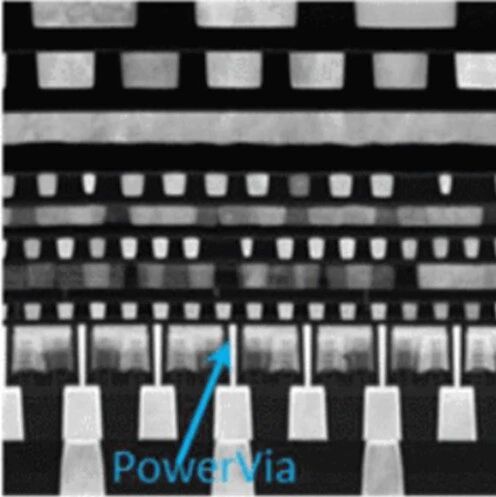
Group 1 - The core concept of Back Power Distribution Network (BPDN) is to enhance processor performance, significantly reduce power loss, and improve power efficiency by supplying power directly from the back of the wafer to the transistors [2][3] - BPDN can reduce IR voltage drop by up to 30%, improving power integrity and allowing for smaller metal spacing on the front, which lowers lithography costs [3][5] - The transition to nanosheet FETs and the adoption of BPDN by leading manufacturers like Intel, Samsung, and TSMC indicate significant advancements in semiconductor technology [2][3] Group 2 - BPDN is crucial for workloads requiring high power and rapid power consumption changes, such as AI accelerators and gaming chips [5][6] - The implementation of BPDN can lead to a 20% to 30% reduction in IR drop, a 2% to 6% increase in maximum frequency, and a 5% to 15% reduction in core area [6] - New manufacturing challenges arise with BPDN, including precise alignment of back metal to front transistors and managing thermal effects [6][10] Group 3 - The manufacturing process for BPDN involves thinning the wafer, bonding, and precise alignment, which are critical for achieving the desired performance [9][11] - The introduction of BPDN changes the design process by reducing wiring congestion on the front side, allowing for more efficient layout and routing [13][14] - The separation of power and signal routing in BPDN can significantly reduce congestion and improve signal integrity, particularly for high-speed IP modules [13][15] Group 4 - Thermal management is a significant concern with BPDN, as simulations indicate that peak temperatures can be 14°C higher compared to traditional front-side PDN [17][18] - The reduction of the silicon substrate thickness during the BPDN process affects thermal diffusion, leading to increased thermal resistance and potential hotspots [17][19] - IBM has developed a machine learning model to predict thermal resistance in BEOL stacks, which aids in managing the thermal challenges associated with BPDN [19][20] Group 5 - The implementation of BPDN is seen as a major breakthrough for the 2nm process node, addressing long-standing voltage loss issues and layout congestion [23] - Companies are exploring better thermal materials for wafer bonding to enhance heat dissipation in BPDN structures [23] - Future challenges include aligning back interconnects with front vias and managing thermal impacts to mitigate hotspot issues [23]


CY25Q4营收创新高,2026年WFE预期上修至1350亿美元:Lam Research(LRCX)FY26Q2业绩点评及业绩说明会纪要
Huachuang Securities· 2026-02-01 13:20
Investment Rating - The industry investment rating is "Recommended," indicating an expected increase in the industry index exceeding the benchmark index by more than 5% in the next 3-6 months [72]. Core Insights - Lam Research reported a record revenue of $5.34 billion for CY25Q4, marking a 0.40% quarter-over-quarter increase and a 22.14% year-over-year increase, achieving growth for 10 consecutive quarters [2][9]. - The company expects the global wafer fabrication equipment (WFE) market to reach $135 billion in 2026, with significant growth momentum anticipated in the second half of the year [3][30]. - Non-GAAP gross margin for CY25Q4 was 49.7%, slightly down by 0.9 percentage points from the previous quarter but up 2.2 percentage points year-over-year, exceeding guidance [2][9]. Summary by Sections 1. Performance Overview - CY25Q4 revenue reached $5.34 billion, surpassing the guidance midpoint of $52 billion by $0.34 billion [2][9]. - For the full year 2025, revenue totaled $20.6 billion, reflecting a 27% year-over-year increase [2][9]. 2. Business Segment Performance - Equipment Segment: - Storage business accounted for 34% of equipment revenue, with DRAM revenue rising to 23%, a record high [2][14]. - Foundry business represented 59% of equipment revenue, significantly up from 35% in CY24Q4 [2][14]. - Customer Support Business: Revenue was approximately $2 billion, with a 12% quarter-over-quarter and 14% year-over-year increase [3][15]. 3. Regional Market Performance - Revenue from mainland China accounted for 35% of total revenue, down 8 percentage points quarter-over-quarter, but slightly above initial expectations [3][16]. - Taiwan and South Korea each contributed 20% to total revenue, with South Korea showing significant quarter-over-quarter growth [3][17][18]. 4. Performance Guidance - For CY2026Q1, the company projects revenue of approximately $5.7 billion, with a Non-GAAP gross margin of 49% ± 1% [3][32]. - The company anticipates significant year-over-year growth for the entire year of 2026, primarily driven by the second half [3][32]. 5. Demand Situation Analysis - The global WFE market size is expected to approach $110 billion in 2025 and reach $135 billion in 2026, with demand growth concentrated in the second half of the year [30]. - Investment growth is led by DRAM and advanced logic foundry sectors, while NAND market demand is boosted by high-capacity SSD applications and AI inference scenarios [30].

拓荆科技:在手订单饱满,将持续深耕薄膜沉积设备和三维集成设备领域
Zheng Quan Shi Bao Wang· 2025-12-04 03:17
Core Viewpoint - The company,拓荆科技, is focused on high-end semiconductor equipment, particularly in the development and industrial application of thin film deposition equipment, which has seen significant demand in the semiconductor manufacturing sector [1][4]. Group 1: Company Performance and Product Development - The company held a performance briefing on December 4, 2025, discussing its operational results and financial metrics for Q3 2025 [1]. - The company has established industrial bases in Shenyang and Shanghai, with a production capacity exceeding 700 sets per year, and is expanding its capacity with a new factory in Shenyang [1]. - The thin film deposition product series, including PECVD, ALD, SACVD, HDPCVD, and Flowable CVD, has achieved industrial application in the storage chip manufacturing sector, with a full order book indicating strong future demand [1][4]. Group 2: Technological Advancements and Market Trends - The company is continuously expanding its thin film deposition product series and increasing production scale, with new equipment platforms and advanced processes entering mass production [2]. - The semiconductor industry is transitioning into a post-Moore era, with rapid technological iterations and the emergence of new structures and materials, driving demand for advanced semiconductor equipment [3]. - The rise in storage prices reflects strong demand in the storage chip market, which may lead to increased production capacity among manufacturers, further driving the need for advanced thin film equipment [4]. Group 3: Future Outlook - The company plans to maintain its core competitiveness through high-intensity R&D investments, focusing on thin film deposition and three-dimensional integration equipment, while expanding into new products and processes required for advanced manufacturing [3]. - The ongoing complexity in storage chip processes and structures is expected to significantly boost the demand for thin film equipment, as manufacturers seek to enhance performance with advanced materials [4].

芯片,怎么连?(上)
半导体行业观察· 2025-08-11 01:11
Group 1 - The article discusses the importance of interconnectivity in the information age, focusing on the internal interconnect structures within semiconductor chips [2] - It introduces various interconnect elements such as wires, vias, local interconnects, and contact points, explaining their roles and construction methods [4][8] - The manufacturing process of chips is divided into two main stages: front-end process (FEoL) for creating transistors and back-end process (BEoL) for building interconnect layers [6][12] Group 2 - A typical silicon chip can contain up to five different interconnect elements, including metal lines, vias, local interconnects, contact points, and through-silicon vias (TSVs) [4][8] - Metal lines are primarily used for signal transmission, with advanced nodes allowing for multiple layers of metal interconnects [7][22] - TSVs are crucial for connecting signals from the front of the chip to the back, especially in stacked chip configurations [17][41] Group 3 - The article highlights the transition from aluminum to copper as the primary material for interconnects due to copper's superior conductivity [22][25] - It describes the dual-damascene process used for copper interconnects, which involves etching trenches in dielectric materials and filling them with copper [26] - Other metals such as tungsten, nickel, and emerging materials like cobalt are also discussed for their roles in interconnect applications [30] Group 4 - Dielectric materials are essential for maintaining isolation between metal lines, with silicon dioxide (SiO₂) being the most commonly used [31] - The article emphasizes the development of low-k dielectric materials to reduce capacitive effects in densely packed circuits [33] - High-k materials like hafnium oxide (HfO₂) are explored for their benefits in gate oxide applications, providing better performance without thinning the layer [38][40] Group 5 - The interconnect system within chips is evolving from simple point-to-point connections to more complex structures like buses and networks on chip (NoC) [50][75] - Buses allow for multiple signal lines to transmit data, while NoC mimics external network structures to improve efficiency in large-scale systems [53][75] - The article discusses various addressing methods in NoC, including unicast, multicast, and broadcast, to enhance data transmission efficiency [78]