
自研OS

Search documents
千万大奖落地!雷军最新回应
Zhong Guo Ji Jin Bao· 2026-01-08 07:21
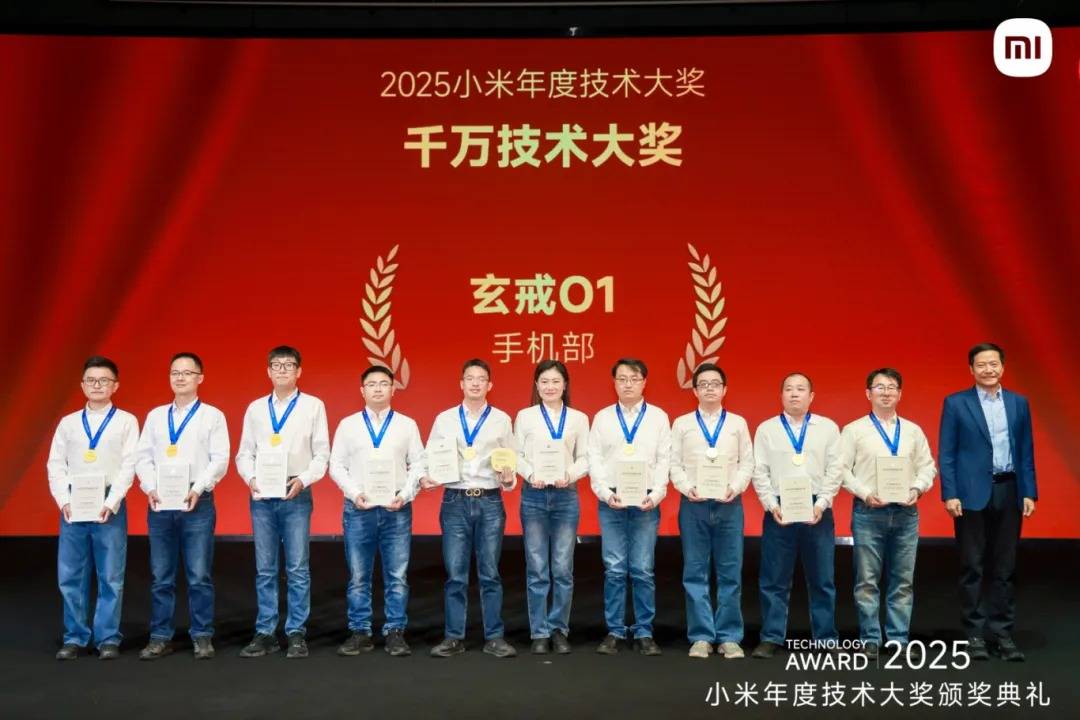
Core Insights - Xiaomi's O1 team won the highest award at the annual technology awards, with a total of 154 projects competing for the prize [2] - Lei Jun announced a future R&D investment plan of 200 billion yuan over the next five years, emphasizing the importance of core technologies such as chips, operating systems, and AI [2][4] - The company has invested approximately 105 billion yuan in R&D over the past five years, exceeding its initial commitment of 100 billion yuan [2] R&D Investment - Xiaomi plans to invest 200 billion yuan in R&D over the next five years, focusing on core technologies to build a comprehensive ecosystem [2][4] - The company has a history of significant R&D investment, with over 7.5 million yuan awarded in total since the inception of the technology awards in 2019 [4][7] Technology Achievements - The O1 chip, developed by Xiaomi, features a GPU that reduces power consumption by 35% compared to Apple's chips and supports dynamic performance scheduling [4] - The O1 chip is manufactured using advanced 3nm technology, marking a significant milestone in Xiaomi's pursuit of core technology development [4] Awards and Recognition - The Xiaomi Technology Award has been upgraded to 10 million yuan, aimed at recognizing engineering teams that achieve industry-leading breakthroughs in core technologies [7] - The O1 team received the highest honor at the awards, with other notable projects also recognized, including the Xiaomi Super Steel and Xiaomi Smart Glasses [3][4]


雷军爆料2026年重磅新品:自研芯片、OS、AI大模型将“大会师”
Sou Hu Cai Jing· 2026-01-08 07:06
Group 1 - The core event was the awarding of Xiaomi's self-developed chip "Xuanjie O1" at the "Ten Million Technology Awards" ceremony held in Beijing [1] - Xiaomi's founder and CEO Lei Jun announced that in 2026, the company will launch a terminal product that integrates self-developed chips, OS, and AI models, speculated to be the Xiaomi 17S Pro with the new Xuanjie O2 chip [3] - The Xuanjie O2 chip is expected to be released around September this year, utilizing the latest Arm public architecture, with an IPC improvement of at least 15% and the potential integration of the Arm Cortex-X9 series super-large core [5] Group 2 - Xiaomi is concurrently advancing its self-developed Xuanjie 5G baseband, which has reportedly achieved key breakthroughs, although it is not confirmed if it will launch alongside the Xuanjie O2 [7] - In the AI model sector, Xiaomi's open-source self-developed model MiMo-V2-Flash has shown impressive performance, with a total parameter count of 309 billion and 15 billion active parameters, outperforming competitors in response speed and ranking among the top tier of open-source models [10] - The integration of Xuanjie O1, Xuanjie O2, and MiMo-V2-Flash signifies a rapid closure of Xiaomi's self-developed ecosystem, marking a new phase of deep collaboration between hardware and software, enhancing user experience and setting a new benchmark for self-developed technology integration in the industry [10]
雷军:小米将发布机器人业务的新进展
Sou Hu Cai Jing· 2026-01-08 04:17
Group 1 - Xiaomi's founder Lei Jun announced new developments in the company's robotics business expected in 2026, with further details to be shared later [1] - Xiaomi has been an early player in the development of robotic dogs and humanoid robots, launching "CyberDog" in 2021 and "CyberOne" in 2022, with the "CyberDog" team winning the highest award at the 2021 Xiaomi Annual Technology Awards [1] - Despite the recent surge in embodied intelligence, Xiaomi has not released an updated version of its humanoid robot and has ceased public demonstrations of previous models, although patent applications and job postings indicate ongoing research and development [1] Group 2 - Xiaomi's Beijing Xiaomi Robotics Technology Co., Ltd. registered a copyright for the "third-generation humanoid robot CyberOne" in October 2025, seen as evidence of the company's continued development in humanoid robotics [2] - Xiaomi has been investing in the robotics field for four to five years, with a focus on the potential of humanoid robots in industrial applications, although the practical implementation remains challenging [2] - In addition to robotics, Lei Jun revealed plans for Xiaomi to achieve a convergence of self-developed chips, operating systems, and AI models in a terminal product by 2026 [4] Group 3 - Xiaomi's self-developed 3nm smartphone SoC, released in May 2025, positions the company as the fourth globally to design such a chip, following Apple, Qualcomm, and MediaTek [4] - The team behind the 3nm chip received the highest award at the 2025 Xiaomi Annual Technology Awards, with further advancements expected in the future [4] - Xiaomi plans to invest 200 billion yuan in research and development over the next five years, focusing on core technologies such as chips, AI, and operating systems [4]


玄戒O1芯片获小米千万技术大奖
Guan Cha Zhe Wang· 2026-01-07 13:52
Group 1 - Xiaomi awarded its 2025 Technology Awards, with the top prize going to the "Xuanjie O1" chip, and the second and third prizes awarded to the 2200MPa Xiaomi Ultra-Strong Steel and Xiaomi Smart Glasses, respectively [1] - Xiaomi's chairman Lei Jun mentioned the potential for the company to achieve a convergence of self-developed chips, operating systems, and AI models in a single terminal product this year [1] - The "Xuanjie O1" chip, launched in May last year, features a die area of 109mm, utilizes second-generation 3nm process technology, and contains over 19 billion transistors [1][3] Group 2 - The "Xuanjie O1" chip includes a 16-core GPU with the latest Immortalis-G925 and employs dynamic performance adjustment technology for GPU operation based on running scenarios, achieving single-core and multi-core performance scores of 3008 and 9509, respectively [1] - Xiaomi denied market speculation that the "Xuanjie O1" is based on a customized Arm chip, asserting that it was entirely designed by the Xuanjie team over a four-year development period [3] - The 2200MPa Xiaomi Ultra-Strong Steel is the highest strength hot-formed steel currently in mass production, with a 40% increase in tensile strength and a 24% increase in yield strength compared to 1500MPa hot-formed steel [3] Group 3 - The Xiaomi Smart Glasses feature a dual-chip architecture that allows for ultra-low power consumption, automatically activating the Qualcomm AR1 flagship chip in complex scenarios while seamlessly switching to a low-power Bluetooth audio processor in low-load situations [5] - Since 2019, Xiaomi has held an annual technology awards ceremony for engineers, with Lei Jun attending each year; the 2025 award has been upgraded to a prize of ten million RMB [9]
