药品价格监管

Search documents
重点监测21种药品
Xin Lang Cai Jing· 2026-01-04 19:01
Core Viewpoint - The Qinghai Provincial Market Supervision Administration is implementing a comprehensive price monitoring system for pharmaceuticals to regulate market prices and ensure compliance with pricing laws [1][2] Group 1: Price Monitoring and Regulation - A price monitoring network has been established covering 137 retail pharmacies across 8 cities and 45 counties in Qinghai, focusing on 21 key medications [1] - The monitoring system aims to dynamically track market price trends and act as an early warning mechanism [1] - Regulatory measures have been strengthened to prevent price fraud, including mandatory price labeling and prohibiting additional charges [1] Group 2: Enforcement Actions - A total of 17 price-related illegal cases have been investigated, resulting in the confiscation of illegal gains amounting to 6,117.62 yuan and fines totaling 63,200 yuan [2] - Special research teams have been formed to conduct on-site investigations in various regions to guide pharmaceutical businesses in setting reasonable price margins [2] Group 3: Collaborative Governance - The administration is breaking down departmental barriers to enhance collaboration with healthcare insurance and drug supervision departments, establishing mechanisms for information sharing and joint enforcement [2] - Regular meetings and data sharing are being utilized to improve regulatory efficiency and transition from isolated actions to collaborative governance [2] - The market supervision department plans to intensify enforcement efforts and improve cooperation among departments to maintain stable pharmaceutical market prices [2]
新华时评·民生无小事丨惩治“阴阳价”!定点药店岂能“看人下菜碟”
Xin Hua Wang· 2025-11-04 01:54
Core Points - The article highlights the issue of "yin-yang pricing" in designated pharmacies, where the same cold medicine is priced differently for insured and uninsured customers, leading to significant price discrepancies [1] - It emphasizes the need for strict regulation and monitoring of pharmacies engaging in such practices to protect the integrity of the medical insurance fund and public trust in the healthcare system [1][2] Group 1 - The practice of "yin-yang pricing" is driven by pharmacies attempting to alleviate operational pressures by shifting costs onto insured patients, alongside a lack of transparency in drug pricing [1] - A recent notification has been issued to enhance monitoring and handling of "yin-yang pricing" in designated retail pharmacies, calling for serious investigations and penalties [1] - Measures against pharmacies practicing "yin-yang pricing" may include interviews, suspension of medical insurance settlements, and termination of medical service agreements, aiming to deter such illegal activities [1] Group 2 - To combat the "yin-yang pricing" phenomenon, there is a call for preventive measures, including the use of technology to create a comprehensive supervision network through drug price comparison apps and traceability codes [2] - The article stresses that the qualification for medical insurance designated pharmacies should not be seen as a license for unregulated practices but as a commitment to honest business operations [2] - The goal is to ensure fair and transparent drug purchasing, allowing the medical insurance fund to be utilized effectively, thereby increasing public confidence in the healthcare system [2]
百利天恒子公司药品挂网价遭疑,70倍价差背后的风险几何?
Xin Lang Zheng Quan· 2025-09-26 09:01
Core Viewpoint - The significant price disparity between the oral solution of Enalapril Maleate at 558 yuan and the common tablet form priced at approximately 8 yuan raises questions about the underlying research and development costs, as well as potential unethical marketing practices [1][2]. Pricing Concerns - The oral solution of Enalapril Maleate is priced at 558 yuan, while the tablet form has seen a price drop from 19.15 yuan to 5.66 yuan after two rounds of national procurement, reflecting a 70.4% decrease [2]. - The difference in dosage forms may justify the high price, as the oral solution is produced by only two companies in China, requiring higher R&D and production standards [2][3]. - Regulatory scrutiny is increasing, with the Yunnan Medical Security Bureau demanding detailed explanations regarding the pricing structure and sales profits of the high-priced product [1][3]. Regulatory Environment - The national drug price governance is tightening, with the National Medical Insurance Administration working on a comprehensive price list to identify and address unreasonable high prices [3]. - The recent inquiries from regulatory bodies indicate a zero-tolerance approach towards high-priced drugs, suggesting that companies relying on unique dosage forms to maintain high prices may face challenges [3]. Company Financials - Sichuan Baili Pharmaceutical, a subsidiary of Baili Tianheng, reported a revenue of 113 million yuan in the first half of 2025, accounting for 66% of Baili Tianheng's total revenue, but incurred an operating loss of 29.97 million yuan and a net loss of 23.48 million yuan [4]. - Baili Tianheng experienced significant financial volatility, with cumulative losses of 1.162 billion yuan from 2021 to 2023, followed by a profit of 3.75 billion yuan in 2024, but a 96.9% revenue drop in the first half of 2025, leading to a net loss of 1.12 billion yuan [4]. - The company's cash reserves decreased by 26.2%, while total liabilities increased by 86.06% to 4.386 billion yuan, with long-term loans surging 14 times to 2.572 billion yuan, indicating rising financial pressure and debt risk [4]. Conclusion - The regulatory inquiry not only pertains to the pricing of a single product but also highlights multiple risks related to the company's pricing strategy, profitability, financial health, and business transformation [5]. - In the context of stricter drug regulations and normalized procurement practices, the reliance on a few high-priced drugs for revenue is unsustainable, necessitating a balance between R&D investment and price compliance, as well as debt structure optimization and innovation acceleration [6].
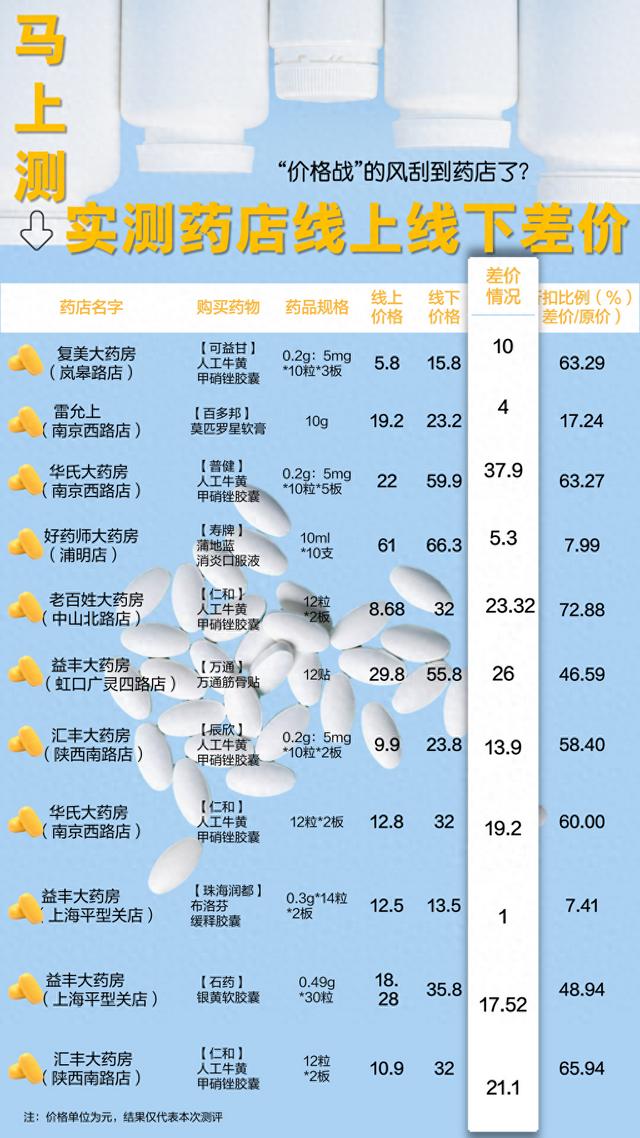
“线上8元,线下32元” ,实测10家药店
Xin Lang Cai Jing· 2025-09-07 11:26
Core Viewpoint - There is a significant price discrepancy between online and offline pharmacies for the same medications, with some prices being more than three times higher in physical stores compared to online platforms [1][2][5]. Group 1: Price Discrepancy - A survey of ten pharmacies revealed that the same medication can have a price difference of over three times between online and offline sales [1][6]. - For example, the "仁和" artificial cow bile metronidazole capsules cost 8.68 yuan online but 32 yuan offline, resulting in a difference of 23.32 yuan [1][6]. - Other examples include "可益甘" artificial cow bile metronidazole capsules priced at 5.8 yuan online and 15.8 yuan offline, and "百多邦" mupirocin ointment at 19.2 yuan online versus 23.2 yuan offline [5][6]. Group 2: Reasons for Price Differences - Pharmacy staff indicated that online prices are often lower due to platform subsidies, although not all medications follow this trend [2][9]. - Consumers have the option to choose between online and offline purchases based on their preferences, but online shopping may incur additional delivery fees [2][9]. - Legal experts noted that the price difference alone does not constitute price fraud; it must be assessed in the context of whether the pharmacy transparently communicates the reasons for the price difference [11][12]. Group 3: Regulatory Responses - The National Medical Insurance Administration has issued directives to compare offline pharmacy prices with online platforms to address unreasonable pricing [10]. - Local regulations have been established, such as in Shaanxi Province, where offline prices cannot exceed 20% of the online price displayed by the same pharmacy [10]. - Zhejiang Province has mandated that online prices should not exceed 1.3 times the listed price, emphasizing the need for price consistency across different sales channels [10].