
蛋价

Search documents
2026-02-02:五矿期货农产品早报-20260202
Wu Kuang Qi Huo· 2026-02-02 01:28
Report Industry Investment Rating - Not provided Core Viewpoints - For sugar, wait until the northern hemisphere starts to finish squeezing in February and the bearish impact of increased production is basically realized, then the international sugar price may rebound. Domestically, as the supply of imported sugar gradually decreases and the sugar price falls to a low level, the short - term downward space may be limited, so it's advisable to wait and see [4]. - For cotton, in the medium - to - long term, with the reduction of the new - year planting area and the positive macro - economic expectations, the cotton price still has room to rise. Pay attention to the opportunity of low - buying before the Spring Festival [9]. - For protein meal, affected by the sudden news from Canada, the rapeseed meal price rebounded. The January USDA report data is slightly bearish, but the overall balance sheet is better than that of the 2024/25 season. The domestic soybean and soybean meal inventories have decreased on a weekly basis, and the protein meal price may be bottoming out [13]. - For oils and fats, affected by the sudden news from Canada and the year - on - year decline in Malaysian palm oil production in January, the oil price rose significantly yesterday. The domestic inventory of the three major oils has been decreasing on a weekly basis. Wait for a pullback and then try to go long [17]. - For eggs, the spot price is about to experience seasonal price increases, which will drive the futures price down. The near - term contract may fluctuate weakly, while the far - end contract may continue to correct its valuation, so maintain a short - selling strategy [19]. - For pigs, the basic supply is large and the live - animal inventory is accumulating. The spot and near - term expectations are pessimistic, so maintain a strategy of short - selling on rebounds. The far - end production capacity decline has been revised down, but there are still expectations of high fat - to - standard price differences, seasonal support, and recovery in consumer demand, so pay attention to the downside support after the price follows the decline [22]. Summary by Commodity Sugar - **Market Quotes**: On Friday, the Zhengzhou sugar futures price fluctuated. The closing price of the May contract of Zheng sugar was 5248 yuan/ton, down 9 yuan/ton or 0.17% from the previous trading day. The offer price of Guangxi sugar - making groups was 5290 - 5370 yuan/ton, unchanged from the previous trading day [2]. - **Industry Data**: In the second half of December 2025, the central - southern region of Brazil crushed 2.171 million tons of sugarcane, a year - on - year increase of 26.60%. The sugar output was 56,000 tons, a year - on - year decrease of 14.93%. The sugar - making ratio of sugarcane was 21.24%, a decrease of 11.28 percentage points compared with the same period last year. In December 2025, China imported 580,000 tons of sugar, an increase of 190,000 tons year - on - year. In 2025, China's cumulative sugar imports were 4.92 million tons, an increase of 570,000 tons year - on - year. As of the end of December in the 2025/26 sugar - crushing season, China's cumulative sugar imports were 1.77 million tons, an increase of 310,000 tons year - on - year. In December, China imported a total of 69,700 tons of syrup and premixed powder, and the cumulative imports in 2025 were 1.1888 million tons. As of January 15, 2026, India's national sugar output had reached 15.909 million tons, a nearly 22% increase compared with 13.044 million tons in the same period last year. The number of sugar mills still in operation increased from 500 in the same period last year to 518 [3]. Cotton - **Market Quotes**: On Friday, the Zhengzhou cotton futures price fell. The closing price of the May contract of Zheng cotton was 14,670 yuan/ton, down 240 yuan/ton or 1.61% from the previous trading day. The China Cotton Price Index (CCIndex) 3128B was reported at 16,183 yuan/ton, up 80 yuan/ton from the previous trading day [6]. - **Industry Data**: As of the week of January 23, the spinning mill's operating rate was 64.2%, a 0.4 - percentage - point decrease from the previous week. The national commercial cotton inventory was 5.65 million tons, a decrease of 50,000 tons from the previous week. The January 2026 USDA forecast for the 2025/26 global cotton production was 26 million tons, a decrease of 80,000 tons from the December forecast and an increase of 200,000 tons from the previous year. The inventory - to - consumption ratio was 62.63%, a 1.42 - percentage - point decrease from the December forecast and a 0.62 - percentage - point increase from the previous year. The January forecast for US production was 3.03 million tons, a decrease of 76,000 tons from the December forecast. The export forecast remained unchanged, and the inventory - to - consumption ratio was 30.43%, a 2.17 - percentage - point decrease. Brazil's production forecast remained unchanged at 4.08 million tons; India's production was revised down by 110,000 tons to 5.12 million tons; China's production was revised up by 220,000 tons to 7.51 million tons. From January 15 to January 22, the US current - year cotton export sales were 51,800 tons, and the cumulative export sales were 1.7722 million tons, a decrease of 194,900 tons year - on - year. Among them, the export to China that week was 8800 tons, and the cumulative export to China was 97,400 tons, a decrease of 66,000 tons year - on - year. In December 2025, China imported 180,000 tons of cotton, an increase of 40,000 tons year - on - year. In 2025, China's cumulative cotton imports were 1.08 million tons, a decrease of 1.56 million tons year - on - year [7][8]. Protein Meal - **Market Quotes**: On Friday, the protein meal futures price fell. The closing price of the May contract of soybean meal was 2767 yuan/ton, down 35 yuan/ton or 1.25% from the previous trading day. The closing price of the May contract of rapeseed meal was 2287 yuan/ton, down 38 yuan/ton or 1.63% from the previous trading day. The spot price of Dongguan soybean meal was reported at 3120 yuan/ton, unchanged from the previous trading day; the spot price of Huangpu rapeseed meal was reported at 2490 yuan/ton, down 30 yuan/ton from the previous trading day [11]. - **Industry Data**: From January 15 to January 22, the US exported 820,000 tons of soybeans, and the current - year cumulative soybean exports were 33.85 million tons. Among them, the export of soybeans to China that week was 230,000 tons, and the current - year cumulative export to China was 9.65 million tons. From January 16 to January 23, the domestic sample soybean arrivals were 1.47 million tons, a decrease of 30,000 tons from the previous week; the sample soybean port inventory was 7.21 million tons, a decrease of 500,000 tons from the previous week; the sample oil - mill soybean meal inventory was 810,000 tons, a decrease of 30,000 tons from the previous week. The January 2026 USDA forecast for the 2025/26 global soybean production was 425.67 million tons, an increase of 3.13 million tons from the December forecast and a decrease of 1.48 million tons from the previous year. The inventory - to - consumption ratio was 29.4%, a 0.39 - percentage - point increase from December and a 0.44 - percentage - point decrease from the previous year. The January forecast for US soybean production was 115.99 million tons, an increase of 238,000 tons from the December forecast and a decrease of 3.05 million tons from the previous year; the January forecast for Brazil's production was 178 million tons, an increase of 3 million tons from the December forecast and an increase of 6.5 million tons from the previous year; the January forecast for Argentina's production was 48.5 million tons, unchanged from the December forecast and a decrease of 2.6 million tons from the previous year. In addition, in the January forecast, the US export volume was slightly revised down by 1.63 million tons to 42.86 million tons compared with the December forecast [12]. Oils and Fats - **Market Quotes**: On Friday, the oils and fats futures price fell. The closing price of the May contract of soybean oil was 8282 yuan/ton, down 100 yuan/ton or 1.19% from the previous trading day. The closing price of the May contract of palm oil was 9240 yuan/ton, down 222 yuan/ton or 1.3% from the previous trading day. The closing price of the May contract of rapeseed oil was 9380 yuan/ton, down 66 yuan/ton or 0.7% from the previous trading day. The spot price of first - grade soybean oil in Zhangjiagang was reported at 8800 yuan/ton, down 100 yuan/ton from the previous trading day; the spot price of 24 - degree palm oil in Guangdong was reported at 9260 yuan/ton, down 100 yuan/ton from the previous trading day. The spot price of rapeseed oil in Jiangsu was reported at 10,140 yuan/ton, down 30 yuan/ton from the previous trading day [15]. - **Industry Data**: Malaysia's palm oil production from January 1 - 20, 2026, decreased by 14.43% compared with the same period of the previous month. From January 16 to January 23, the domestic sample inventory of the three major oils slightly decreased by 30,000 tons to 1.95 million tons. The US government plans to finalize the 2026 biofuel blending quota in early March. Indonesia's Deputy Minister of Energy said that Indonesia has cancelled the plan to increase the mandatory biodiesel blending ratio to 50% this year (i.e., the B50 plan) and will maintain the current B40 plan. The January 2026 USDA forecast for US soybean oil consumption was 1.32 million tons, a decrease of 249,000 tons from the December forecast and an increase of 1 million tons from the previous year. India's total vegetable oil imports in December 2025 were 1.38 million tons, an increase of 200,000 tons from November [15][16]. Eggs - **Market Quotes**: Over the weekend, domestic egg prices generally fell, with some areas experiencing relatively large declines. The price in Heishan remained at 3.8 yuan/jin, the price in Guantao dropped 0.2 yuan to 3.33 yuan/jin, and the price in Xishui dropped 0.23 yuan to 3.84 yuan/jin. The market supply was normal, the supply of small eggs was slightly tight, the inventory was not large, the downstream demand was limited, the wholesale market sales slowed down, and the purchasing intention of traders weakened. Egg prices may continue to fall this week [18]. Pigs - **Market Quotes**: Over the weekend, domestic pig prices mainly rose, with some areas being weak. The average price in Henan rose 0.04 yuan to 12.52 yuan/kg, and the average price in Sichuan fell 0.16 yuan to 11.76 yuan/kg. At the beginning of the month, the slaughter rhythm of farmers slowed down, the slaughter volume decreased, the downstream demand was relatively stable, the procurement difficulty increased, and the pig price mainly rose under the situation of supply less than demand. The supply pressure in a few southern regions was relatively large, and the pig price was stable. It is expected that the pig price will be mainly strong today [21].
11月在产蛋鸡存栏量或小幅增加 供应充裕蛋价仍将受压
Xin Hua Cai Jing· 2025-11-05 06:18
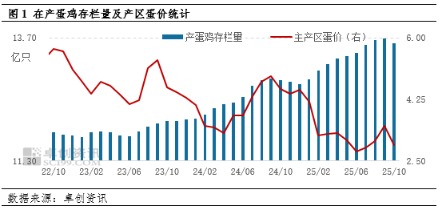
Core Viewpoint - The egg production industry is experiencing a decline in the number of laying hens, leading to continued low egg prices due to excess supply and seasonal demand fluctuations [1][6]. Supply Situation - In October, the number of laying hens was approximately 1.359 billion, a month-on-month decrease of 0.66% but a year-on-year increase of 5.59% [1]. - The average price of eggs in major production areas was 2.95 yuan per jin, reflecting a month-on-month decline of 15.47% and a year-on-year decline of 35.16% [1]. - The supply pressure remains high despite a slight decrease in the number of laying hens, as the egg production rate increases with lower temperatures [1]. Profitability and Production Dynamics - The egg production sector entered a loss state in October, with a profit of -0.17 yuan per jin, a decrease of 0.43 yuan from the previous month [3]. - The average age of culled hens was 494 days at the end of October, which is 6 days earlier than the end of September, with a total culling volume of approximately 89 million hens, a month-on-month increase of over 13% [3]. - The number of newly added laying hens decreased to around 81 million, a month-on-month reduction of 9.40%, due to poor profitability and increased difficulty in rearing chicks [3]. Outlook for November - The theoretical number of laying hens in November is expected to be around 1.360 billion, with a slight month-on-month increase of 0.07% [4]. - The new laying hens are primarily from chicks reared in July, which saw a decrease in the number of chicks added to around 80 million, a month-on-month reduction of about 2% [4]. - The actual culling volume of hens in November may slightly decrease due to the planned culling schedule before the Spring Festival, despite the overall high level of laying hens [4]. Market Demand and Price Expectations - The overall supply of laying hens is expected to remain stable, with continued supply pressure in the market [6]. - Although market demand shows slight improvement, it is insufficient to significantly boost prices, which are expected to remain low in November compared to October [6].

银河期货鸡蛋日报-20250922
Yin He Qi Huo· 2025-09-22 11:26
Report Summary 1. Industry Investment Rating No industry investment rating is provided in the report. 2. Core View The overall egg supply is relatively high compared to previous years. High inventory, low costs, and weak demand have pushed egg prices to their lowest levels in recent years. The recent rebound in egg prices is mainly due to pre - holiday stocking, but as the stocking ends, egg prices are starting to decline. The enthusiasm for culling laying hens decreased as egg prices rebounded [10]. 3. Summary by Directory 3.1 Futures Market - **Futures Prices**: JD01 closed at 3366, down 52 from the previous day; JD05 closed at 3432, down 38; JD09 remained unchanged at 3193 [3]. - **Cross - month Spreads**: The 01 - 05 spread was - 66, down 14; the 05 - 09 spread was 239, down 38; the 09 - 01 spread was - 173, up 52 [3]. - **Price Ratios**: The 01 egg/corn ratio was 1.58, down 0.01; the 01 egg/bean粕 ratio was 1.11, down 0.02. Other ratios also showed minor changes [3]. 3.2 Spot Market - **Egg Prices**: The average price in production areas was 3.67 yuan/jin, down 0.04 yuan/jin; the average price in sales areas was 3.75 yuan/jin, down 0.07 yuan/jin. Prices in most regions were stable, with some fluctuations in a few areas [3]. - **Culled Hen Prices**: The average price of culled hens was 4.55 yuan/jin, up 0.1 yuan/jin from the previous day. Prices in most regions increased [3]. 3.3 Profit Calculation - **Costs**: The average price of corn was 2358 yuan/ton, down 2 yuan; the average price of bean粕 was 3012 yuan/ton, unchanged. The price of egg - laying hen compound feed was 2.55 yuan/jin, down 0.01 yuan/jin [3]. - **Profits**: The profit per laying hen was 30.93 yuan, down 1.04 yuan from the previous day [3]. 3.4 Fundamental Information - **Inventory**: In August, the national inventory of laying hens in production was 1.365 billion, an increase of 0.09 billion from the previous month and a year - on - year increase of 5.9%. It is estimated that the inventory from September to December 2025 will be 1.363 billion, 1.356 billion, 1.356 billion, and 1.352 billion respectively [7]. - **Chick Hatchlings**: In August, the monthly hatchling volume of sample enterprises was 39.81 million, a month - on - month decrease of 0.1% and a year - on - year decrease of 8% [7]. - **Culling Volume**: In the week of September 18, the culling volume of laying hens in the main production areas was 17.61 million, a decrease of 6% from the previous week. The average culling age was 497 days, an increase of 2 days from the previous week [7]. - **Sales Volume**: In the week of September 18, the sales volume of eggs in representative sales areas was 7685 tons, an increase of 5.2% from the previous week [8]. - **Inventory Days**: As of September 18, the average weekly inventory in the production link was 0.91 days, a decrease of 0.02 days; the average weekly inventory in the circulation link was 0.99 days, a decrease of 0.04 days [8]. - **Profits**: As of September 18, the average weekly profit per jin of eggs was 0.45 yuan/jin, an increase of 0.3 yuan/jin; the expected profit per laying hen was 2.97 yuan/hen, a decrease of 0.03 yuan/hen from the previous week [8]. 3.5 Trading Logic The current high supply, low demand, and low egg prices have led to an initial increase in culling enthusiasm. However, as egg prices rebounded, the culling willingness decreased. The recent slowdown in market sales is due to the end of pre - holiday stocking [10]. 3.6 Trading Strategies - **Single - side Trading**: The short - term downward space may be limited, and it is recommended to choose the right opportunity [11]. - **Arbitrage**: It is recommended to wait and see [11]. - **Options**: It is recommended to wait and see [11].