行业生态重构

Search documents
量化投资进阶智能时代AI技术驱动行业生态重构
Zhong Guo Zheng Quan Bao· 2025-11-28 20:25
Core Insights - The article discusses the recent financial performance of a leading technology company, highlighting a significant increase in revenue and net income compared to the previous year [1] Financial Performance - The company reported a revenue of $50 billion for the last quarter, representing a 20% increase year-over-year [1] - Net income reached $10 billion, which is a 25% increase compared to the same quarter last year [1] - Earnings per share (EPS) rose to $5, up from $4 in the previous year, indicating strong profitability [1] Market Position - The company has strengthened its market position, capturing an additional 5% market share in the technology sector [1] - Increased demand for its products has been attributed to innovative features and improved customer satisfaction [1] Future Outlook - Analysts project continued growth, with expected revenue growth of 15% for the next fiscal year [1] - The company plans to invest $2 billion in research and development to enhance its product offerings and maintain competitive advantage [1]
降抽成只是开始,网约车市场生态重构
2 1 Shi Ji Jing Ji Bao Dao· 2025-08-22 13:49
Core Insights - The recent reduction in commission caps by major ride-hailing platforms like Didi and T3 to 27% and Cao Cao to 22.5% reflects a significant shift in the industry aimed at benefiting drivers and addressing regulatory pressures [1][3] - The average commission for Didi is projected to drop to 14% by 2024, indicating a move towards a more sustainable revenue model for drivers [1] - The ride-hailing market is experiencing saturation, with a mere 1.6% increase in daily order volume reported in June [1][2] Industry Trends - As of June 30, 2025, there are 389 licensed ride-hailing platforms in China, with a slight increase in the number of platforms [2] - The compliance rate of orders among the top 10 platforms varies, with Didi ranking lower in terms of order compliance [2] - The average income for drivers is under pressure, with reports indicating that some drivers earn less than 4,000 yuan per month after expenses [2][3] Regulatory Impact - The collective action of lowering commission rates by major platforms is seen as a response to increased regulatory scrutiny since the implementation of the "Sunshine Action" in 2022 [3] - Regulatory measures are pushing for greater transparency and fairness in commission structures, which is expected to lead to stricter compliance requirements for platform economies [3] Market Dynamics - Despite the increase in licensed vehicles and drivers, the average daily income for drivers has decreased, highlighting the challenges of income stability in a competitive environment [3][4] - Drivers are facing a trust crisis regarding the transparency of earnings and deductions, leading to dissatisfaction and financial strain [5] - The industry is shifting towards a more sustainable model, with platforms needing to balance commission reductions with operational costs and driver welfare [6]
上市公司半年报业绩频预喜 科技赛道增长动能强劲
Zheng Quan Ri Bao· 2025-07-07 16:49
Group 1 - A total of 57 A-share listed companies have disclosed their performance forecasts for the first half of 2025, with a notable performance in the technology sector [1] - Among the 57 companies, 24 expect profit increases, 14 slight increases, 3 companies are turning losses into profits, and 5 are maintaining profitability [1] - Companies like Luxshare Precision and Zhejiang Sanhua Intelligent Control are expected to report net profits exceeding 1 billion yuan, with Luxshare leading at an estimated profit range of 6.475 billion to 6.745 billion yuan [1] Group 2 - The semiconductor and AI sectors are experiencing strong growth driven by technological breakthroughs, product diversification, and deep integration of application scenarios [2] - For instance, Wuxi Chipone Microelectronics expects a net profit growth of approximately 104%, with significant revenue increases in new product lines and industrial markets [2] - TaiLing Microelectronics anticipates a staggering net profit growth of around 267%, attributed to the successful launch of its edge AI chips and significant sales growth in the second quarter [2] Group 3 - The technology sector's strong performance is a result of industry upgrades and market mechanisms, with a positive feedback loop between technological iteration and market demand [3] - However, some companies are facing performance pressures, with 3 companies expecting profit declines and 5 companies forecasting losses [3] - For example, Juguang Technology expects a net loss of 54 million to 42 million yuan due to transitional pressures during its business optimization efforts [3] Group 4 - The core of performance differentiation lies in "industry ecosystem reconstruction," with high growth in the technology sector reflecting breakthroughs in global supply chains [4] - Traditional industries are under pressure, indicating the pains of transitioning from old to new dynamics, where companies lacking product iteration capabilities are seeing profit shrinkage [4] - Future trends suggest that structural differentiation may continue, with technology companies benefiting from core technological breakthroughs and those in cyclical industries needing to adapt to new supply chains to maintain resilience [4]


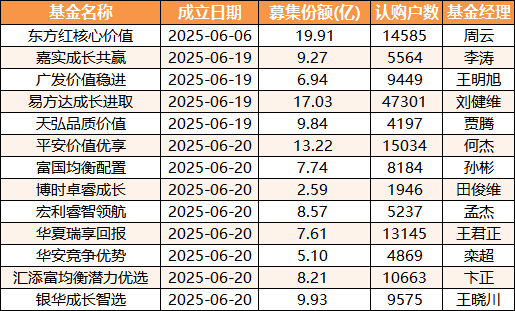
13只浮动费率基金已成立:合计募资126亿 易方达、东方红规模榜
Xin Lang Ji Jin· 2025-06-21 07:41
Core Insights - The first batch of floating fee rate funds has been launched, with a total of 13 funds raising a combined amount of 12.696 billion RMB, averaging 977 million RMB per fund, indicating initial market acceptance of this fee structure reform [1][2]. Fund Performance - The top-performing funds in terms of scale include E Fund's Growth Progress with 1.703 billion RMB and 47,301 subscriptions, followed closely by Oriental Red Core Value at 1.991 billion RMB with 14,585 subscriptions [2][3]. - The lowest performing fund was Bosera's Zhuo Rui Growth, which raised only 259 million RMB, reflecting limited investor appeal amid a crowded issuance environment [2]. Subscription Dynamics - Subscription numbers varied significantly among the funds, highlighting different customer structures and sales strategies. E Fund's Growth Progress not only led in scale but also had a high subscription count of 47,301, with an average subscription amount of only 36,000 RMB, indicating strong retail investor engagement [3]. - Other funds like Ping An Value Enjoyment and Huaxia Rui Xiang Return also had over 10,000 subscriptions, showcasing a solid retail base [3]. - In contrast, Bosera's Zhuo Rui Growth and Manulife's Smart Navigation had lower subscription counts, with 1,946 and 5,237 respectively, indicating a less broad appeal [3]. Industry Implications - The launch of floating fee rate funds marks not only product innovation but also a potential restructuring of the industry ecosystem, shifting from a "scale-first" approach to a model centered on "investor returns" [3].