
规则之治

Search documents
焦点访谈|民法典五年实践,守护民生温度
Yang Shi Wang· 2026-01-10 13:42
Core Viewpoint - The implementation of the Civil Code in China has significantly influenced social life and legal practices over the past five years, marking a milestone in the development of the legal system and providing a solid foundation for the rule of law in the country [1][17]. Group 1: Impact on Legal Practices - Since the Civil Code's implementation on January 1, 2021, over 73.26 million civil litigation cases have been adjudicated across various categories, including property disputes and family law [7]. - The Civil Code has introduced new rules that have led to profound changes in daily life, such as the "Good Samaritan clause," which encourages helping others by allowing compensation for damages incurred while protecting others' rights [7]. - The Civil Code's emphasis on the principle of good faith has been highlighted in cases, reinforcing the importance of honesty and integrity in legal proceedings [7]. Group 2: Case Studies Illustrating the Civil Code's Application - A case in Wuxi regarding the installation of elevators in old residential buildings showcased the Civil Code's role in resolving conflicts between residents, where the requirement for majority approval for modifications was reduced from two-thirds to a simple majority [3][5]. - In Chongqing, a food safety case involving a large purchase of bamboo shoots led to judicial recommendations for industry upgrades, demonstrating the Civil Code's influence on social governance and modernization [10][13]. - The first case of voice rights infringement in China involved the unauthorized use of an individual's voice by AI, which was addressed under the Civil Code's provisions for personality rights, marking a significant advancement in legal protections for digital rights [15][17]. Group 3: Broader Implications for Society - The Civil Code's comprehensive nature has been described as a "encyclopedia of social life," reflecting its extensive impact on various aspects of daily living and legal interactions [1][5]. - The establishment of the Civil Code is seen as a critical step in the evolution of China's legal framework, aligning with the country's goals for a rule-based society and governance [17]. - The Civil Code's provisions, including the independent compilation of personality rights, respond to contemporary societal needs and contribute to the ongoing development of a fair and just legal system [17].

扩容、提质、增效 期货价格已融入千行百业
Shang Hai Zheng Quan Bao· 2025-12-23 19:06
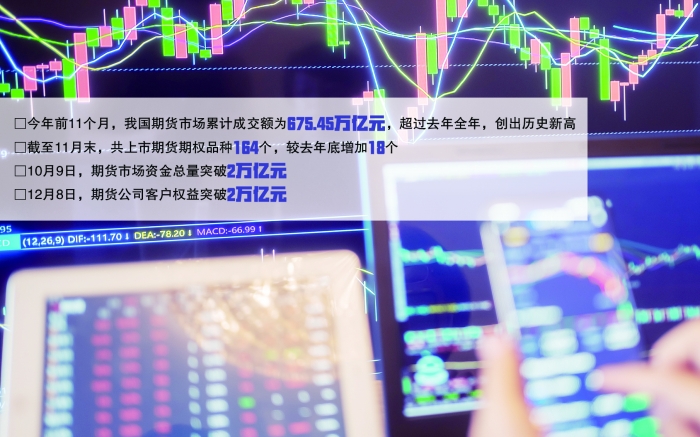
Core Viewpoint - The global commodity market is undergoing significant restructuring in 2025, influenced by trade dynamics and geopolitical competition, leading to a reshaping of the global industrial chain. The year has seen volatile commodity prices, with metals like gold, silver, and copper reaching new highs, while energy and agricultural products remain weak [2]. Market Participation and Trading Volume - In the face of market uncertainties, more entities are engaging in the futures market, with China's cumulative trading volume reaching 67.545 trillion yuan in the first 11 months of the year, surpassing the total for the previous year and setting a historical record. As of October 9, total funds in the futures market exceeded 2 trillion yuan, and by December 8, client equity of futures companies also surpassed 2 trillion yuan [2]. Product Innovation and Expansion - The expansion of product variety is a key focus for the development of China's futures market, with 164 futures and options products listed by the end of November, an increase of 18 from the previous year [3]. - New products are categorized into three types: 1. Filling gaps in existing product lines to enhance risk management across the supply chain, such as the introduction of pure benzene and propylene futures [3]. 2. Innovating contract models to align with trading habits, exemplified by the launch of monthly average price futures for certain chemical products [4]. 3. Accelerating the establishment of a green product system, including the listing of futures for recycled aluminum alloys and precious metals like platinum and palladium [4]. Options Market Development - The acceleration of options coverage is a notable trend, with all new futures products introduced alongside options. Existing products have also seen corresponding options launched, enhancing the risk management tools available to entities [5]. Service Enhancement for the Real Economy - The futures market aims to serve the real economy effectively, with various service models optimized to meet industry needs. For instance, a steel delivery warehouse was established in Northwest China, addressing long-standing delivery challenges for local steel enterprises [6]. - The "insurance + futures" model has evolved over ten years, now involving multiple stakeholders to provide comprehensive risk management for agricultural products [6][7]. Regulatory Improvements and Market Integrity - Since the implementation of the Futures and Derivatives Law in 2022, the regulatory framework for China's futures market has been continuously improved, aligning with the central economic work conference's emphasis on effective regulation [8]. - Recent regulations have focused on enhancing the management of algorithmic trading, internet marketing, and overall industry standards, aiming to create a transparent and efficient futures market [9].
制度型开放的本质是规则之治
Zhong Guo Fa Zhan Wang· 2025-12-18 07:23
Core Viewpoint - The establishment of the Hainan Free Trade Port marks a significant step in China's high-level opening-up strategy, emphasizing a rules-based governance approach to facilitate trade and investment [1][5]. Group 1: Policy and Regulatory Framework - The Hainan Free Trade Port will implement a "one line" open and "two lines" regulated approach, balancing openness with regulation and freedom with order [1][2]. - A new customs model will enhance efficiency by allowing eligible goods to be released directly and reducing the number of customs declaration items from 105 to 42 [2]. - The initial establishment of a policy and institutional framework for the free trade port focuses on trade, investment, cross-border capital flow, personnel movement, and data security [2][4]. Group 2: Sectoral Developments - In the medical sector, over 30 medical institutions are operational, and 15 biomedical technologies have completed clinical transformation, showcasing regulatory innovation in drug approval and medical practice [3]. - The education sector allows foreign high-level universities to operate independently, enhancing educational resource supply and exploring the integration of international standards with local conditions [3]. Group 3: Broader Implications - Hainan's regulatory innovations are expected to be replicated nationwide, providing a template for other free trade zones [4]. - The exploration of a rules system that aligns with international standards while incorporating Chinese characteristics will enhance China's participation in global competition and contribute to the improvement of global trade rules [4]. - The long-term vision for Hainan aims to establish a mature free trade port system by 2035, emphasizing sustainable development and digital transformation [4].