
货币政策框架改革

Search documents
解码央行发布会:八项措施落地,全面降准降息还有多远?
Hua Er Jie Jian Wen· 2026-01-16 00:37
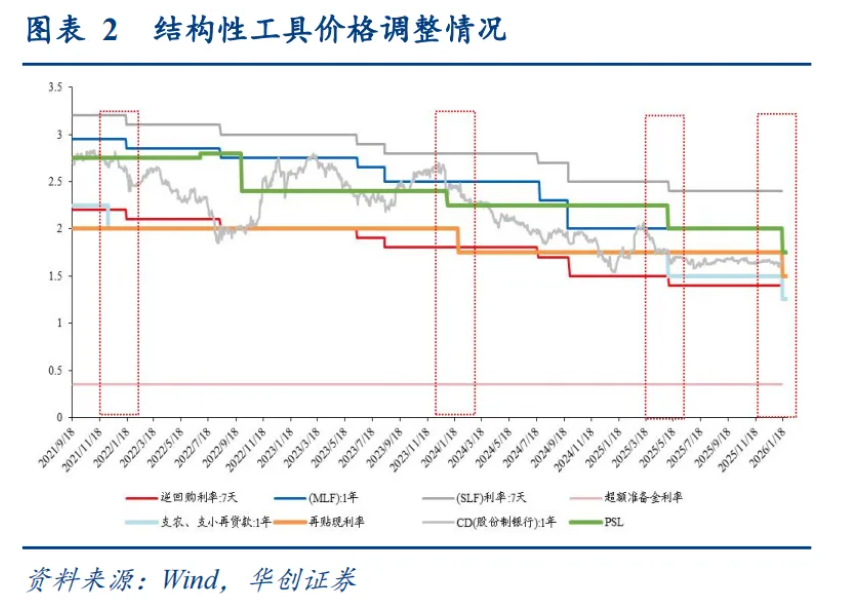
Core Viewpoint - The People's Bank of China (PBOC) has introduced a set of structural monetary policy measures, including a 0.25 percentage point reduction in various structural monetary policy tool rates, signaling a targeted approach to enhance liquidity without a broad interest rate cut [1][2][5]. Group 1: Structural Monetary Policy Measures - The PBOC announced a reduction in the one-year relending rate from 1.5% to 1.25%, and the rediscount rate from 1.75% to 1.5% [2]. - The total balance of structural monetary policy tools was approximately 5.4 trillion yuan as of Q3 2025, with the rate cut expected to save banks around 13.5 billion yuan [8]. - The measures aim to support domestic demand, technological innovation, and small and medium-sized enterprises [12]. Group 2: Specific Policy Tools - The PBOC will increase the relending quota for agricultural and small enterprise support by 500 billion yuan, with a dedicated quota of 1 trillion yuan for private enterprises [16]. - The relending quota for technological innovation and transformation will be increased by 400 billion yuan, totaling 1.2 trillion yuan [16]. - The minimum down payment ratio for commercial property loans will be lowered to 30% to support the commercial real estate market [18]. Group 3: Future Monetary Policy Outlook - The PBOC indicated that there is still room for further reductions in reserve requirement ratios and interest rates, with a potential 50 basis point cut in the first quarter of 2026 [19][20]. - Constraints on interest rate cuts are easing, with improvements in exchange rates and net interest margins noted [21]. - The PBOC aims to guide overnight rates to operate near policy rate levels, indicating a shift in monetary policy management [24][26]. Group 4: Market Implications - The structural easing is expected to positively impact various asset classes, with a potential "spring rally" in the stock market anticipated due to the release of monetary signals [29]. - The bond market is expected to remain stable, with 10-year government bond yields projected to stay between 1.6% and 1.9% [30]. - The Chinese yuan is forecasted to appreciate moderately, with expectations of reaching around 6.9 by the end of 2026 [30].

政治干预、降息空间、缩表争议……美联储2026年避不开的六道难关
Hua Er Jie Jian Wen· 2026-01-06 14:16
Core Insights - The Federal Reserve faces six key challenges in 2026, including independence, monetary policy framework reform, and regulatory issues, which will significantly impact global financial markets and investor expectations [1] Group 1: Political Independence - Political interference, particularly from former President Trump, poses a substantial threat to the Federal Reserve's independence, complicating the decision-making process for the next chair [2] - The potential for the Supreme Court to expand presidential powers to dismiss Federal Reserve officials could undermine the long-standing independence of the Fed [2] Group 2: Interest Rate Policy - The current economic fundamentals support a stable policy stance, with the labor market remaining robust and inflation gradually returning to the 2% target [3] - Economic growth is characterized by sustainable drivers, including AI investment expansion and tax policy implementation, while inflationary pressures from tariffs are expected to diminish [3] Group 3: Balance Sheet Management - The Federal Reserve plans to continue purchasing Treasury securities to maintain a substantial balance sheet, ensuring ample cash reserves in the banking system [4] - The current balance sheet size stands at $6.6 trillion, and effective management of this asset portfolio is crucial for market liquidity and overall stability [4] Group 4: Banking Regulation Reform - The recent regional banking crisis highlights significant flaws in financial regulation processes and culture, necessitating a focus on core issues related to bank safety and soundness [5] - There is a call for simplifying the existing regulatory framework, although the effectiveness of such reforms remains to be seen [6] Group 5: Stablecoin Regulation - A proposal from Federal Reserve Governor Christopher Waller suggests allowing fintech companies with limited banking licenses to hold "streamlined accounts" at the Fed, enhancing transparency and security for stablecoin issuers [7] - However, these accounts would not earn interest or provide overdraft privileges, which could limit their effectiveness during financial stress [7] Group 6: Monetary Policy Framework Reform - The Fed's current communication strategy, primarily based on modal forecasts, may obscure the complexities behind policy decisions, necessitating structural reforms for improved transparency [8] - Consideration of scenario-based economic forecasts, similar to practices by the European Central Bank, could enhance market understanding and stabilize expectations [8]
债市日报:12月22日
Xin Hua Cai Jing· 2025-12-22 16:29
Core Viewpoint - The bond market showed weakness on December 22, with long-term bonds experiencing a decline while short-term bonds remained stable. The central bank is expected to potentially implement a new round of interest rate cuts in Q1 2026, with concerns about structural supply and demand for long-term bonds persisting [1][5]. Market Performance - The closing prices for government bond futures showed a decline across all maturities, with the 30-year contract down 0.28% to 111.98, the 10-year down 0.09% to 107.98, the 5-year down 0.06% to 105.86, and the 2-year down 0.02% to 102.464 [2]. - The yield on the 30-year government bond rose by 1.7 basis points to 2.244%, while the 10-year government bond yield increased by 1.7 basis points to 1.909% [2]. Overseas Market Trends - In North America, U.S. Treasury yields increased across the board, with the 2-year yield rising by 2.76 basis points to 3.483% and the 10-year yield up by 2.74 basis points to 4.147% [3]. - In the Eurozone, the 10-year French bond yield rose by 5.5 basis points to 3.610%, and the 10-year German bond yield increased by 4.6 basis points to 2.894% [3]. Funding Conditions - The central bank conducted a 7-day reverse repo operation of 673 billion yuan at a rate of 1.40%, resulting in a net withdrawal of 636 billion yuan for the day [4]. - The Shibor rates showed mixed performance, with the overnight rate declining to 1.272%, the lowest since August 2023, while the 14-day and 1-month rates increased [4]. Institutional Insights - Huatai Securities noted that the bond market is becoming desensitized to fundamentals, with increased zero-sum competition under low interest rates. They suggest focusing on short-term credit bonds and 5-7 year government bonds [5]. - CITIC Securities highlighted increased volatility in long and ultra-long bond yields due to pressure on bank liabilities, suggesting that long-term bonds still hold value for allocation despite current market conditions [5][6].
陆家嘴论坛后,宽松交易或延续
Huachuang Securities· 2025-06-18 14:46
Report Industry Investment Rating Not provided in the content Core Viewpoints - The expectation of monetary easing in the bond market may continue to play out, and June may be a good window for layout in the second half of the year. The market can take advantage of the potential positive expectations brought by the possible restart of the central bank's bond - buying and the compression of credit spreads before the seasonal entry of wealth management funds in July [19]. Summary by Directory I. Review of Speeches by the Central Bank Governor at the Lujiazui Forum - From 2019 - 2020, the conferences focused on Shanghai's "Five Centers" positioning, including the construction of a RMB asset allocation center, a RMB financial asset risk management center, a financial opening - up center, a demonstration center for a high - quality business environment, and a financial technology center [11]. - From 2021 - 2023, the topics shifted to green finance and inclusive finance, echoing the "Dual Carbon" goals and support for small and micro entities. Specific measures included using structural monetary policy tools to promote the green transformation of the economy and guiding banks to increase support for first - time loans and credit loans to small and micro enterprises [11]. - In 2024, the topic focused on the reform of the monetary policy framework, with five major directions proposed, promoting the transformation of the monetary policy from a parallel quantity - based and price - based regulation to a price - based regulation dominated by interest rates [11]. - In 2025, the speech revolved around global financial governance, covering four aspects: the international monetary system, cross - border payment system, global financial stability system, and international financial organization governance. The weak supervision of non - bank intermediary institutions was emphasized [12]. II. Yield Performance after Historical Lujiazui Forums - The impact of the central bank governor's statements at the Lujiazui Forum on the bond market is relatively limited, and the yield trend often continues the previous situation. The yield change within 30 trading days after the conference is mostly within 10bp, except in 2020 and 2021 [15]. - The probability of yield decline is relatively high, but the trading mainline has limited correlation with the conference content. In 2020, the yield was in an upward adjustment window due to the shift of monetary policy to neutral and the acceleration of government bond issuance. In 2019, 2021, and 2023, the yield declined under the drive of monetary easing. In 2024, the yield was in a narrow - range oscillation [15]. III. Bond Market Strategy: Loose Trading Continues, Seize Layout Opportunities - **10 - year Treasury Bonds**: Maintain narrow fluctuations. When the market approaches 1.62%, it is recommended to take partial profits. The bond market is expected to trade within a narrow range of 1.6% - 1.7% [20]. - **Short - term Treasury Bonds**: There may still be a compression space of 5 - 10bp. Considering factors such as increased supply and a slower bond - buying rhythm this year, the downward range of the short - end may be further reduced [23]. - **Certificates of Deposit**: With loose funds, they are waiting for the drive of wealth management funds in July. The reasonable pricing level is around 1.6% - 1.7%, and it may continue to repair towards 1.6% [28]. - **Credit Bonds**: Pay attention to the opportunities of credit sinking within 3 years and a slight compression of the spread for 4 - 5 - year bonds. There may be a catch - up opportunity for credit bonds within 3 years, and the 4 - 5 - year credit spread has relatively sufficient odds compared to the 2024 low [29].
【UNFX课堂】美联储主席鲍威尔政策立场深度解析
Sou Hu Cai Jing· 2025-05-17 06:24
Economic Status - The U.S. economy is experiencing a complex tug-of-war, with inflation declining but facing persistent resistance, while overall growth and employment data show resilience, masking deeper structural issues [1][2] - As of March 2025, the core PCE year-on-year growth rate is approximately 2.7%-2.8%, indicating challenges in the "last mile" of inflation reduction, largely due to structural factors such as supply chain regionalization and geopolitical tensions [2] - The job market shows significant mismatches, with a low unemployment rate of about 4.2% as of April 2025, but notable layoffs in the tech sector and job shortages in manufacturing [3][4] Policy Framework Adjustments - The Federal Reserve recognizes the need for adaptive adjustments to its policy framework to better respond to complex shocks, moving from an average inflation targeting (AIT) approach to a more forward-looking range management [6][7] - Discussions around expanding liquidity support tools, including the potential expansion of the Standing Repo Facility (SRF) and the possibility of reintroducing yield curve control (YCC) under extreme market conditions, aim to enhance financial system resilience [7][8] External Shocks and Market Impact - The comprehensive tariff strategy initiated during the Trump administration is impacting the U.S. economy through direct cost transmission and supply chain restructuring, leading to varied effects across different industry sectors [8][9] - The erosion of the dollar's dominance due to emerging economies pushing for local currency settlements and central banks exploring digital currencies may increase volatility in the dollar's exchange rate and affect global asset allocation strategies [9][10] Future Outlook - The market is highly focused on when the Federal Reserve will begin to lower interest rates, with a clear "data-dependent" threshold set by Powell, emphasizing the importance of core PCE trends and labor market conditions [10][11] - The potential upward shift in the long-term neutral interest rate (r*) from around 0.5% pre-pandemic to 1.5%-2% suggests a systemic revaluation of capital markets, impacting asset valuations and increasing liquidity and repayment risks for high-leverage sectors [11][12]