货币波动性

Search documents
货币市场:2024年末波动降至多年低位,明年或延续趋稳
Sou Hu Cai Jing· 2025-12-18 22:41
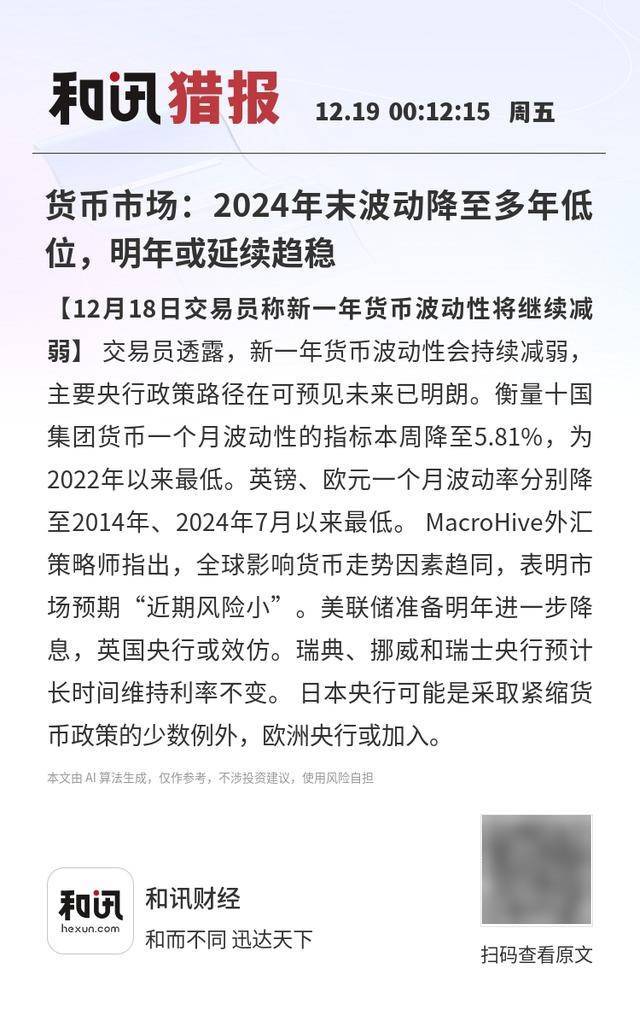
Group 1 - The core viewpoint is that currency volatility is expected to continue decreasing in the upcoming year due to clear central bank policy paths [1][2] - The indicator measuring the one-month volatility of G10 currencies has dropped to 5.81%, the lowest since 2022 [1][2] - The one-month volatility rates for the British pound and euro have reached their lowest levels since 2014 and July 2024, respectively [1][2] Group 2 - MacroHive forex strategists indicate that global factors influencing currency movements are converging, suggesting market expectations of "low near-term risks" [1][2] - The Federal Reserve is preparing for further interest rate cuts next year, with the Bank of England likely to follow suit [1][2] - Central banks in Sweden, Norway, and Switzerland are expected to maintain interest rates for an extended period, while the Bank of Japan may be one of the few exceptions considering tightening monetary policy [1][2]

ATFX:美元重新展现韧性,削弱新兴市场货币吸引力
Sou Hu Cai Jing· 2025-08-14 17:31
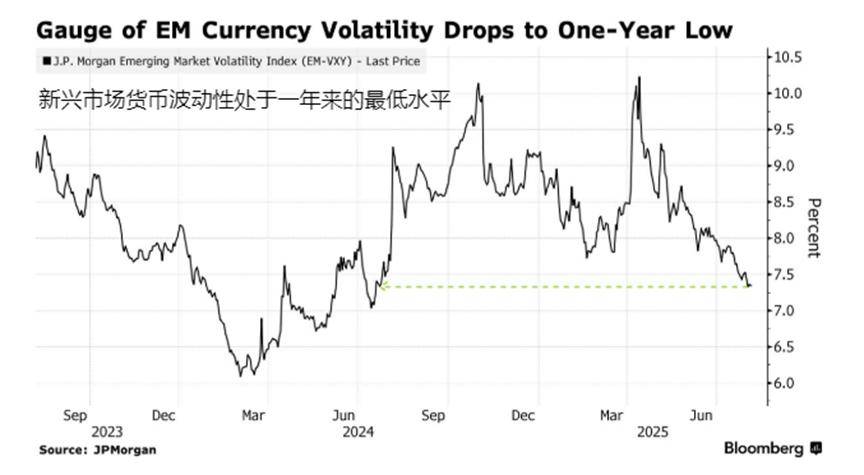
Core Viewpoint - The US dollar index has shown resilience recently, with a 3.4% increase in July, ending a streak of declines, despite a disappointing non-farm payroll report [1] Group 1: Dollar Performance - The Bloomberg Dollar Spot Index rose by 2.7% in July, breaking a six-month downward trend [1] - Emerging market currencies, represented by the MSCI Emerging Markets Currency Index, fell by 1.2% [1] - The Taiwanese dollar has appreciated approximately 9.5% this year, leading Asian currencies, while the South Korean won has risen nearly 6% [1] Group 2: Investor Sentiment - The rebound of the dollar has led some emerging market investors to believe that the dollar will continue to rise in the coming months [1] - Barclays Bank has advised clients to avoid shorting the dollar against other Asian currencies [1] - Fidelity International noted that prolonged high US interest rates reduce the attractiveness of borrowing dollars for arbitrage trading [1] Group 3: Emerging Market Currency Dynamics - The volatility of emerging market currencies is at its lowest in a year, which diminishes demand for Asian currencies in favor of higher-yielding European and Latin American currencies [2] - The average interest rate differential for Asian currencies is negative 1.1%, indicating higher holding costs compared to potential returns from holding dollars [5] - Latin American currencies have a positive interest rate differential of 3.7%, while European and African currencies have a positive differential of 1.1% [5] Group 4: Market Uncertainty - The uncertainty surrounding US tariffs continues to impact the attractiveness of emerging market currencies, despite some agreements reached with major trading partners [6] - The potential for further interest rate cuts by the Federal Reserve remains a key factor influencing the dollar's trajectory [6]