
新兴市场货币

Search documents
大摩闭门会-强势美元政策是否依然存在
2026-02-05 02:21
Summary of Key Points from Conference Call Industry Overview - The discussion revolves around the **U.S. dollar's strength policy** and its implications on the global market, particularly focusing on the role of the **Federal Reserve** and the **U.S. Treasury** in managing currency values [1][2][3]. Core Insights and Arguments - The **strong dollar policy** is not clearly defined but acknowledges the dollar's critical role in the global market, benefiting the U.S. without specifying exact values or long-term fair value theories [1][2]. - Key factors influencing exchange rates include **interest rate differentials**, **growth rate differences**, and **capital flows**. Direct foreign exchange intervention is a tool for adjusting currency values, but its long-term effectiveness is debated [1][5]. - The **Federal Reserve's dual mandate** aims for maximum sustainable employment and price stability, indicating that it will not use monetary policy tools to achieve specific exchange rate targets in the short term [5]. - **Kevin Walsh**, the new Federal Reserve Chair, is expected to maintain a mainstream policy stance, suggesting no significant changes in the policy response mechanism despite his appointment [5]. Market Predictions - **Morgan Stanley** holds a bearish outlook on the dollar for early 2026, driven by traditional factors like growth expectations and Federal Reserve policies, as well as risk premiums [6][7]. - Recent discussions on foreign exchange intervention have led to a **strengthening of the yen**, with risk premium levels approaching highs seen in the second quarter of the previous year [6][7]. - If the **European Central Bank** and the **Bank of England** signal potential rate cuts, it could exert downward pressure on their currencies against the dollar [7]. Emerging Markets - Many **emerging market central banks** are currently adopting a conservative stance, raising interest rates to combat inflation. However, if their currencies strengthen and domestic conditions allow, these countries may have more room for easing [8]. - Short-term easing could lead to slight currency depreciation, but in a low-volatility global environment, such fluctuations may present buying opportunities as asset managers increase bond holdings, leading to more capital inflows and supporting local currency values [8]. Additional Considerations - The **ambiguity** in U.S. exchange rate policy reflects a deliberate strategy to maintain flexibility in response to market conditions [2]. - The **negative impacts** of the dollar's status as a reserve currency have been acknowledged, particularly in terms of its influence on U.S. foreign policy and sanctions [3]. This summary encapsulates the key points discussed in the conference call, highlighting the dynamics of U.S. dollar policy, market expectations, and the behavior of emerging market currencies.
巴克莱:新兴市场货币有望跑赢,资金流入空间巨大
Sou Hu Cai Jing· 2026-01-27 23:48
Core Viewpoint - Barclays strategists indicate that emerging market currencies are expected to significantly outperform major currencies due to the unwinding of short positions in the Japanese yen and the potential for substantial capital inflows into emerging market assets [1] Group 1: Emerging Market Currencies - The strengthening of the yen is providing support for emerging market assets, particularly emerging market currencies, which is different from previous scenarios of yen unwinding [1] - Barclays believes that the weakening of the US dollar has not diminished global risk appetite, which is currently supporting emerging market currencies [1] - There is a significant potential for capital inflows into emerging market portfolios, suggesting a strategic catch-up in the allocation of local currency assets [1] Group 2: Investment Strategy - Barclays recommends continuing to go long on high-yielding emerging market currencies and emerging market commodity currencies, indicating that they still hold value [1] - The expectation is that these currencies will appreciate steadily over time in the current environment [1]
巴克莱:新兴市场货币将显著跑赢主要货币 资金流入空间巨大
Sou Hu Cai Jing· 2026-01-27 18:24
Core Viewpoint - Barclays indicates that with the unwinding of short positions in the yen and the potential for significant capital inflows into emerging market assets, emerging market currencies are expected to "significantly" outperform major global currencies [1] Group 1: Yen and Emerging Markets - Unlike previous instances of yen short position unwinding, the current strengthening of the yen is providing support for emerging market assets, particularly emerging market currencies [1] - Barclays strategists, including Marek Raczko, highlight that the weakening of the dollar has not diminished global risk appetite, which is currently supporting emerging market currencies [1] Group 2: Investment Opportunities - The confidence shock regarding the dollar is triggering a delayed strategic chase for emerging market local currency assets [1] - Barclays believes there is substantial room for capital inflows into emerging market investment portfolios [1] - The demand for emerging market currencies is expected to persist even as recent events fade from the short-term narrative, with continued value in high-yield emerging market currencies and emerging market commodity currencies [1]

美元走弱助推外汇套利交易开门红 华尔街押注新兴货币涨势延续
Zhi Tong Cai Jing· 2026-01-26 15:45
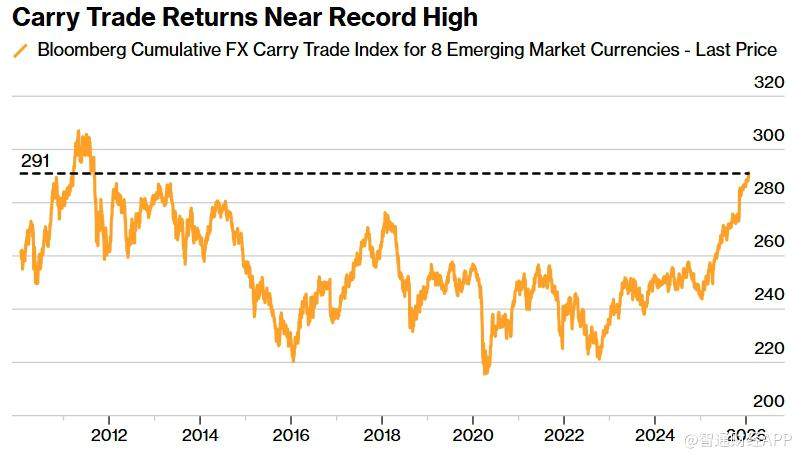
Core Viewpoint - Investors have achieved significant returns through "arbitrage trading" by selling dollars and buying high-yield emerging market currencies, with expectations for continued gains amid ongoing pressure on the dollar from Trump-era policies [1] Group 1: Market Performance - The index tracking returns from eight emerging market currencies has risen by 1.3% year-to-date [1] - As of Monday, the index reached 291 points, just about 5% shy of its historical high set in 2011 [4] - The Brazilian real has accumulated a return of 4.3% since the beginning of 2026, building on a 23.5% increase from the previous year [4] Group 2: Economic Factors - The attractiveness of arbitrage trading stems from both currency appreciation and the high real interest rates in developing countries [4] - Many emerging market central banks are cautiously advancing easing policies, maintaining a high interest rate environment despite signs of slowing inflation [4] Group 3: Investment Strategies - Morgan Stanley's emerging markets strategy head, James Lord, is optimistic about currencies from countries with tight monetary policies and high central bank credibility, including the Brazilian real, Turkish lira, and Czech koruna [4] - Citigroup strategists also recommend going long on the Brazilian real against the dollar and see potential in the Turkish lira [4] Group 4: Risks and Considerations - Not all emerging market currencies are benefiting; the Indian rupee, which was the worst performer last year, has continued to decline, down approximately 2% in arbitrage returns this year [4] - The Indonesian rupiah has also put investors at a loss [4] - Historical data shows that the strongest year for arbitrage trading was in 2003, with a return of 25%, but a repeat of such a "harvest year" requires a sustained weakening of the dollar and stable emerging market currency fluctuations [5]

今日国际国内财经新闻精华摘要|2026年1月24日
Xin Lang Cai Jing· 2026-01-24 00:31
International News - The trilateral talks between Russia, the US, and Ukraine commenced in Abu Dhabi on January 23, with closed-door discussions expected to continue on January 24 [1][10] - The US has imposed new sanctions on Iran's energy and shipping sectors, freezing assets of related entities and vessels, and prohibiting US individuals and entities from engaging in transactions with them [1][10] - The Turkish Foreign Minister indicated signs that Israel is still seeking to attack Iran [2] - The Venezuelan Defense Minister claimed that the US has used previously untested weapons in Venezuela, turning it into a weapons testing ground [3] - The US Treasury announced tax-advantaged investment accounts for all citizens under 18, as part of the Trump administration's tax reduction plan for working families [3] - The precious metals market saw significant gains, with spot silver surpassing $100 per ounce and gold reaching a historical high of $4976.59 per ounce [3][12] - The CFTC reported an increase of 2,614 contracts in net long positions for COMEX gold and a reduction of 3,719 contracts in net long positions for silver as of January 20 [3][12] Market Dynamics - Natural gas futures in the US rose over 7% to $5.417 per million British thermal units, while Bitcoin surpassed $91,000 [4][13] - The US stock market showed mixed results, with the Dow Jones down 0.59% at 49,098.71 points, while the Nasdaq rose 0.27% [4][13] - Intel's stock plummeted 17% to $45.07, ending a three-day rally with a trading volume of 290.4 million shares [4][13] - Amazon plans to lay off up to 16,000 employees next week, while Meta will temporarily block teenage users from accessing its AI features [5][14] Domestic News - The domestic commodity futures market experienced significant volatility, with silver contracts rising 7% to 25,818.00 yuan, tin rising 8% to 453,230.00 yuan, and fuel oil rising 6% to 2,770.00 yuan [8][17] - The Nasdaq Golden Dragon China Index fell 0.22%, with notable declines in several Chinese companies listed in the US, including a 6.98% drop for Fuling Global and a 6.57% drop for Haitian Network [8][17]
1月20日隔夜要闻一览
Sou Hu Cai Jing· 2026-01-19 22:57
Group 1 - President Trump is expected to meet with global business leaders, including CEOs from financial services, cryptocurrency, and consulting industries, at the World Economic Forum in Davos [1] - OpenAI's policy head, Chris Leonne, announced plans to release the company's first hardware device in the second half of 2026, although no commitment was made for a formal launch this year [3] - HSBC's corporate and investment banking head stated that the company's market value is now aiming to exceed £300 billion (approximately $402 billion) after recently surpassing £200 billion (approximately $268 billion) [8] Group 2 - JPMorgan's strategists downgraded their outlook on emerging market currencies from "overweight" to "neutral," citing that short-term positions have become "overbought" after a year of strong gains [9]


【环球财经】新年首日南非兰特持稳 市场预期稳定
Xin Hua Cai Jing· 2026-01-02 01:44
Core Viewpoint - The South African Rand (ZAR) has shown a strong performance at the beginning of 2026, trading at approximately 16.51 ZAR per USD, benefiting from a weaker USD and various supportive domestic factors [1][2]. Group 1: Currency Performance - The South African Rand appreciated by about 12.4% against the USD in 2025, making it one of the standout performers among major emerging market currencies [1]. - Despite facing pressures from US trade and political policies, the Rand has remained relatively strong, with a measure of expected volatility reaching its lowest level since the turn of the century [1]. Group 2: Contributing Factors - Key factors supporting the Rand's strength include its removal from the Financial Action Task Force's special scrutiny list in October 2025, a mid-term budget policy that gained market approval in November 2025, and an upgrade in South Africa's sovereign credit rating by S&P Global [1]. - The government's implementation of interest rate cuts in a low inflation environment has also contributed positively to market sentiment [1]. Group 3: Future Outlook - According to Investec's chief economist, the Rand's performance is significantly influenced by USD fluctuations, with expectations of US Federal Reserve rate cuts potentially boosting commodity prices, which would benefit commodity currencies like the Rand [2]. - However, the Rand remains a highly volatile emerging market currency, with risks of correction due to domestic policy changes or external shocks that could impact exchange rate trends and market expectations [2].
新兴市场货币强势逆袭!2026年万亿资金有望为涨势续上动能
Zhi Tong Cai Jing· 2025-12-15 12:59
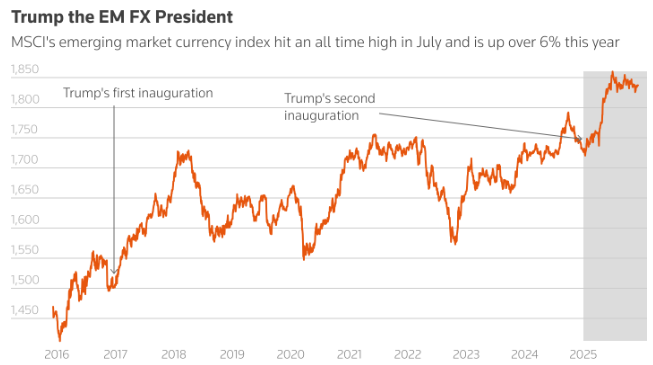
Core Insights - Emerging market currencies are performing strongly due to increased volatility and a weakening dollar, prompting investors to reassess their exposure to the dollar and consider the economic value of developing countries [2][5] - The trend of emerging market currencies is expected to continue into 2026, with significant interest from hedge funds and banks benefiting from foreign exchange trading [1][6] Group 1: Emerging Market Currency Performance - The Hungarian Forint's trading volume has more than doubled since January, with a 20% increase in its exchange rate against the dollar, marking its best performance in 25 years [1] - The MSCI Emerging Markets Currency Index reached a historical high in July, with an expected annual increase of over 6%, the best since 2017 [1] - The Brazilian Real and Mexican Peso are among the best-performing emerging market currencies, supported by robust central banks and high interest rates, with Brazil's rate at 15%, the highest in nearly 20 years [12] Group 2: Impact of Dollar Weakness - The dollar's weakening is part of a broader cycle shift, ending a 14-year bear market for emerging market currencies, as investors move away from reliance on U.S. assets [2][5] - Analysts expect the Federal Reserve to lower interest rates by another two 25 basis points in the coming year, which is crucial for many emerging market currencies and is driving capital inflows [9][12] - The high volatility in the foreign exchange market has created profitable opportunities for hedge funds, with EDL Capital reporting a 28% increase in value this year [5][6] Group 3: Institutional Insights - Major banks have generated nearly $40 billion in revenue from emerging market foreign exchange trading in the first nine months, more than double the revenue from trading ten major currencies [6] - Over half of surveyed top forex traders and hedge fund managers indicated increasing interest in emerging market currencies as the dollar's dominance wanes [9] - The International Monetary Fund has warned of potential risks in the currency market, highlighting that nearly half of global forex trading is dominated by a small number of large banks [5]
11月25日人民币汇率解析:稳定背后的深层原因
Sou Hu Cai Jing· 2025-11-25 22:13
Group 1 - The recent fluctuations of the RMB have sparked discussions, with some predicting continued depreciation while others see stability as a positive sign amidst global economic uncertainties [1] - On November 25, the RMB to USD midpoint was reported at 7.0847, indicating resilience in the domestic economy and effective government intervention in the foreign exchange market [1] - The RMB's stability is attributed to macroeconomic strategies, including foreign exchange reserve management and capital flow controls, which have limited drastic fluctuations [1] Group 2 - The strong rebound of the USD is a major focus in the currency market, driven by rising expectations of US interest rate hikes, while the Euro and GBP have seen slight declines due to economic slowdown risks in Europe [3] - The Japanese Yen remains stable due to increased demand as a safe-haven currency amidst global uncertainties, providing relative security for investors [3] - Emerging market currencies show varied performances, with the Thai Baht and South Korean Won strengthening due to economic recovery and strong exports, while the South African Rand and Mexican Peso face pressure from inflation [3] Group 3 - Future currency markets will face variables from US interest rate expectations and global economic slowdown, with the USD likely to strengthen, while the RMB may maintain stability through its midpoint mechanism [5] - Economic recovery in Europe and Japan will be crucial for future currency trends, with the Euro potentially benefiting and the Yen facing downward pressure [5] - Long-term prospects for the RMB include increased internationalization and high-level domestic openness, which may enhance its global standing [5] Group 4 - Companies and investors must closely monitor currency policy changes, particularly in the US and China, and adjust foreign exchange management strategies based on trends [7] - Diversifying risk by avoiding concentration in a single currency asset is essential for managing exchange rate risks [7] - The current mild fluctuations in the currency market present a favorable situation for investors and companies, reflecting the effectiveness of domestic economic strategies and China's resilience in the global economy [7]

巴克莱:美元将在2026年前继续走强
Sou Hu Cai Jing· 2025-11-24 04:05
Core Viewpoint - Barclays Research anticipates that risk assets will receive stronger support, and the US dollar will continue to strengthen until 2026, despite market volatility due to uncertainties surrounding AI valuations, investment returns, and earnings growth [1] Group 1: US Dollar Outlook - The positive outlook for the US dollar is primarily based on significant AI capital expenditure plans in the US, which could have transformative impacts on the economy, geopolitics, and competition [1] - Concerns regarding the independence of the Federal Reserve are diminishing, tariff risks are easing, and fiscal stimulus measures are advancing, contributing to a positive momentum for the dollar expected to last until 2026 [1] Group 2: Market Dynamics - Even if risk sentiment deteriorates further, there is still potential for the dollar to appreciate against the yen, while high-beta emerging market currencies may face vulnerabilities [1]