
货币金融环境

Search documents
甘肃本外币存贷款余额双双突破3万亿元
Xin Hua Cai Jing· 2025-12-10 06:04
Core Insights - Gansu Province's financial sector has reached a historic milestone with both deposits and loans exceeding 3 trillion yuan as of the end of Q3 this year, with financial value added amounting to 81 billion yuan, representing 8.1% of the province's GDP [1] Financial Growth - The province's deposit balance increased from 2.1 trillion yuan to over 3 trillion yuan, marking a growth of 47% compared to the end of the 13th Five-Year Plan in 2020 [1] - Loan balances rose from 2.22 trillion yuan to over 3 trillion yuan, reflecting a growth of 36% during the same period [1] - Over the past five years, the total social financing scale in Gansu has increased by over 1.2 trillion yuan, averaging an annual increment of over 240 billion yuan, providing continuous financial support to the real economy [1] Financial Sector Contribution - In the first three quarters of this year, the financial sector's value added reached 81 billion yuan, accounting for 8.1% of the province's GDP, a significant increase compared to the 13th Five-Year Plan period [1] - The financial sector's contribution to the tertiary industry's value added is as high as 15.2% [1] - The total assets of the banking sector in Gansu have surpassed 4 trillion yuan, while the insurance sector's assets exceed 180 billion yuan [1] Credit Growth and Economic Development - The adaptability of credit growth to economic development has significantly improved, with an average annual loan growth rate of 6.4% over the past five years, consistently outpacing the growth rate of regional GDP [1] - This stable monetary environment supports the province's key initiatives such as "strong technology, strong industry, strong provincial capital, and strong county areas," highlighting the financial sector's role as a stabilizing force in the journey towards high-quality economic development [1]
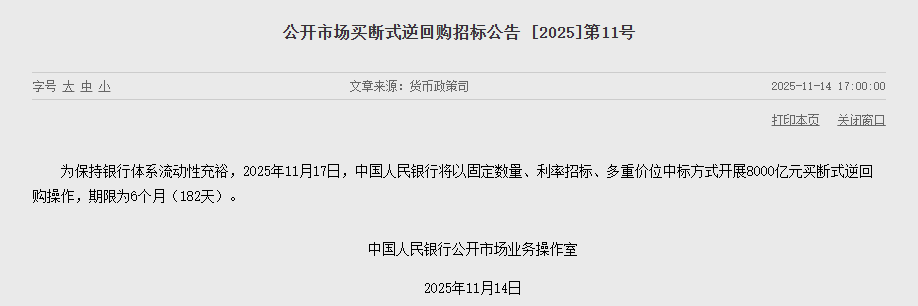
央行宣布!下周一,8000亿元
Zhong Guo Zheng Quan Bao· 2025-11-14 12:34
Core Viewpoint - The People's Bank of China (PBOC) is set to conduct a 800 billion yuan reverse repo operation on November 17, aimed at maintaining ample liquidity in the banking system, with a term of 6 months [1][4]. Group 1: Reverse Repo Operations - The upcoming operation will involve a fixed amount and interest rate bidding, with a total of 800 billion yuan for a 182-day term [1]. - This operation indicates a continuation of the 6-month reverse repo, with an additional 500 billion yuan, aligning with market expectations [4]. - The PBOC's previous operation on November 5 involved a 700 billion yuan 3-month reverse repo, effectively renewing the same amount due to the maturity of 700 billion yuan [4]. Group 2: Market Analysis - Analysts suggest that this marks the sixth consecutive month the PBOC has injected medium-term liquidity through reverse repos [5]. - Factors contributing to this liquidity support include the issuance of 500 billion yuan in local government bonds and the completion of 500 billion yuan in new policy financial instruments, which are expected to increase loan issuance [5]. - The upcoming maturity of 900 billion yuan in Medium-term Lending Facility (MLF) is anticipated to create pressure for renewal, which the reverse repo operation may alleviate [5]. Group 3: Future Expectations - There is a general expectation that the PBOC will continue to utilize various tools, including reverse repos and MLF, to ensure sufficient liquidity in the banking system [7]. - The PBOC may also consider increasing the scale of government bond purchases to smooth liquidity pressures, reflecting its intention to maintain a supportive monetary environment [6].

【早知道】住建部:持续巩固房地产市场稳定态势;证监会:完善发行上市等制度机制
Sou Hu Cai Jing· 2025-09-23 00:04
Group 1 - The China Securities Regulatory Commission (CSRC) aims to deepen reforms in the Sci-Tech Innovation Board, ChiNext, and Beijing Stock Exchange, enhancing the issuance and listing systems to cultivate patient capital [1] - The People's Bank of China (PBOC) is focused on creating a favorable monetary and financial environment to support sustained economic recovery [1] - The State Administration of Foreign Exchange (SAFE) is committed to maintaining the basic stability of the RMB exchange rate at a reasonable and balanced level, alongside ensuring basic equilibrium in international payments [1] Group 2 - The National Audit Office is increasing efforts to reveal major risk hazards in local government debt, finance, and energy sectors [1] - The Ministry of Housing and Urban-Rural Development is working to solidify the stability of the real estate market and is focused on developing a new model for real estate growth [1] - The General Administration of Sport of China has issued guidelines to promote the high-quality development of health through sports [1] - The National Energy Administration has set a goal for 2030 to achieve self-sufficiency in the supply chain of key energy equipment industries [1]