贸易收支

Search documents
日本2月对华出口减少10.9%
日经中文网· 2026-03-18 08:03
Trade Balance Summary - Japan's trade balance recorded a surplus of 57.2 billion yen in February, a significant decrease of 89.8% year-on-year, marking a return to surplus after two months [1] - Exports to the United States have decreased for three consecutive months, while exports of electronic components such as chips to Asia have increased [1] Export and Import Data - February exports increased by 4.2% year-on-year, reaching a record high of 9.5715 trillion yen, marking six consecutive months of growth [3] - Imports rose by 10.2% year-on-year to 9.5143 trillion yen, with crude oil imports decreasing by 4.2% to 756.3 billion yen [3] - The average price of crude oil in USD was $65.7 per barrel, down 18.3% year-on-year, with a similar decline in yen terms [3] Country-Specific Trade Analysis - Exports to the United States amounted to 1.7528 trillion yen, a decrease of 8.0% year-on-year, influenced by tariff policies from the Trump administration, particularly affecting automobile exports which fell by 14.8% to 470.6 billion yen [3] - The average unit price of exported vehicles decreased by 10.6% to 4 million yen, continuing a 12-month decline [3] - Exports to China decreased by 10.9% to 1.3696 trillion yen, marking a decline after three months, with reductions in semiconductor manufacturing equipment and plastics [3] - Imports from China surged by 35.4% to 2.3368 trillion yen, influenced by differences in holiday schedules affecting logistics and factory operations [3]


日本出口连降四月 对美贸易创四年最大跌幅
智通财经网· 2025-09-17 03:33
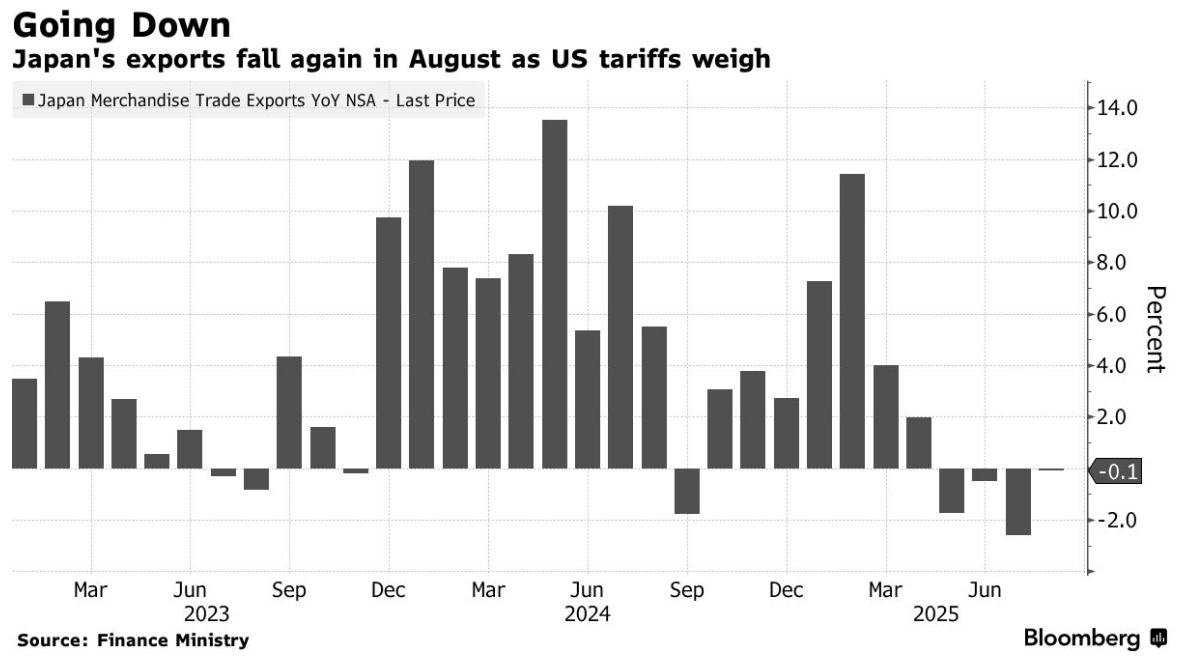
Core Viewpoint - Japan's exports have declined for the fourth consecutive month, primarily due to the impact of U.S. tariffs under President Trump's trade policies, particularly affecting trade with the U.S. [1][3] Export Performance - In August, Japan's export value decreased by 0.1% year-on-year, with automobiles and steel being the main contributors to this decline [1] - Exports to the U.S. saw a significant drop of 13.8%, with automobile exports falling by 28.4% and export volume down by 9.5% [3][4] - Exports to China decreased by 0.5%, while exports to Europe increased by 5.5% [3] Trade Balance - Japan's trade balance recorded a deficit of 242.5 billion yen (approximately 1.7 billion USD) [3] - The import value fell by 5.2%, which was worse than the consensus expectation of a 4.1% decline [3] Economic Implications - The ongoing decline in exports poses risks to Japan's fragile economic growth, potentially disrupting the desired cycle of inflation, wage growth, and overall economic expansion [3] - The impact of U.S. tariffs on Japanese companies, particularly in the automotive sector, may lead to cost-cutting measures that could suppress profit margins and wage growth [3][4] U.S. Trade Relations - Japan's trade surplus with the U.S. was 324 billion yen, indicating ongoing pressure from the U.S. to reduce this gap [5] - The recent trade agreement, which includes a reduction of tariffs on Japanese automobiles, may provide some relief, but its effectiveness will depend on Japan's commitment to invest 5.5 trillion yen as part of the agreement [4]
日本5月出口额减1.7%,对华减8.8%
日经中文网· 2025-06-20 07:27
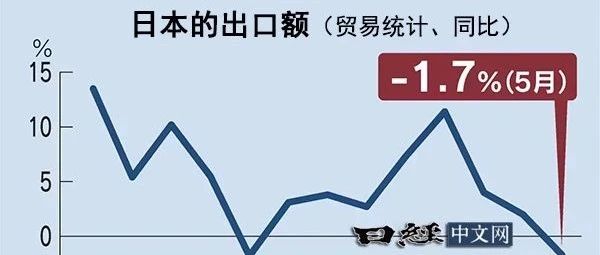
Core Viewpoint - Japan's overall exports in May decreased by 1.7% year-on-year, marking the first decline in eight months, primarily due to a drop in automobile exports to the United States [1]. Group 1: Export Performance - Japan's total export value fell to 8.1349 trillion yen in May, with a significant reduction in exports to the U.S. by 11.1%, amounting to 1.514 trillion yen [1]. - Exports of automobiles to the U.S. saw a substantial decline of 24.7%, indicating a notable impact from the additional tariffs imposed by the Trump administration [1]. - The decrease in export volume was only 3.9%, suggesting that the decline in export value was primarily driven by falling prices [1]. Group 2: Trade Balance - The trade balance with the U.S. showed a surplus of 451.7 billion yen, which is a reduction for the first time in five months [1]. - Japan's exports to China also decreased by 8.8%, totaling 1.4417 trillion yen, with declines in semiconductor manufacturing equipment, copper, and hybrid vehicles [1]. - Overall imports into Japan amounted to 8.7726 trillion yen, down 7.7%, marking a consecutive two-month decline [1]. - The trade balance, after subtracting imports from exports, resulted in a deficit of 637.6 billion yen, continuing a trend of deficits for two consecutive months [1].