
资产配置冲击

Search documents
硬资产轮动!高盛:这轮商品上涨更像“资产配置冲击”,不再是单纯的供需故事
美股IPO· 2026-02-09 12:27
Core Viewpoint - Goldman Sachs indicates that the strong performance of the commodity market in early 2026 cannot be explained solely by supply and demand logic, as asset allocation is becoming the dominant variable influencing commodity prices [3][4][5]. Group 1: Shift from Supply-Demand Pricing to Asset Allocation Pricing - The current strength in the commodity market is increasingly driven by asset allocation rather than traditional supply-demand dynamics, marking a significant shift in pricing logic [4][5]. - Investors are reassessing asset allocation due to concerns over macroeconomic policy uncertainty, geopolitical risk premiums, and long-term inflation anxieties, leading to a rotation from "soft assets" to "hard assets" like commodities [4][5]. Group 2: Market Structure and Price Impact - The commodity market is relatively small compared to equity and bond markets, meaning even moderate inflows of asset allocation can lead to significant price impacts [6][7]. - Active investors, such as hedge funds and CTAs, are primarily responsible for driving price changes through their position adjustments, which can quickly influence futures prices and, subsequently, the spot market [8][9]. Group 3: Hard Asset Rotation Favoring Metals - Precious metals and copper are seen as the primary beneficiaries of the current hard asset rotation, while energy commodities are expected to benefit only temporarily [10]. - Structural differences, such as market size, supply response speed, and storage characteristics, make metals more favorable for investment compared to energy [12]. Group 4: Gold as the Ideal Hard Asset - Gold is identified as the most direct and least supply-constrained hard asset for investment, serving as a neutral asset against policy uncertainty and currency risks [13][14]. - Goldman Sachs projects a price of $5,400 per ounce for gold by December 2026, with significant upside potential as the allocation of gold in U.S. financial assets remains low at approximately 0.2% [15]. Group 5: Price Expectations for Copper and Oil - While maintaining a long-term bullish stance on copper with a target price of $15,000 per ton by 2035, Goldman Sachs expresses caution regarding short-term price movements, predicting a potential decline to $11,200 per ton by Q4 2026 [16]. - The outlook for oil is more conservative due to quicker supply responses and fragile inventory structures, indicating that energy is not the best long-term vehicle for hard asset allocation [16]. Group 6: Long-Term Price Stability - The asset allocation-driven hard asset rotation may lead to certain metal prices remaining above levels that can be explained by physical fundamentals for an extended period [17][18]. - This shift suggests that understanding the current commodity market solely from a supply-demand perspective may underestimate the influence of financial capital on pricing [19][20].


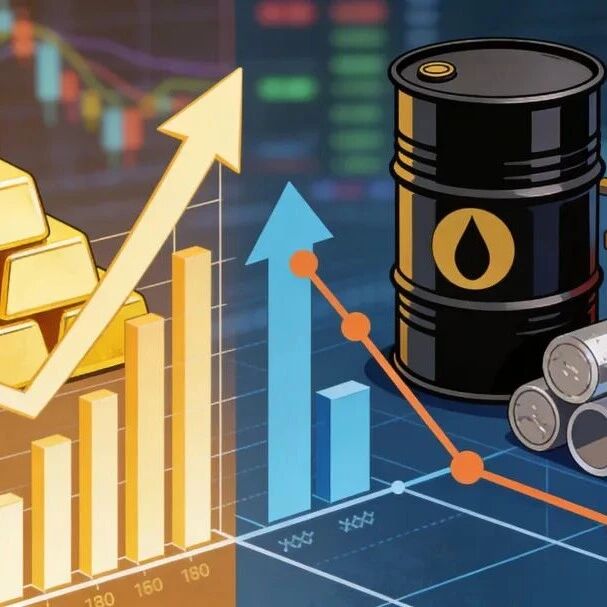
硬资产轮动!高盛:这轮商品上涨更像“资产配置冲击”,不再是单纯的供需故事
Xin Lang Cai Jing· 2026-02-09 07:20
Group 1 - The core driver of the current commodity market is shifting from "supply-demand balance" to "asset allocation impact" [1][18] - Investors are reallocating funds from "soft assets" like bonds and equities to "hard assets" such as commodities due to concerns over macroeconomic policy uncertainty, geopolitical risks, and long-term inflation anxiety [2][19] - This shift in asset allocation is expected to lead to commodity prices remaining elevated beyond what physical fundamentals can justify [12][28] Group 2 - The commodity market is relatively small compared to equity and bond markets, making it susceptible to price impacts from even moderate inflows of asset allocation funds [3][20] - Active investors, such as hedge funds and trading funds, are primarily responsible for driving price changes through their position adjustments [4][21] - Financial flows exceeding industrial hedging and physical flows will likely lead to price increases in the short term [5][22] Group 3 - Precious metals and copper are seen as the primary beneficiaries of the current "hard asset rotation," while energy commodities are viewed as only temporarily benefiting [6][23] - Structural differences, such as market size, supply response speed, and storage characteristics, favor metals over energy in the context of asset allocation [7][24] - Metals are considered easier to hold and more resilient in the current asset allocation framework [9][25] Group 4 - Gold is identified as the most direct and least supply-constrained hard asset for allocation, with a price forecast of $5,400 per ounce by December 2026 [10][26] - The potential for increased allocation to gold in U.S. financial portfolios suggests significant upward price pressure, as a 1 basis point increase in allocation could raise gold prices by approximately 1.5% [10][26] - Current copper prices are above fair value based on inventory and demand, with a forecasted decline to $11,200 per ton by Q4 2026, although upward risks remain if asset rotation continues [11][27] Group 5 - The phenomenon of prices remaining elevated due to asset allocation-driven hard asset rotation may become a new norm [12][28] - The current copper market reflects this trend, while precious metals are expected to be the next major beneficiaries [13][29] - Understanding the current commodity market solely through supply and demand may underestimate the influence of financial capital on pricing [14][30] - The fundamental change in the commodity market is driven by a deep shift in global asset allocation [15][31]