
硬资产轮动

Search documents
高盛闭门会-黄金持续上涨引发向硬资产的轮动-对冲地缘货币贬值ai浪潮
Goldman Sachs· 2026-03-01 17:22
Investment Rating - The report indicates a positive outlook on hard assets, particularly metals, due to their potential for price appreciation amid geopolitical risks and macroeconomic uncertainties [1][5]. Core Insights - Geopolitical risks and supply chain vulnerabilities are driving sovereign demand for commodities as a form of insurance, leading to increased inventory accumulation and domestic production support [1][3]. - The transition to hard assets is seen as a key driver for the overall rise in commodity prices, with metals expected to outperform energy due to their smaller market size and constrained supply response [1][5]. - There are two observed waves of investment: the first focused on inflation hedging and portfolio diversification, while the second emphasizes strategic asset allocation in commodities, particularly in response to geopolitical risks [1][6]. Summary by Sections Geopolitical and Economic Context - Sovereign demand for commodities has increased as countries seek to hedge against geopolitical and financial tail risks, with significant purchases of gold observed since 2022 [3][4]. - The copper market has shown signs of supply-demand imbalance, with U.S. inventory accumulation leading to price increases despite an overall surplus [3][4]. Investment Trends - The report notes a significant increase in commodity net managed funds, up 50% compared to the average levels in 2024, indicating strong demand for hard assets [4][6]. - The hard asset rotation is expected to continue, with a focus on metals initially, followed by basic metals, as investors seek to enhance portfolio resilience [1][6]. Price Dynamics - The report highlights that the price impact of hard asset rotation could be significant due to the smaller scale of the commodity markets compared to equities and bonds [5][6]. - Historical relationships suggest that increases in gold holdings can lead to substantial price increases, with copper and oil also expected to respond positively to increased positions [5][6]. Supply Chain and Storage Considerations - The report emphasizes the importance of supply chain resilience and the rising costs of transportation, which are critical factors in the current market environment [2][6]. - Storage capabilities are becoming increasingly important as investors look to enhance system flexibility amid rising demand for physical commodities [6][7]. Future Outlook - The report suggests that the current phase of investment in hard assets is just the beginning, with potential for further capital inflows as investors adapt to new asset classes [6][7]. - The unique characteristics of gold as a hedge against extreme risk events are highlighted, while the need for broader commodity diversification is emphasized to mitigate supply disruption risks [8][9].
宏观利好共振,有色板块迎投资窗口?从“硬资产轮动”到有色重估:机构眼中的2026主线
Xin Lang Cai Jing· 2026-02-26 08:33
Core Viewpoint - The recent performance of precious metals, particularly gold and silver, has shown a strong upward trend driven by "safe-haven" and "stagflation trading" dynamics, with gold prices surpassing $5240 per ounce as of February 24, 2026 [1][7]. Group 1: Safe-Haven Logic - Multiple macroeconomic uncertainties globally are providing fundamental support for the prices of non-ferrous metals, including precious metals [3][9]. - The reversal of U.S. tariff policies, following a Supreme Court ruling against large-scale tariffs from the Trump administration, indicates prolonged trade friction and increased market risk aversion [3][9]. - Geopolitical uncertainties, such as the lack of progress in Russia-Ukraine negotiations and potential military conflicts between the U.S. and Iran, are heightening global risk aversion [3][9]. - Analysts from Goldman Sachs suggest that rising macro and geopolitical risks are driving investors to diversify into "hard assets," with precious metals and copper showing significant price appreciation potential [3][9]. Group 2: Stagflation Trading - Recent U.S. economic data indicates a slowdown, with the actual GDP growth for 2025 projected at 2.2%, down from 2.8% in 2024, marking the lowest growth since 2021 [3][9]. - The Personal Consumption Expenditures (PCE) price index for December 2025 is expected to rise by 3.0%, significantly above the Federal Reserve's 2% inflation target, raising concerns about stagflation [3][9]. - Stagflation, characterized by stagnant economic growth and high inflation, typically benefits commodities due to their inflation-hedging properties [3][9]. Group 3: Focus on Non-Ferrous Core Assets - As the market enters a "profit-driven growth phase" in 2026, the strong cyclical nature of non-ferrous metals is expected to manifest, supported by domestic re-inflation narratives [4][11]. - The ongoing issuance of the Silver Hua Zhongzheng Non-Ferrous Metals ETF provides a convenient investment tool for investors looking to capitalize on core assets in the non-ferrous sector [4][11]. - The top five sectors in the Zhongzheng Non-Ferrous Metals Index as of February 24, 2026, are copper (29.6%), gold (14.9%), aluminum (14.7%), rare earths (8.3%), and lithium (6.5%), reflecting a broad representation of the industry [6][13].


宏观利好共振,有色板块迎投资窗口? 从“硬资产轮动”到有色重估:机构眼中的2026主线
Sou Hu Cai Jing· 2026-02-26 07:46
Core Viewpoint - The precious metals market, represented by gold and silver, has shown a strong upward trend since the Spring Festival, driven by "hedging" and "stagflation trading" dynamics [1] Group 1: Hedging Logic - Global macro uncertainties are providing fundamental support for the prices of non-ferrous metals, including precious metals [4] - The reversal of U.S. tariff policies, with the Supreme Court ruling against large-scale tariffs from the Trump administration, has led to increased trade friction and market risk aversion [4] - Geopolitical uncertainties, such as the lack of progress in Russia-Ukraine negotiations and U.S.-Iran tensions, are heightening global risk aversion, prompting investors to diversify into "hard assets" like precious metals and copper [5] Group 2: Stagflation Trading - Recent U.S. economic data indicates a slowdown, with projected GDP growth for 2025 at 2.2%, down from 2.8% in 2024, marking the lowest growth since 2021 [6] - The Personal Consumption Expenditures (PCE) price index for December 2025 is expected to rise by 3.0%, significantly above the Federal Reserve's 2% inflation target, raising concerns about stagflation [6] - Stagflation, characterized by stagnant economic growth and high inflation, typically benefits commodities due to their inflation-hedging properties [7] Group 3: Focus on Non-Ferrous Core Assets - As the market transitions into a "profit-driven growth phase" by 2026, the strong cyclical nature of non-ferrous metals is expected to manifest, presenting revaluation opportunities [8] - The ongoing issuance of the Silver Hua Zhongzheng Non-Ferrous Metal ETF Connect (Class A: 026458; Class C: 026459) offers a convenient investment tool for investors seeking exposure to core assets in the non-ferrous sector [8] - The CSI Non-Ferrous Metal Index, as of February 24, 2026, shows significant representation across various sectors, including copper (29.6%), gold (14.9%), aluminum (14.7%), rare earths (8.3%), and lithium (6.5%) [10]

金银冲高跳水!国际黄金价格失守5060美元!幕后藏3多大“黑手”?
Sou Hu Cai Jing· 2026-02-12 14:52
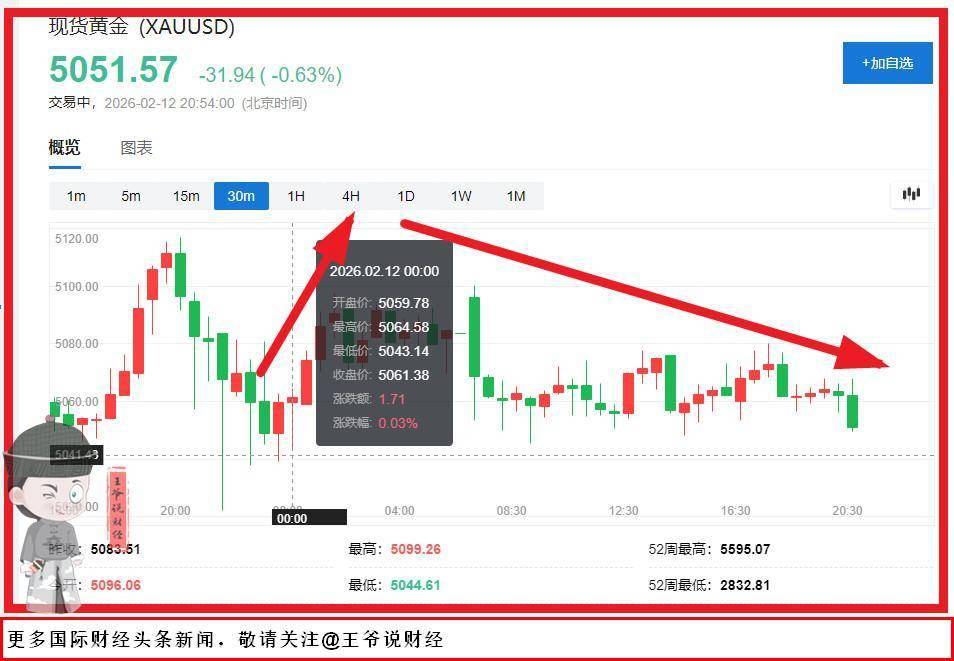
Group 1 - The gold and silver market experienced a significant drop on February 12, with gold prices falling from a high of $5099 per ounce to a low of $5044, closing at $5051.57, a decrease of $31 or 0.63% [1][3] - Silver prices also declined, dropping by $0.234 to $82.49 per ounce, a decrease of 0.28%, while the Shanghai silver futures saw a more substantial drop of 1.87% [1][3] - The recent price fluctuations are attributed to a concentrated market correction following a substantial increase in gold prices over the past three months, where gold rose over 24% from approximately $375 to over $5000 [3][6] Group 2 - The primary reasons for the sudden drop in gold prices include: 1. Short-term profit-taking by investors, leading to a sell-off after significant gains [6][7] 2. Ongoing hawkish expectations from the Federal Reserve, which raises concerns about potential interest rate hikes, making gold less attractive compared to interest-bearing assets [8] 3. A shift in investment focus from gold to other hard assets like copper, resulting in reduced buying pressure for gold and silver [9] Group 3 - The impact of the price drop is significant for various stakeholders: - Investors who bought gold at higher prices are facing losses, while those purchasing gold jewelry may not need to panic as the price fluctuations are less impactful on jewelry [11] - Mining companies like Zijin Mining saw stock price increases, indicating a divergence in market reactions based on asset class [11] - Short-term outlook suggests continued volatility in gold prices due to profit-taking and Fed rate hike concerns, while long-term predictions remain optimistic with potential prices reaching $5400 per ounce by the end of 2026 due to persistent inflation [11][13]
格林大华期货早盘提示:全球经济-20260212
Ge Lin Qi Huo· 2026-02-12 00:56
Report Industry Investment Rating - No information provided Core Viewpoints - The global economy has passed its peak in late 2025 and is now on a downward trajectory due to consecutive wrong policies in the US [3] - The US is at the verge of a "capital war" and civil war, and investors should be aware of capital control risks [2] - There may be a trend of "fleeing US assets" from July to November 2026 due to the uncertainty of the Fed [2] - The rotation of funds from financial assets to hard assets like commodities is forming, with metals being significantly affected [1] - The development of AI is bringing revolutionary changes to programming and various industries [1] - The US retail sales in December 2026 had an unexpected zero - growth, and consumer K - type differentiation is intensifying [1][2] - The US is returning to the Monroe Doctrine, which will have a profound impact on major asset classes [3] - The Fed's potential policy shift (Wash's rate - cut + balance - sheet reduction combination) will cause a strong liquidity contraction expectation for equity assets [3] - The Nasdaq futures' rebound after breaking through the half - year line is a technical pullback, and a new round of large - scale technology stock selling may be triggered [3] Summary by Related Catalogs Global Economic Logic - Hedge funds have been net - selling US stocks for four consecutive weeks, with the strongest selling since early April last year [2] - The US 12 - month retail sales had an unexpected zero - growth, with weak and uneven holiday consumption momentum, and 8 out of 13 retail categories declined [1][2] - Bridgewater's founder Dalio warns of a "capital war" and civil war in the US, and investors should beware of capital control risks [2] - The expected policy of Fed nominee Wash has a strong negative impact on global equity and commodity assets [2] - The US's actions in seizing Venezuelan oil and attempting to buy Greenland bring great uncertainty to the global political order and economy [2] - The Fed's uncertainty may lead to a "fleeing US assets" trend from July to November 2026 [2] - The decline in Las Vegas gambling revenue is similar to the early warning signals before the 2008 financial crisis [2] - The US is adjusting its economic relationship with China and aiming to revive its economic autonomy [2] - The Fed's Beige Book shows an intensified K - type differentiation among consumers, with high - income consumers maintaining spending while middle - and low - income families are tightening their belts [2] - Funds are flowing from technology stocks to defensive sectors, and investors should be wary of subsequent sharp fluctuations [2] Important Information - Seedance2.0 represents a significant leap for Chinese tech companies in the global AI competition, creating a self - consistent parallel physical law in the digital space [1] - Global funds are shifting from financial assets to hard assets, and metals are significantly affected by the inflow of funds [1] - Programming is undergoing a revolution from "writing code" to "commanding intelligent agent legions", with AI capable of autonomous system development and reducing development thresholds [1] - The FCC has approved Amazon's application to deploy 4500 satellites, expanding its satellite constellation to about 7700 to compete with SpaceX [1] - Altruist launched an AI tool for tax strategies, and insurance brokerage stocks dropped significantly after a similar tool launch [1] - The White House wants AI giants to follow an agreement to regulate data center expansion and ensure related issues are addressed [1] - The proportion of overdue US household debt in Q4 last year rose to 4.8%, the highest since 2017, mainly driven by mortgage loan defaults of low - income and young borrowers [1]
港股收评:恒科指涨0.9%,黄金股走强,影视股集体回调!
Ge Long Hui· 2026-02-11 08:56
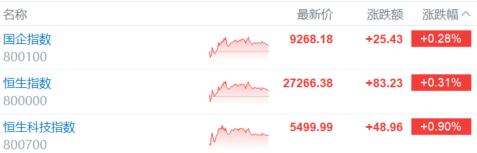
Market Overview - The Hong Kong stock market continued its rebound, with the Hang Seng Technology Index rising by 1.3% at one point and closing up 0.9%, while the Hang Seng Index and the National Enterprises Index increased by 0.31% and 0.28%, respectively, marking three consecutive days of gains [1] - Major technology stocks showed mixed performance, with Bilibili rising over 5% and Xiaomi up over 4%, while Tencent, Alibaba, and JD.com experienced slight declines [4] Sector Performance - The gold sector led the gains, with Zijin Mining International up over 9%, Lingbao Gold up over 7%, and Shandong Gold and China National Gold also seeing increases [5][6] - The building materials and cement sector performed strongly, with China National Building Material rising over 11% and Huaxin Cement up over 2%, driven by improved capacity utilization rates in the industry [7] - The semiconductor sector faced declines, with Aixin Yuan Zhi dropping over 9% and several other semiconductor stocks also experiencing losses [10] Capital Flows - Southbound funds recorded a net inflow of HKD 4.816 billion, with the Shanghai-Hong Kong Stock Connect contributing HKD 2.824 billion and the Shenzhen-Hong Kong Stock Connect adding HKD 1.992 billion [11] Investment Outlook - According to Everbright Securities, the current Hong Kong technology sector has entered a strategic allocation zone characterized by high win rates and high odds, suggesting a favorable environment for medium to long-term investments [13]
高盛:全球资金开启“硬资产轮动”,大宗商品或迎长期溢价
Hua Er Jie Jian Wen· 2026-02-10 13:27
Core Insights - Investors are shifting funds from financial assets to hard assets like commodities to seek refuge amid increasing global market volatility [1] - Goldman Sachs indicates that this "hard asset rotation" may sustain high prices for various metals beyond what their physical supply-demand fundamentals would typically support [1] Group 1: Hard Asset Rotation - The rotation towards hard assets is driven by rising macroeconomic and geopolitical risks, leading investors to diversify into tangible assets [1][2] - Hard assets include commodities, real estate, and infrastructure, which are attracting funds away from traditional financial assets like stocks and bonds due to their inflation-hedging properties [1] Group 2: Price Dynamics of Metals - Precious metals and copper are expected to have greater price appreciation potential compared to oil and natural gas during this rotation [1][2] - Goldman Sachs maintains a target price of $5,400 per ounce for gold by December 2026, driven by private sector diversification demand [1][3] - Copper prices are also supported by hard asset rotation and strategic reserve demand, with a strong foundation for price increases [1] Group 3: Mechanisms of Price Influence - The rotation towards hard assets is closely linked to investor positioning and commodity prices, with significant short-term price impacts from capital inflows due to the smaller market size of commodities [2] - Structural reasons for the price potential of metals include market depth differences, supply elasticity, and storage costs [2] Group 4: Specific Commodity Sensitivities - For gold, a 1 basis point increase in its allocation within U.S. financial portfolios could lead to a price increase of approximately 1.5% [3] - Copper prices are sensitive to fund flows, with a 1 standard deviation increase in net managed funds potentially raising prices by about 6.9% in the short term [3] - Oil prices exhibit greater short-term elasticity, with a similar increase in net managed funds potentially pushing prices up by around 10% [3] Group 5: Market Outlook - The current trend of capital allocation towards hard assets may lead to some metal prices, like copper, operating above their fundamental supply-demand levels, creating structural premiums [5] - This investment-driven price support is becoming a mid-term pricing variable in the commodity market, influenced by market sentiment and macroeconomic expectations [5]
硬资产轮动!高盛:这轮商品上涨更像“资产配置冲击”,不再是单纯的供需故事
美股IPO· 2026-02-09 12:27
Core Viewpoint - Goldman Sachs indicates that the strong performance of the commodity market in early 2026 cannot be explained solely by supply and demand logic, as asset allocation is becoming the dominant variable influencing commodity prices [3][4][5]. Group 1: Shift from Supply-Demand Pricing to Asset Allocation Pricing - The current strength in the commodity market is increasingly driven by asset allocation rather than traditional supply-demand dynamics, marking a significant shift in pricing logic [4][5]. - Investors are reassessing asset allocation due to concerns over macroeconomic policy uncertainty, geopolitical risk premiums, and long-term inflation anxieties, leading to a rotation from "soft assets" to "hard assets" like commodities [4][5]. Group 2: Market Structure and Price Impact - The commodity market is relatively small compared to equity and bond markets, meaning even moderate inflows of asset allocation can lead to significant price impacts [6][7]. - Active investors, such as hedge funds and CTAs, are primarily responsible for driving price changes through their position adjustments, which can quickly influence futures prices and, subsequently, the spot market [8][9]. Group 3: Hard Asset Rotation Favoring Metals - Precious metals and copper are seen as the primary beneficiaries of the current hard asset rotation, while energy commodities are expected to benefit only temporarily [10]. - Structural differences, such as market size, supply response speed, and storage characteristics, make metals more favorable for investment compared to energy [12]. Group 4: Gold as the Ideal Hard Asset - Gold is identified as the most direct and least supply-constrained hard asset for investment, serving as a neutral asset against policy uncertainty and currency risks [13][14]. - Goldman Sachs projects a price of $5,400 per ounce for gold by December 2026, with significant upside potential as the allocation of gold in U.S. financial assets remains low at approximately 0.2% [15]. Group 5: Price Expectations for Copper and Oil - While maintaining a long-term bullish stance on copper with a target price of $15,000 per ton by 2035, Goldman Sachs expresses caution regarding short-term price movements, predicting a potential decline to $11,200 per ton by Q4 2026 [16]. - The outlook for oil is more conservative due to quicker supply responses and fragile inventory structures, indicating that energy is not the best long-term vehicle for hard asset allocation [16]. Group 6: Long-Term Price Stability - The asset allocation-driven hard asset rotation may lead to certain metal prices remaining above levels that can be explained by physical fundamentals for an extended period [17][18]. - This shift suggests that understanding the current commodity market solely from a supply-demand perspective may underestimate the influence of financial capital on pricing [19][20].

硬资产轮动!高盛:这轮商品上涨更像“资产配置冲击”,不再是单纯的供需故事
Xin Lang Cai Jing· 2026-02-09 07:20
Group 1 - The core driver of the current commodity market is shifting from "supply-demand balance" to "asset allocation impact" [1][18] - Investors are reallocating funds from "soft assets" like bonds and equities to "hard assets" such as commodities due to concerns over macroeconomic policy uncertainty, geopolitical risks, and long-term inflation anxiety [2][19] - This shift in asset allocation is expected to lead to commodity prices remaining elevated beyond what physical fundamentals can justify [12][28] Group 2 - The commodity market is relatively small compared to equity and bond markets, making it susceptible to price impacts from even moderate inflows of asset allocation funds [3][20] - Active investors, such as hedge funds and trading funds, are primarily responsible for driving price changes through their position adjustments [4][21] - Financial flows exceeding industrial hedging and physical flows will likely lead to price increases in the short term [5][22] Group 3 - Precious metals and copper are seen as the primary beneficiaries of the current "hard asset rotation," while energy commodities are viewed as only temporarily benefiting [6][23] - Structural differences, such as market size, supply response speed, and storage characteristics, favor metals over energy in the context of asset allocation [7][24] - Metals are considered easier to hold and more resilient in the current asset allocation framework [9][25] Group 4 - Gold is identified as the most direct and least supply-constrained hard asset for allocation, with a price forecast of $5,400 per ounce by December 2026 [10][26] - The potential for increased allocation to gold in U.S. financial portfolios suggests significant upward price pressure, as a 1 basis point increase in allocation could raise gold prices by approximately 1.5% [10][26] - Current copper prices are above fair value based on inventory and demand, with a forecasted decline to $11,200 per ton by Q4 2026, although upward risks remain if asset rotation continues [11][27] Group 5 - The phenomenon of prices remaining elevated due to asset allocation-driven hard asset rotation may become a new norm [12][28] - The current copper market reflects this trend, while precious metals are expected to be the next major beneficiaries [13][29] - Understanding the current commodity market solely through supply and demand may underestimate the influence of financial capital on pricing [14][30] - The fundamental change in the commodity market is driven by a deep shift in global asset allocation [15][31]