资产驱动负债

Search documents
总经理离任后开启高管选聘 珠江人寿经营困局仍待解
Bei Jing Shang Bao· 2025-12-26 09:51
Core Viewpoint - The insurance company Zhujiang Life is undergoing a significant executive recruitment drive, aiming to fill five key management positions, including the general manager, amidst ongoing operational challenges and a lack of transparency regarding its financial health [1][2]. Group 1: Executive Recruitment - Zhujiang Life is publicly recruiting for five senior management positions, including general manager, financial officer, board secretary, chief investment officer, and chief compliance officer, with a deadline for applications set for January 15, 2026 [1]. - The recruitment reflects a strategic move to strengthen leadership and address operational challenges, as the company currently has only four executives, with most being long-term members since its inception [2]. - The previous general manager, Fu Anping, has left the company, indicating a significant leadership change [1][2]. Group 2: Company Background and Challenges - Established in 2012, Zhujiang Life is the only national life insurance company headquartered in Guangzhou, with shareholders including Guangdong Zhujiang Investment Holding Group and Guangzhou Financial Holding Group [3]. - The company initially thrived by leveraging an "asset-driven liability" model during a booming real estate market, achieving profitability by 2015 [3]. - However, the shift towards a more conservative insurance model and the downturn in the real estate sector have led to significant investment risks, with overdue investments totaling 3.5 billion yuan in 2021 [4]. Group 3: Financial Health and Regulatory Concerns - As of the end of Q4 2021, Zhujiang Life's core and comprehensive solvency ratios were 52.02% and 104.04%, respectively, indicating a precarious financial position [5]. - The company has ceased disclosing solvency information since 2022, raising concerns about its operational transparency and future performance [5]. - Experts suggest that increasing capital and attracting strategic investors could be viable paths for Zhujiang Life to address its financial challenges, emphasizing the need for careful vetting of potential investors [5].
总经理离任后开启高管选聘,珠江人寿经营困局仍待解
Bei Jing Shang Bao· 2025-12-25 13:17
Core Viewpoint - The insurance company, Zhujiang Life, is undergoing a significant executive recruitment drive, aiming to fill five key management positions, including the general manager, amidst ongoing operational challenges and a lack of transparency in financial reporting [1][5]. Group 1: Executive Recruitment - Zhujiang Life is publicly recruiting for five senior management positions, including general manager, financial officer, board secretary, chief investment officer, and chief compliance officer, with a deadline for applications set for January 15, 2026 [3]. - The requirements for the general manager position include over 15 years of experience in the finance or insurance industry, with at least 10 years in life insurance management, and prior experience in comprehensive life insurance management is preferred [4]. - The previous general manager, Fu Anping, has left the company, and the current executive team consists of only four members, indicating a significant gap in leadership that the recruitment aims to address [4]. Group 2: Company Background and Challenges - Zhujiang Life was established in 2012 and is the only national life insurance company headquartered in Guangzhou, with shareholders including Guangdong Zhujiang Investment Holding Group and Guangzhou Financial Holding Group [5]. - The company initially thrived by leveraging an "asset-driven liability" model during a booming real estate market, achieving profitability by 2015, which was notable in the life insurance sector [5]. - However, the shift towards a focus on insurance fundamentals and the downturn in the real estate market have led to significant investment risks, with Zhujiang Life reporting overdue investments totaling 3.5 billion yuan in a real estate project [6]. Group 3: Financial Health and Future Strategies - As of the end of 2021, Zhujiang Life's total investment assets amounted to 851.55 billion yuan, with overdue investment assets reaching 30.94 billion yuan, primarily in real estate [6]. - The company's core and comprehensive solvency adequacy ratios were reported at 52.02% and 104.04%, respectively, indicating a precarious financial position, with a risk rating of C class [6]. - Experts suggest that increasing capital and introducing strategic investors could be viable paths for Zhujiang Life to address its solvency and investment risks, emphasizing the need for careful vetting of potential investors [7].


富德生命人寿再因财务数据问题收罚单,已四年未披露年报
Nan Fang Du Shi Bao· 2025-12-18 01:53
Core Viewpoint - Fude Life Insurance, once a rising star in the insurance industry, is currently facing compliance issues, with multiple penalties for false financial data and lack of transparency in reporting [2][5][6]. Group 1: Compliance Issues - Fude Life Insurance's Quanzhou branch was fined 220,000 yuan for untrue financial data, and a manager received a warning and a fine of 44,000 yuan [2]. - Since 2025, Fude Life Insurance has faced at least 10 regulatory penalties for issues such as false data and misleading sales practices [2]. - Various branches have been penalized for similar violations, with fines ranging from 80,000 to 250,000 yuan for different infractions [3][4]. Group 2: Financial Reporting and Transparency - The company has not disclosed annual reports for four consecutive years from 2021 to 2024, raising concerns about its operational transparency and risk status [2][5]. - The last available solvency report from the fourth quarter of 2021 indicated that the core solvency ratio was at 87%, and the comprehensive solvency ratio was at 103%, nearing regulatory limits [6]. - The lack of financial disclosures is attributed to significant asset management issues, with many investments becoming idle due to market fluctuations [6][7]. Group 3: Industry Context and Challenges - The insurance industry is witnessing a shift back to core protection products, with increased regulatory scrutiny on universal insurance and short-term financial products [7]. - Fude Life Insurance's challenges reflect a broader trend among smaller insurance companies that prioritize scale over compliance, leading to a cycle of violations and penalties [7]. - The company's future hinges on its ability to address compliance shortcomings, enhance information disclosure, and rebuild market trust amid ongoing industry transformations [7].

万能险,还“万能”吗?
Mei Ri Jing Ji Xin Wen· 2025-04-29 02:26
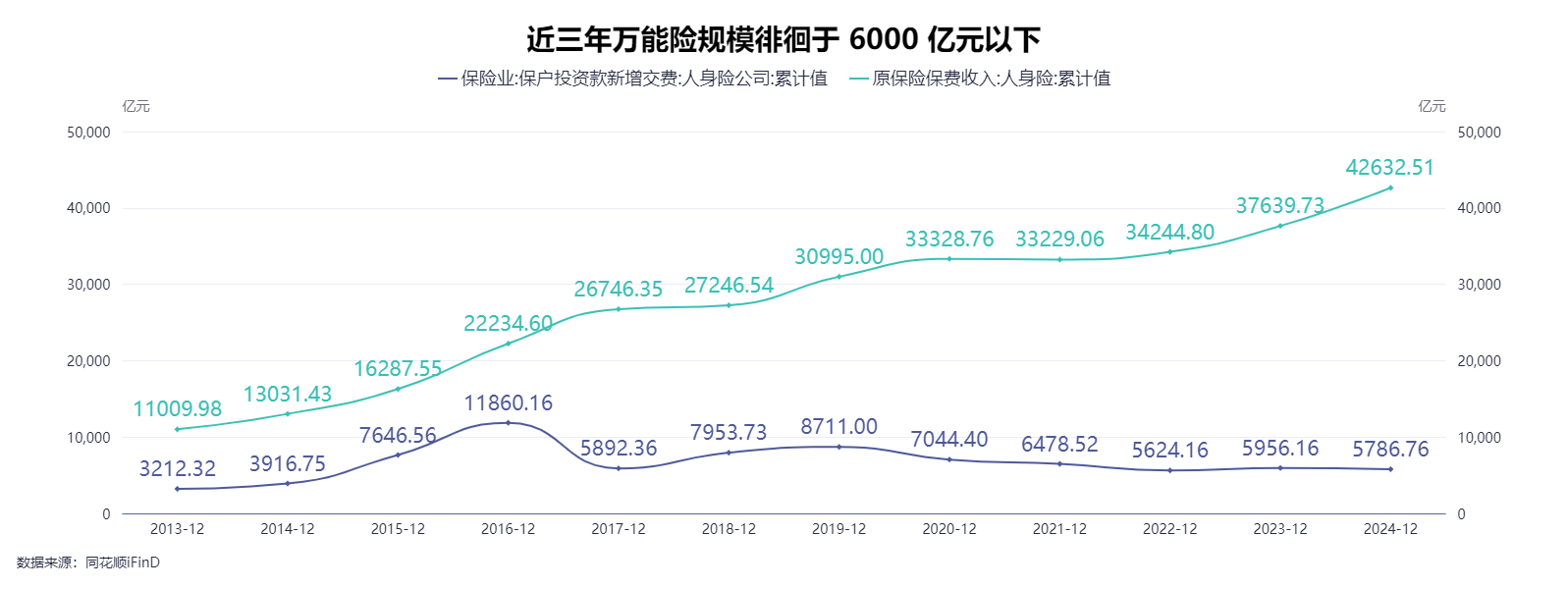
Core Viewpoint - The universal insurance market, once thriving and reaching a scale of over one trillion, is now experiencing a decline due to regulatory tightening and a shift in focus towards long-term protection products [1][9]. Group 1: Market Trends - Universal insurance premiums for 2024 are projected to be 578.7 billion yuan, reflecting a year-on-year decrease of approximately 3% [1]. - The peak of universal insurance premiums occurred in 2016, reaching 1.2 trillion yuan, following a significant growth period from 2015 [2][4]. - The average settlement interest rate for universal insurance products has dropped to 2.86% by the end of 2024, down 54 basis points from the previous year [8]. Group 2: Regulatory Changes - New regulations prohibit the development of universal insurance products with a term of less than five years, aiming to promote long-term insurance solutions [6][10]. - The minimum guaranteed interest rate for universal insurance has been reduced to 1.5% starting from October 2024, with a dynamic adjustment mechanism linked to market interest rates [8][10]. - The new regulations require insurance companies to base policy benefits on actual investment returns, preventing the inflation of account investment yields [14]. Group 3: Product Characteristics - Universal insurance products have historically been attractive due to their high yields, with some offering rates as high as 6% to 7% during peak periods [2][4]. - The shift in focus from high-yield, short-term products to long-term protection is expected to reshape the market landscape [9][15]. - The introduction of a special reserve mechanism aims to smooth out investment yield fluctuations, similar to dividend insurance [15]. Group 4: Industry Implications - The tightening of regulations and the shift in product focus may lead to a contraction in the overall premium scale of the universal insurance market, which has remained below 600 billion yuan in recent years [15]. - Smaller insurance companies may face increased operational costs due to compliance with new regulations, potentially leading to a reduction in their universal insurance offerings [14].