资本迁徙

Search documents
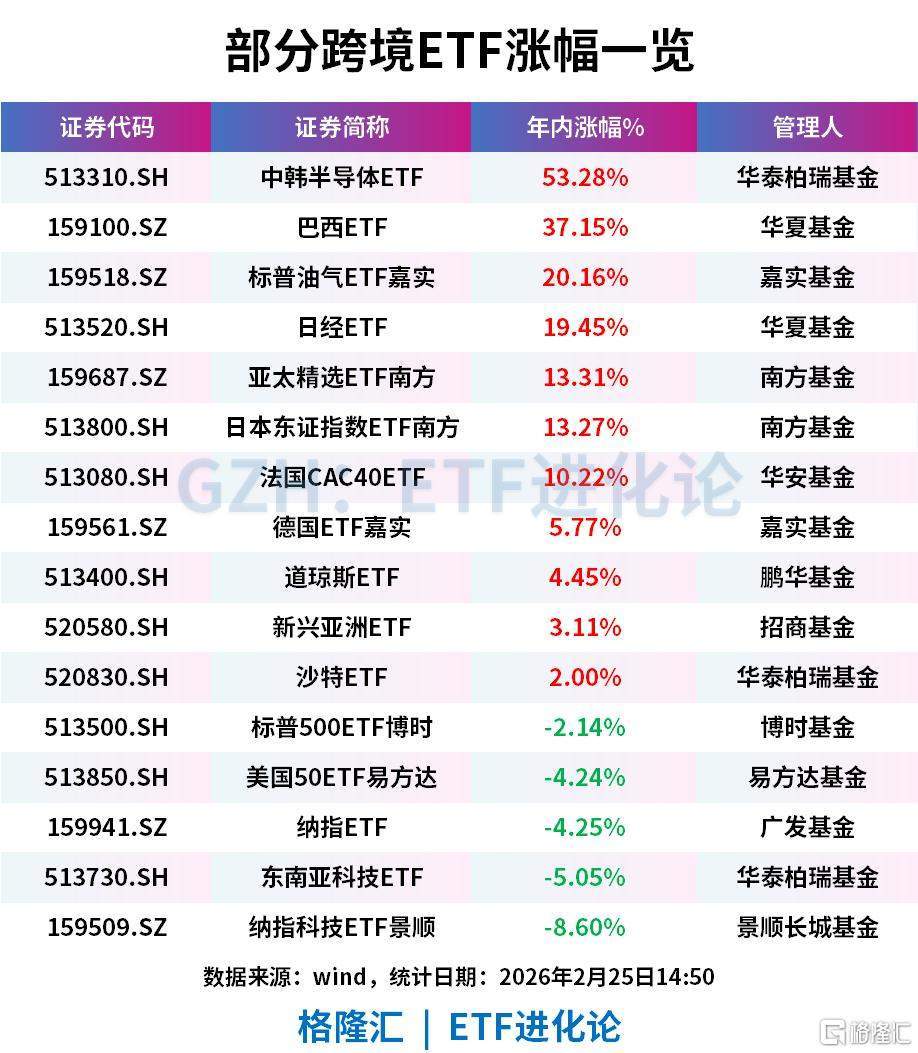
中韩半导体ETF年内涨幅超53%,巴西ETF年内涨超37%,纳指科技ETF、纳指ETF、美国50ETF年内下跌
Sou Hu Cai Jing· 2026-02-25 08:08
Group 1 - The South Korean stock market has experienced significant growth, with a cumulative increase of 75.63% in 2025 and an additional 45% from 2026 to the present, making it the top-performing market globally [1] - The total market capitalization of South Korea's stock market has risen to $3.76 trillion, an increase of approximately $2.23 trillion since the beginning of 2025, surpassing France's $3.69 trillion [1] - The surge in South Korea's market value highlights its growing importance in the global AI supply chain, particularly in sectors like memory chips and robotics [1] Group 2 - Over the past year, the South Korean Composite Index has increased by over 120%, significantly outperforming other indices such as Japan's Nikkei 225 and Brazil's IBOVESPA, which both rose over 50% [1] - In terms of ETFs, the South Korea-China Semiconductor ETF has seen a year-to-date increase of 53.28%, while other ETFs like the Brazil ETF and Japan's Nikkei ETF have also shown positive performance [3] - U.S. investors are withdrawing from domestic stock markets at the fastest rate in 16 years, with approximately $75 billion pulled from U.S. equity products over the past six months, indicating a shift towards global investment [5][6] Group 3 - The trend of "buy America" is shifting towards "bye America," as U.S. investors seek opportunities in emerging markets and Europe, with significant capital flowing into South Korea and Brazil [6][9] - Hedge funds and institutional clients are reducing their exposure to U.S. stocks, with active managers' stock exposure dropping to an eight-month low [8] - The appeal of U.S. tech stocks is declining amid the AI wave, prompting funds to explore new directions, particularly in emerging markets [9]

9月3日那天,更是资本博弈!全球资金下注,但在中国却无人在意?
Sou Hu Cai Jing· 2025-08-31 10:27
Group 1 - Capital is increasingly seeking safety and profitability, with historical trends showing that during global turmoil, such as the Russia-Ukraine conflict, capital flows rapidly to perceived safe havens like the US [1][3] - The Federal Reserve is expected to end its interest rate hike cycle and shift towards rate cuts, which may lead to a decline in returns on US dollar assets, prompting capital to seek undervalued opportunities in other markets, particularly in China [3][10] - The Chinese stock market is currently experiencing significant foreign capital inflows, with net inflows reaching $27 billion in July and $426 million in August, indicating a growing interest from international investors [10][16] Group 2 - The upcoming military parade in China is seen as a demonstration of national stability and security, which is attractive to international capital amid global uncertainties [6][19] - Goldman Sachs reported that hedge funds are rapidly increasing their investments in Chinese stocks, with the allocation to China by global mutual funds rising to 6.6%, suggesting room for further growth [8][10] - The valuation of Chinese assets is appealing compared to US assets, with the price-to-earnings ratio of the Shanghai Composite Index at 11, significantly lower than the S&P 500's 24, indicating a potential investment opportunity [14][16] Group 3 - The stability of the Chinese yuan around 7.18 and the government's proactive measures to support the stock market are contributing to China's perception as a "safe haven" for capital [16] - The geopolitical landscape is influencing capital flows, with Japan's diplomatic efforts to undermine China's military display being largely ignored by Southeast Asian nations, highlighting China's growing influence [17][19] - The shift in capital preferences is evident as investors reassess their strategies in light of declining returns on US assets and the relative stability and growth potential in China [19]

万亿资本南渡潮:解码香江金融春汛2025
格隆汇APP· 2025-06-14 08:37
Group 1 - The global economy is facing "triple pressure" from escalating geopolitical conflicts, rising trade protectionism, and looming debt crises, with the IMF lowering the global economic growth forecast for 2025 to 2.8%, a decrease of 0.5 percentage points from earlier predictions [1] - Despite the economic downturn, emerging sectors such as artificial intelligence and renewable energy are thriving, with investment growth in these areas maintaining over 15% annually for the past three years, serving as a new engine to counteract traditional economic decline [1] - The Hong Kong market is showing signs of recovery, with 117 IPO applications received by the Hong Kong Stock Exchange by May 2025, a 23% decrease in the first-day drop rate of new stocks year-on-year, and a 47% increase in the number of investors participating in IPO subscriptions, indicating a clear market recovery signal [1] Group 2 - Global capital is shifting towards a new narrative, focusing on actively creating opportunities rather than passively enduring pressures, and exploring new territories instead of clinging to old patterns [2]