跨境业务扩张

Search documents
券商频频“输血”海外子公司,释放什么信号?
券商中国· 2025-11-28 04:00
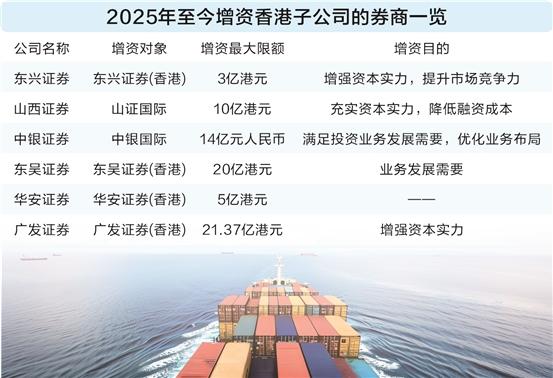
Core Viewpoint - Chinese securities firms are significantly increasing capital support for their overseas subsidiaries, driven by the demand for cross-border investment banking and wealth management expansion [2][6]. Group 1: Capital Support Initiatives - Huatai Securities announced the issuance of four medium-term notes totaling $230 million, guaranteed by its wholly-owned subsidiary [1]. - This year, several Chinese securities firms, including Dongxing Securities and Huatai Securities, have provided capital support to their Hong Kong subsidiaries, with the highest capital increase reaching HKD 21.37 billion [3][4]. - The common methods for capital supplementation include direct shareholder capital increases, issuance of perpetual bonds, and capital loans [3]. Group 2: Business Expansion Drivers - The demand for capital supplementation is primarily driven by the expansion of cross-border businesses and high capital-consuming operations, particularly in the OTC derivatives sector [6][7]. - The growth in cross-border client demand and the need for risk management and asset allocation services are pushing Chinese securities firms to enhance their capital strength [6][7]. Group 3: Challenges in Capital Supplementation - Despite the increasing capital support, challenges remain, including restrictions on cross-border capital flows and difficulties in overseas financing [8][9]. - The current foreign exchange management system poses obstacles for Chinese securities firms in conducting cross-border transactions, leading to liquidity risks [9]. - Recommendations for overcoming these challenges include optimizing regulatory policies, enhancing group coordination, and transforming subsidiaries towards lighter capital business models [10].


中资券商频频“输血”海外子公司 专家建议三管齐下夯实国际化根基
Zheng Quan Shi Bao· 2025-11-25 18:32
Core Viewpoint - The announcement by Huatai Securities highlights the increasing trend of Chinese securities firms providing capital support to their overseas subsidiaries, driven by the demand for cross-border investment banking and wealth management services [2][4][8] Group 1: Capital Support Trends - Huatai International Finance Co., a wholly-owned subsidiary, issued a total of $230 million in medium-term notes, backed by Huatai International [2] - Chinese securities firms have significantly increased their capital support for overseas subsidiaries this year, utilizing methods such as capital increases and guarantees for bond financing and bank loans [2][4] - Notable firms like Dongxing Securities, Shanxi Securities, and others have announced capital increases for their Hong Kong subsidiaries, with amounts reaching up to 2.137 billion HKD [4][5] Group 2: Business Expansion Drivers - The demand for capital is primarily driven by the expansion of cross-border businesses and high capital-consuming operations, particularly in the OTC derivatives sector [7][8] - OTC derivatives are highlighted as a key profit source for international investment banks, necessitating sufficient capital to cover risk exposures [7] - The increasing demand for cross-border asset management and the trend of Chinese companies listing in Hong Kong are contributing to the growth of investment opportunities for Chinese securities firms [8] Group 3: Challenges in Capital Supplementation - Despite the push for capital supplementation, challenges remain, including restrictions on cross-border capital injection and difficulties in overseas financing [9][10] - The current foreign exchange management system presents obstacles for Chinese securities firms in conducting cross-border transactions, leading to liquidity risks [10] - Experts suggest a multi-faceted approach involving regulatory policy optimization, group coordination, and subsidiary transformation to address these challenges [10][11]
香港核心商务区写字楼需求回升
Zheng Quan Shi Bao· 2025-07-17 19:12
Core Viewpoint - The Hong Kong office market, particularly in the Central business district, is showing signs of recovery driven by a resurgence in the capital market and IPO activities, despite challenges such as high vacancy rates and new supply [1][2][3]. Group 1: Market Trends - The Hong Kong Exchange's acquisition of a commercial building for HKD 6.3 billion signifies a major transaction in the office market, reflecting confidence in the sector [1]. - Reports indicate that while the office market faces pressure from new supply and high vacancy rates, there are emerging signs of recovery, especially in Central [2][3]. - As of June 2025, Grade A office rents in Central are expected to have dropped nearly 45% from their peak in 2019, making it an attractive option for financial institutions [2]. Group 2: Demand Drivers - The demand for premium office space in Central is primarily driven by financial institutions, particularly as more mainland companies list in Hong Kong, which is expected to boost leasing activity [2][4]. - The first half of the year saw a notable demand from mainland financial, insurance, real estate, and professional services firms for quality office spaces in core business districts [3]. - Smaller tech companies and startups are also entering the market, seeking affordable office spaces ranging from 200 to 500 square feet [3]. Group 3: Future Outlook - The recovery of the Hong Kong capital market is attracting more Western financial institutions to the office market, with several large leasing contracts signed recently [4]. - The IPO market's activity is anticipated to positively influence the demand for office spaces, particularly in Central, with expectations of rental stabilization in the second half of the year [4]. - A differentiated market trend is expected, with core areas stabilizing while non-core areas may continue to face pressure, dependent on global economic conditions and the absorption of new supply [4].