
场外衍生品

Search documents
中信证券(600030):境内外优势显著 杠杆提升业绩回暖
Xin Lang Cai Jing· 2026-03-28 06:32
Core Insights - The company reported a significant increase in revenue and net profit for 2025, with total operating income reaching 74.854 billion yuan, up 28.79% year-on-year, and net profit attributable to shareholders at 30.076 billion yuan, up 38.58% year-on-year [1] - The adjusted leverage ratio increased to 4.80 times, up 0.28, while the management fee rate decreased by 2.9 percentage points to 44.2% [1] - The international business segment showed growth, with overseas revenue reaching 15.5 billion yuan, accounting for 21% of total revenue, and further improvement in gross margin [1] Group 1: Business Performance - The brokerage business generated revenue of 14.753 billion yuan, an increase of 37.73% year-on-year, with distribution income at 2.025 billion yuan, also up 37%, representing 14% of brokerage business revenue [1] - Asset management income was 2.757 billion yuan, up 18.8% year-on-year, while fund business revenue reached 9.419 billion yuan, up 15.1% year-on-year, with a 22.31% increase in the management scale of Huaxia Fund [1] Group 2: Investment Banking and Financial Services - Proprietary investment income rose to 31.255 billion yuan, a 61% increase year-on-year, with financial investment assets up 10% [2] - Investment banking revenue reached 6.336 billion yuan, up 52.3% year-on-year, with a market share of 28.4% in domestic equity underwriting [2] - Capital intermediary income was 9.12 billion yuan, an increase of 11.78% year-on-year, with margin financing and securities lending interest income up 15.1% [2] Group 3: Market Outlook and Valuation - The company is expected to benefit from a cyclical recovery and increased market stability, maintaining a leading position in multiple business segments and a strong international presence [2] - The historical valuation center from 2019-2022 was 1.6x PB, with a current upward trend, suggesting a 2026 valuation of 1.4x PB, leading to a reasonable A-share value of 29.31 yuan per share [2]

期现联动 增强“上海价格”影响力
Qi Huo Ri Bao Wang· 2026-01-27 01:16
Core Viewpoint - The development of strategic emerging industries such as new energy vehicles, aerospace, and semiconductors is transforming non-ferrous metals from traditional industrial materials into crucial strategic resources for new productive forces. The recent release of the "Action Plan for Strengthening the Linkage Between Futures and Spot Markets to Enhance the Competitiveness of Non-Ferrous Metal Commodities" by Shanghai marks a significant step in building an international pricing center for bulk commodities [1][2]. Group 1: Policy Framework - The plan focuses on the entire "futures-spot-derivatives" chain, aiming to enhance the accessibility and effectiveness of futures services for the real economy. It promotes the integration of spot trading venues with commodity clearing systems and the development of price indices to support centralized clearing and risk management services for over-the-counter derivatives [1][2]. - The initiative encourages participation from non-ferrous metal application enterprises in sectors such as automotive, construction, and home appliances in the futures and OTC derivatives markets, reflecting a shift in the focus of the futures market from upstream production to processing and end-use applications [1][2]. Group 2: Market Tools and Transparency - The policy toolbox includes futures, options, OTC derivatives, price indices, and warehouse receipt trading, providing differentiated choices for enterprises of various sizes and risk preferences. It particularly encourages the use of futures or spot price indices as trade benchmark prices, which helps reduce reliance on "experience pricing" and "negotiated pricing," thereby enhancing transaction transparency and risk controllability [2]. - The plan emphasizes improving the internationalization of the non-ferrous metal bulk commodity futures and spot markets, with clear policies aimed at enhancing the influence of "Shanghai prices" through expanded varieties of foreign trade, exploration of overseas warehousing, and cross-border delivery [2]. Group 3: Market Ecosystem and Development - The plan addresses "soft constraints" affecting the elevation of bulk commodity levels, focusing on building a better market ecosystem and reducing institutional friction costs through initiatives like blockchain and warehouse receipt registration systems [3]. - Overall, the plan outlines a pathway for the coordinated development of the "futures-spot-derivatives" market, aiming to strengthen the institutional foundation for futures services to the real economy, enhance the international influence of "Shanghai prices," and improve the competitiveness of Shanghai's bulk commodity market [3].
场外衍生品助力企业筑牢风控防线
Qi Huo Ri Bao Wang· 2026-01-21 17:10
Core Insights - The global commodity market in 2025 is characterized by significant price differentiation and volatility, particularly in the non-ferrous metals sector, with copper and tin leading the price surge while lead and zinc face pressure [1] - Companies are increasingly facing challenges related to price fluctuations and complexities in cross-border transactions due to changes in global trade dynamics [1] - Jinrui Capital has developed innovative solutions using over-the-counter derivatives to assist small and medium-sized enterprises in managing risks associated with overseas hedging and raw material procurement [2] Group 1: Risk Management Solutions - Jinrui Capital customized a cross-border income swap solution for a lead trading company facing supply shortages and declining processing fees, allowing direct linkage to LME lead average prices [2] - The solution involves opening long positions in LME lead contracts with a nominal principal exceeding 40.5 million RMB, ensuring alignment with the company's logistics cycle [2] - This approach significantly reduces trading burdens and enhances operational efficiency by allowing companies to hedge based on LME average prices without daily order fragmentation [2] Group 2: Cost Optimization Strategies - A copper processing company faced risks from rising raw material prices due to long lead times on forward orders, prompting Jinrui Capital to introduce a cumulative option strategy [3] - The cumulative option product allows the company to secure procurement at a base settlement price while providing flexibility to adjust based on market conditions, effectively managing costs during price fluctuations [4] - The strategy has proven effective, yielding excess returns of 22.895 million RMB, equating to a reduction of 4,579 RMB per ton in raw material costs, and enabling the company to implement a sustainable cost optimization mechanism [4] Group 3: Evolving Risk Management Philosophy - The use of over-the-counter derivatives is transforming the risk management approach of enterprises from passive defense to proactive management, focusing on value creation rather than mere risk transfer [5] - Companies are leveraging these sophisticated financial tools not only to lock in costs and mitigate risks but also to explore potential profit opportunities and optimize asset allocation [5]
扬期货之帆 护实体之航
Qi Huo Ri Bao Wang· 2026-01-08 02:21
Group 1 - The core message of the news is the implementation of the "15th Five-Year Plan" as outlined in the "Suggestions" from the 20th Central Committee, emphasizing the importance of modernizing the industrial system and strengthening the real economy [1][3] - The company, Nanhua Futures, is actively promoting the learning and implementation of the 20th Central Committee's spirit among its employees, focusing on serving the real economy and supporting initiatives like rural revitalization and the Belt and Road Initiative [2][3] Group 2 - Nanhua Futures has developed a "three-step" plan to ensure the effective dissemination of the 20th Central Committee's spirit, which includes organized learning sessions, sharing meetings, and online knowledge tests [2] - The company emphasizes the importance of a modern industrial system as the material and technical foundation for Chinese-style modernization, focusing on enhancing the self-control level of the industrial chain and promoting high-quality development in key manufacturing sectors [3][4] Group 3 - Nanhua Futures has expanded its services from traditional brokerage to include over-the-counter derivatives, basis trading, and market-making, providing comprehensive risk management solutions for clients [4][5] - The company has launched various innovative risk management tools and services, such as the "Futures Stabilization Order" project and "Insurance + Futures" initiatives, to address the needs of the real economy [5][6] Group 4 - The company has established an international business network to support the "Belt and Road" initiative and the development of outward-oriented enterprises, focusing on risk management and value-added services [7][8] - Nanhua Futures has set up branches in key global financial markets, including the US, Singapore, and the UK, providing a range of financial services and facilitating foreign investment in China [8]

2025年回顾:波动性与技术驱动定价趋势
Refinitiv路孚特· 2025-12-29 06:02
Core Insights - The fixed income and derivatives markets in 2025 were primarily driven by significant political, economic, operational, and climate risk events, with ongoing technological transformations reshaping trading and investment operations across financial institutions [1][4]. Group 1: Market Trends - Market volatility in 2025 was influenced by various factors, including the rapid changes in tariff policies, geopolitical conflicts, and economic events such as government budgets, inflation data, and interest rate fluctuations [3]. - Concerns regarding artificial intelligence (AI) investments not delivering expected short-term returns led to periodic disruptions in both stock and bond markets, with fears that substantial AI-related expenditures could erode profitability [2]. - Despite the turbulent environment, the overall issuance of corporate and municipal bonds remained strong, indicating resilience in the fixed income market [3]. Group 2: Private Debt Market - The global private debt market has expanded since the 2008 financial crisis, driven by tighter bank lending regulations, and is now allowing participation from affluent individual investors [4]. - Recent high-profile defaults in the private credit market have raised concerns about a potential wave of defaults due to economic and market volatility [4][5]. Group 3: Technological Advancements - The electronic trading of fixed income markets has progressed, with 50% of U.S. investment-grade bond trading now conducted electronically, generating vast amounts of market data for financial institutions [6]. - Financial institutions are leveraging cloud-based market data to develop new trading models and execution strategies [6]. Group 4: Strategic Shifts - Asian investors are increasingly viewing U.S. dollar-denominated debt as a strategic asset due to concerns about tariff impacts on regional economic growth, with U.S. Treasuries, asset-backed securities (ABS), mortgage-backed securities (MBS), and over-the-counter derivatives being popular choices [7]. Group 5: Climate Impact - Climate change events, such as the California wildfires in January 2025, have ongoing effects on market pricing, with analysts assessing the long-term impact of weather events on the repayment risks of municipal and corporate bonds [8]. Group 6: Future Outlook - Many trends observed in 2025, including those that caused significant market volatility, are expected to continue influencing the securities market in 2026, presenting ongoing pricing challenges for financial services engaged in low liquidity bond and derivatives trading [8].


券商压力测试工作迎深化要求风险管理迈向提质增效新阶段
Zhong Guo Zheng Quan Bao· 2025-12-24 20:18
Core Viewpoint - The China Securities Association has issued a notice to brokerages, acknowledging the positive outcomes of the 2025 industry stress tests while highlighting existing issues such as "form over substance" and insufficient coverage of complex business risks. The notice outlines further guidelines to enhance the effectiveness and accuracy of stress testing in five key areas [1][2]. Regulatory Guidance Upgrade - The regulatory focus is shifting from mere compliance to management empowerment, indicating a higher level of risk management for brokerages. The 2025 stress test results show a significant increase in the importance brokerages place on stress testing, with many establishing regular testing mechanisms and applying results to capital planning [1][2]. Focus on Complex Risks - The notice emphasizes the need for brokerages to optimize stress testing for over-the-counter derivatives and reputation risks, which are becoming critical areas of focus due to the increasing complexity of brokerage business structures. Specific testing for key products like snowball and long-short swaps is required, along with market impact assessments for hedging transactions [2][3]. Reputation Risk Testing - Reputation risk testing is highlighted as a key area for deepening efforts. The 2025 results indicate that some brokerages inadequately assess reputation risk, equating it to risk disposal costs without considering its transmission effects. The industry is still in the exploratory phase regarding reputation risk testing, necessitating further research on risk characteristics and transmission paths [3]. Comprehensive Management of Subsidiaries - The notice calls for enhanced panoramic and penetrating management of subsidiaries, ensuring that stress testing is coordinated across domestic and international entities. This aims to improve the consistency and effectiveness of overall risk management [3]. Evaluation and Optimization of Testing Mechanisms - Brokerages are required to regularly evaluate and optimize their stress testing mechanisms and execution effectiveness. The China Securities Association will conduct checks as needed to ensure compliance and improvement [3].
南华期货赴港上市加码全球布局,完善覆盖三大时区24小时交易体系
Huan Qiu Wang· 2025-12-20 01:11
Core Viewpoint - The domestic futures industry in China is accelerating its internationalization and moving towards high-quality development, driven by policy guidance and market demand [1] Group 1: Industry Trends - The Chinese futures market is the largest commodity futures market globally, covering over 140 products across 41 industries, with a projected CAGR of 9.1% from 2020 to 2024, expected to reach 986.8 trillion yuan by 2029 [1] - The demand for risk hedging in the real economy is increasing, particularly due to heightened volatility in commodity prices and rising hedging needs among industrial chain enterprises [1] - The cross-border risk management demand remains strong as Chinese companies accelerate their internationalization, with A-share listed companies' overseas business revenue growing by 12.8% year-on-year in the first half of 2024 [1] Group 2: Company Overview - Nanhua Futures is set to officially list on the Hong Kong Stock Exchange on December 22, becoming a pioneer in the internationalization of the domestic futures industry [1] - According to Frost & Sullivan, Nanhua Futures ranks eighth among all domestic futures companies in total revenue for 2024 and first among non-financial institution-related futures companies, with the highest overseas revenue among domestic futures firms [1] Group 3: Financial Performance - Nanhua Futures' overseas financial services revenue is expected to double from 2022 to 2024, with over 50% of total revenue coming from this segment by the first half of 2025, contributing over 90% of operating profit [2] - The company plans to issue 108 million H-shares at a price range of 12-16 HKD, aiming to raise approximately 1.41 billion HKD, with funds allocated to enhance global business layout [2] Group 4: Strategic Initiatives - The company aims to establish an "A+H" dual listing structure to optimize its capital layout and enhance cross-border financial services, which is expected to boost its international brand influence and accelerate overseas business expansion [3] - Nanhua Futures is focusing on increasing investments in risk management, OTC derivatives, and wealth management to capitalize on global derivatives market opportunities [3] Group 5: Profit Forecast and Valuation - Revenue projections indicate a decline in total revenue from 6.247 billion yuan in 2023 to 2.256 billion yuan in 2025, followed by a recovery to 2.738 billion yuan by 2027, with a significant year-on-year decrease of 60.5% in 2025 [4] - The net profit attributable to the parent company is forecasted to grow from 402 million yuan in 2023 to 587 million yuan in 2027, reflecting a steady growth trajectory [4] Group 6: Market Insights - Analysts believe that Nanhua Futures' internationalization strategy, high-margin business structure, and solid customer base will not only create long-term value for investors but also provide valuable insights for the internationalization of the domestic futures industry [5]
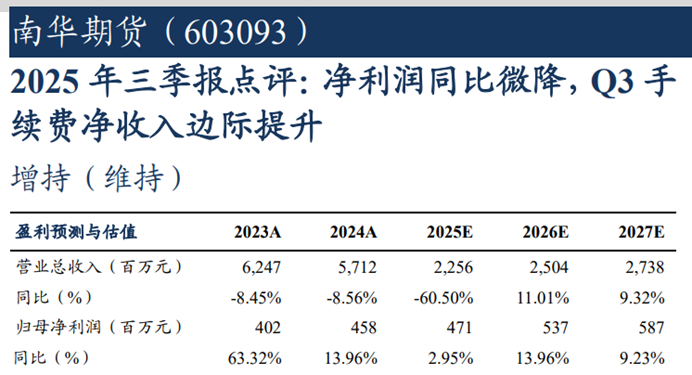
奋力谱写服务实体经济高质量发展期货篇章
Qi Huo Ri Bao Wang· 2025-12-18 01:30
Group 1 - The central economic work conference emphasizes the importance of high-quality development and the need for the futures industry to better serve national strategies, particularly in stabilizing enterprises and markets [2][5] - The futures industry is transitioning from "scale expansion" to "function deepening," focusing on core functions such as price discovery, risk management, and resource allocation [2][3] - 弘业期货 is committed to enhancing service quality and core competitiveness by aligning with national strategies and serving industry clients and small investors [2][4] Group 2 - 弘业期货 is optimizing its business structure by strengthening brokerage services, developing risk management subsidiary businesses, and enhancing research capabilities [3][4] - The company recognizes the need for improvement in service depth, product innovation, and technological empowerment, particularly in providing customized derivative solutions for small and medium enterprises [4] - 弘业期货 plans to deepen its focus on the Yangtze River Delta's characteristic industrial chains and implement tailored service plans for clients [4] Group 3 - The central economic work conference calls for the continuous deepening of capital market investment and financing reforms, with the futures market playing a crucial role in supporting these reforms [5][6] - 弘业期货 aims to enhance its research capabilities on key industrial chains and provide forward-looking price trend analysis to assist investment decisions [5][6] - The company promotes the concept of hedging to help enterprises stabilize profit fluctuations and improve credit quality, indirectly supporting their financing processes [6] Group 4 - 弘业期货 is actively exploring differentiated development paths, emphasizing compliance and risk management as essential to its growth [8][9] - The company aims to leverage its dual advantages of being state-owned and publicly listed to establish itself as a benchmark for industry integrity [8] - 弘业期货 is committed to serving the advanced manufacturing sector and expanding its international presence, particularly in cross-border trade [8][9]
曲峰等:期货与风险管理子公司合规要点与实务建议解析
Sou Hu Cai Jing· 2025-12-07 12:46
Core Insights - The article emphasizes the importance of compliance in the operations of futures and risk management companies, highlighting the need for a dynamic compliance mechanism to navigate hidden compliance traps in business processes [3][5]. Compliance Key Points and Practical Recommendations 1. Key Compliance Nodes in Business Processes - Business entry must prevent internal cross-risk, ensuring risk isolation between futures companies and risk management companies as mandated by regulations [4]. - Recent cases reveal significant compliance failures, such as a brokerage firm failing to isolate customer information, leading to regulatory penalties [4][5]. 2. Contract Design: Substance Over Form in Rigid Payment Clauses - The Asset Management New Regulations prohibit any form of rigid payment clauses, with strict penalties for violations [6]. - Institutions must avoid ambiguous terms that imply guaranteed returns, as these may be deemed invalid in disputes [6]. 3. Margin Management: Building a Comprehensive Risk Control Loop - Margin management is critical for risk control, with recommendations for ensuring margin collection meets exchange standards and maintaining thorough records [7][8]. - Institutions should establish robust credit management systems and ensure that margin amounts are reasonable and aligned with contract risks [8][9]. 4. Investor Suitability Management Requirements - A dynamic customer assessment mechanism is essential, requiring ongoing evaluations of investors' risk tolerance [10][11]. - Strict product risk matching is necessary, prohibiting the sale of high-risk products to low-risk tolerance investors [12]. 5. Comprehensive and Intelligent Risk Control System - Institutions should develop a unified compliance data platform to standardize regulatory data collection and enhance real-time monitoring [15]. - Automated monitoring of key parameters and the implementation of algorithmic trading monitoring modules are recommended to improve compliance efficiency [16][17]. 6. Strengthening Data Security and Personal Information Protection - Institutions must classify and manage data according to its sensitivity, ensuring compliance with data protection laws [19][20]. - Long-term retention of business logs is necessary for regulatory audits and compliance verification [21]. 7. Cross-Border Business and Geopolitical Risk Prevention - The article discusses the increasing facilitation of foreign investor participation in China's futures market, while also highlighting the need for geopolitical risk management in cross-border contracts [25][26]. - Institutions are advised to include renegotiation mechanisms in contracts to address unforeseen geopolitical events [26]. Conclusion - The futures market is expected to develop with a focus on both compliance and innovation, necessitating futures companies to strengthen their compliance frameworks while seizing business opportunities [29].

中证报价开展场外债券投资交易业务展业情况排查
Zhong Guo Zheng Quan Bao· 2025-12-04 20:22
Core Viewpoint - The China Securities Regulatory Commission (CSRC) is conducting a review of off-market bond investment trading activities among securities and fund management institutions to ensure compliance and accurate data reporting [1][2]. Group 1: Regulatory Review - The review focuses on two main aspects: the accuracy of the institution names registered in the off-market bond investment trading data reporting system and whether institutions have actually engaged in bond trading activities with their own funds and asset management businesses [1][2]. - Institutions are required to report their bond investment trading data monthly, and those not engaged in any bond-related business must register on the monitoring platform and provide basic information [2]. Group 2: Off-Market Bond Trading - Off-market bond trading includes activities such as cash bond trading, bond repurchase, bond forwards, and bond lending, conducted by securities and fund management institutions using their own funds and asset management [2]. - Institutions that have not obtained public fund qualifications must report their completed rectifications according to specific guidelines [2]. Group 3: Derivative Products - Off-market derivatives provide customized, flexible, and finely managed tools for professional investors, meeting diverse investment needs [3]. - These derivatives serve as effective risk management tools, helping investors mitigate investment volatility while maintaining their underlying asset positions [3]. - The development of off-market derivatives is driving strategic transformation and service upgrades for trading firms, enhancing their core capabilities in risk management and digital empowerment [3].