跨境电商航空物流

Search documents
拿下“世界级” 广州要重返全国第一?
Mei Ri Jing Ji Xin Wen· 2025-10-31 16:29
Core Viewpoint - The expansion of Guangzhou Baiyun International Airport marks a significant milestone, making it the first airport in China to operate five commercial runways, with a capacity to handle 120 million passengers and 3.8 million tons of cargo annually, thus being dubbed the "world's largest single terminal airport" [1] Group 1: Airport Expansion and Capacity - The newly opened T3 terminal and fifth runway enable Guangzhou Airport to meet the growing demand for passenger and cargo transport, enhancing its status as a major international aviation hub [1] - The airport's passenger throughput reached 73.38 million in 2019, with a growth rate of 5.2%, surpassing major competitors like Beijing and Shanghai at that time [2] - Following the expansion, Guangzhou Airport is projected to achieve a passenger throughput of 120 million by 2030 and 140 million by 2045, breaking previous design limits [3] Group 2: Economic Impact and Cross-Border E-commerce - Guangzhou's foreign trade import and export volume reached 923.68 billion, with a growth rate of 12.5%, leading among major cities, driven by a 21.2% increase in exports [5] - The airport's enhanced cargo capacity supports the booming cross-border e-commerce sector, which saw a significant increase in export volume, with 33.3% of international cargo being cross-border e-commerce in 2023 [5][6] - Guangdong province has become a hub for cross-border e-commerce, with its import and export volume skyrocketing from 11.3 billion to 843.3 billion, accounting for over 30% of the national total [6][7] Group 3: Competitive Landscape and Future Challenges - The competition among major airports in the Guangdong-Hong Kong-Macau Greater Bay Area is intensifying, with Guangzhou, Shenzhen, and Hong Kong vying for international routes and passenger traffic [9][10] - Despite recent growth, Guangzhou Airport's international passenger throughput remains lower than that of Shanghai, indicating a need for improved international connectivity [10] - The management and coordination among the three major airports in the Greater Bay Area will be crucial for optimizing the overall development of the airport cluster [11]
拿下“世界级”,广州要重返全国第一?
Mei Ri Jing Ji Xin Wen· 2025-10-31 14:02
Core Viewpoint - The expansion of Guangzhou Baiyun International Airport marks a significant milestone, positioning it as China's first airport with five operational runways, capable of handling an annual passenger throughput of 120 million and cargo capacity of 3.8 million tons, thus earning the title of "world's largest single terminal airport" [4][12]. Group 1: Airport Expansion and Capacity - The newly opened T3 terminal and the fifth runway enhance Guangzhou Airport's capacity, allowing it to meet the growing demand for passenger and cargo transport [4][12]. - The airport's expansion comes at a time when it aims to reclaim its status as the top airport in China, having previously held the title in 2020 before being surpassed by Shanghai [4][8]. - The airport's design capacity was previously constrained, with T1 and T2 terminals designed for a combined total of 80 million passengers, which has now been exceeded due to the expansion [6][12]. Group 2: Economic Impact and Trade Growth - Guangzhou's foreign trade has seen a significant increase, with a total import and export value of 923.68 billion yuan in the first three quarters of the year, marking a growth rate of 12.5% [13]. - The cross-border e-commerce sector has been a key driver of this growth, with exports maintaining a high growth rate of over 20% [13][17]. - The airport's enhanced cargo capacity is expected to support the booming cross-border e-commerce market, which has seen a substantial increase in export volumes [18][21]. Group 3: Regional Competition and Coordination - The development of the Greater Bay Area airport cluster presents both opportunities and challenges, as Guangzhou competes with Shenzhen and Hong Kong for air traffic and logistics [22][23]. - The ongoing construction of the new airport in the Pearl River Delta aims to complement Guangzhou Airport, potentially creating a combined capacity of 220 million passengers across the region [24][26]. - Effective coordination among the different airport management systems in the Greater Bay Area is crucial for optimizing the overall development of the airport cluster [26].



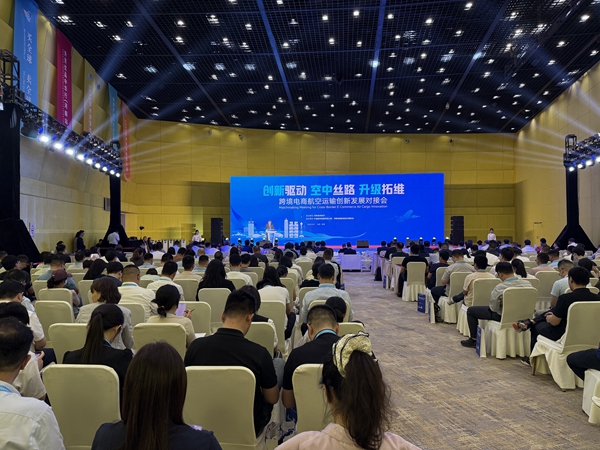
中豫航空集团承办2025跨境电商航空货运创新发展对接会
Zhong Guo Min Hang Wang· 2025-05-30 13:48
Group 1 - The 2025 Zhengzhou Cross-Border E-Commerce Conference and Foreign Trade Quality Products Event was launched on May 29, 2025, at the Zhengzhou International Convention and Exhibition Center, featuring a significant project co-hosted by Zhongyu Aviation Group and the Henan International Freight Forwarding Association [1][3] - The conference theme "Innovation-Driven Air Silk Road Upgrade and Expansion" attracted representatives from the Civil Aviation Administration, International Air Transport Association (IATA), cross-border e-commerce platform TEMU, and leading companies in the industry to discuss the development of cross-border e-commerce air logistics [3][5] - Zhongyu Aviation Group's General Manager Liu Jianmin reported that in 2024, Zhengzhou Airport's cargo volume reached 825,000 tons, with international cargo volume ranking fifth in the country, highlighting the "Zhengzhou-Luxembourg" air route as a landmark project of the Belt and Road Initiative [5][6] Group 2 - The "Zhengzhou-Kuala Lumpur" dual-hub cooperation has been included in the China-Malaysia Joint Statement, accelerating the establishment of new dual-hub layouts in Saudi Arabia and Ethiopia, connecting Central China closely with the world through air transport [6] - A cross-border e-commerce air transport center is set to be completed by the end of the year, significantly enhancing cargo assurance capabilities and providing strong support for the rapid access of global goods [6] - Several strategic cooperation agreements were signed during the event, including ground service agreements for all-cargo aircraft with China Cargo Airlines and Sichuan Airlines, and collaborations with IATA, TEMU, and Eastern Airlines Logistics for cross-border e-commerce logistics [8]